It’s my favourite painting because you’re my favourite person
Through their personal experience, Alex guides us through a vision for a personalized way of appreciating art, demonstrating that the value of art is not in the work, but in our hearts, joyfully entangled by context and life.
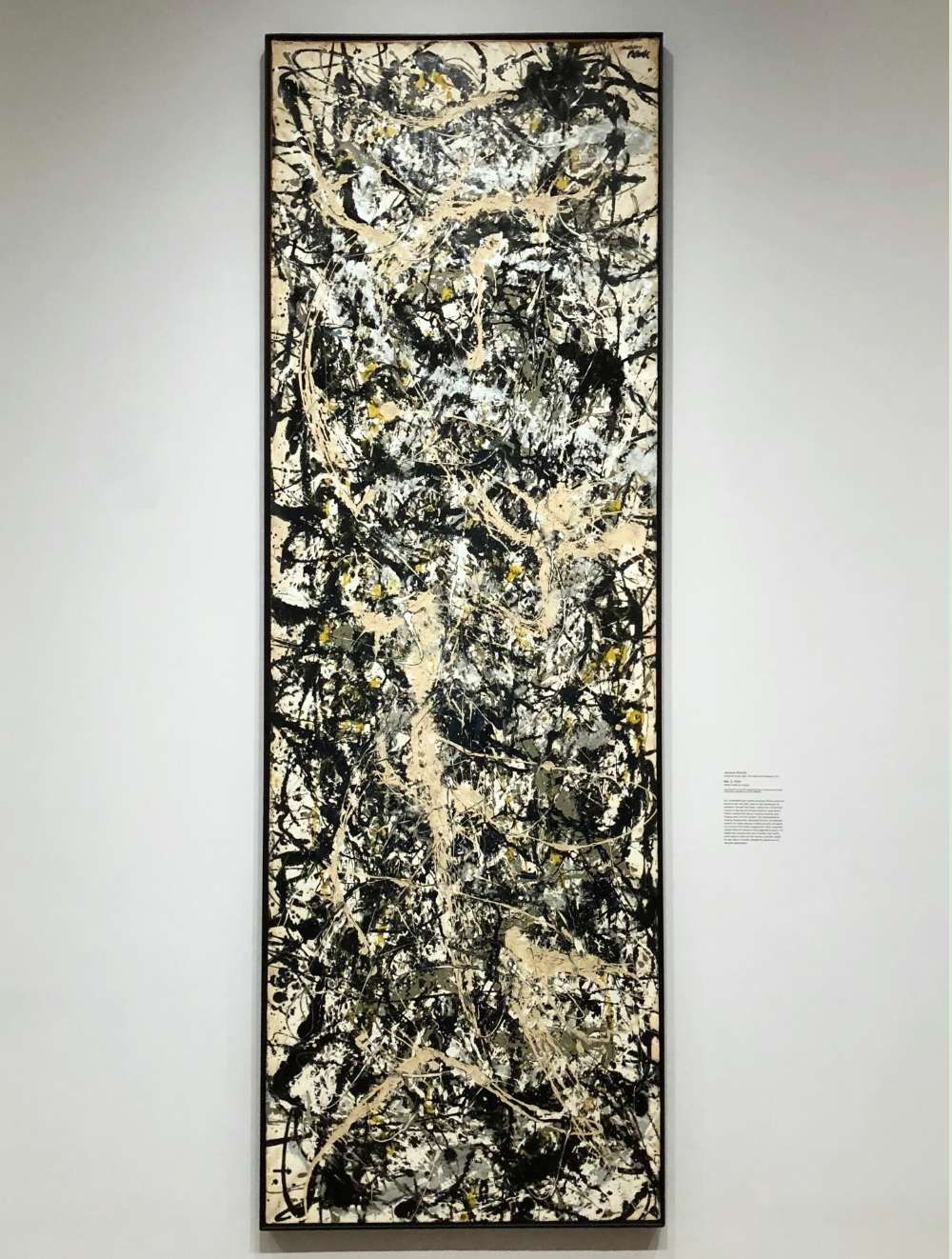
Jackson Pollock, No. 2, 1950, mixed media on canvas, 279.4 x 91.76 cm, Fogg Museum, Cambridge, MA, Object Number 1965.554. (Image courtesy of Alex Mao)
As pretentious as I am with art, most works by Jackson Pollock give my heart little to no ripple. If not for the ludicrous prices, I would spend less than average time on one of them. But I do have a favorite Pollock. On the ground floor of the Fogg Art Museum, there hangs a tall Pollock with his characteristic drip and splashes. I remember its colors vaguely, and I can recall the can-be-interpreted-as-intentional patterns in the strokes of colors.
I remember ignoring the museum’s wall label, a feature that at times feels like religious scripture, occupying a sizable chunk of my cognitive experience of the artwork. With this piece, I didn’t bother. I was not interested in Pollock’s meaning, the “poignant reflection on the physical processes of our universe,” or “the revolutionary act of kinetic painting.” Two reasons: first, these same things could be said of any Pollock, or, heck, anything comparable abstract painting. It’s probably true, but it holds little meaning to my personal enjoyment of the piece. Second, it is my favorite, and I get to make up my own interpretation of it.
So, what did I like about this one? Well, across this painting there’s a bench. Having seen the other three floors of the gallery, my slightly tired companion had come to this room ahead of me to rest a little. When I finally rejoined them in the room, my eyes had finally loosened their grip on my legs, and my heart remembered to sit down. We looked at the piece for a while. Facing toward another work, the bench was not meant for the Pollack, so we squeezed onto one end of the bench between the two of us. We looked in silence for a bit, communicating dramatically with our brows. Our subsequent chat came to a natural rest about twenty minutes after that.
The painting had watched it happen. To be sure, we were talking about the painting for a good portion of the conversation, but was this discussion to the painting’s credit? Maybe the artist of this aesthetic experience was the bench under us, and the painting should thank the wall behind it for being modest and not distracting my eyes. What I am getting at is this: like every other experience, it was only when my feet were planted on the ground, my butt on the bench, and my eyes on the canvas, that I truly saw it and thought about it. Should my brain thank my feet and my butt? There must be an anchor point.
The anchor point I found is “me.” The finite and enclosed body which holds the mind, the soul, the spirit, and all other manners of the self. It wasn’t just me, though. I could pick any Pollock and call it my favorite, if I just sat in front of it for a while (what Zhu Xi calls 格物窮理, pure contemplation of any object as a means to knowledge). Instead, this moment becomes irreplicable with other art because of its context: I had a conversation with them in front of this one.
There’s always an intensely personal feeling when it is my own mind in a particular time and place that came up with the ideas and explanations for a piece. But to have that experience right beside another human is different to sitting on any bench with any painting on any background. The two minds focus effortlessly on the simultaneous and intertwined projects of seeing this art, and the selves softly unify to cast our collective gaze out to this wild and wondrous painting.
Each time I return to the Fogg Art Museum, I sit in the same corner of the bench. Some days my eyes are closed, and the vivid memory of the moments spent here the week before casts against my eyelids as I reminisce about that time I experienced.
Through their personal experience, Alex guides us through a vision for a personalized way of appreciating art, demonstrating that the value of art is not in the work, but in our hearts, joyfully entangled by context and life.
As Frieze London returns, transforming Regents Park into a marketplace for contemporary art, one questions whether the experience of appreciating art has become increasingly indistinguishable from luxury consumption. When it comes to art fairs, how much do we value art for what it actually communicates and how much for what it is worth to us as a commodity?
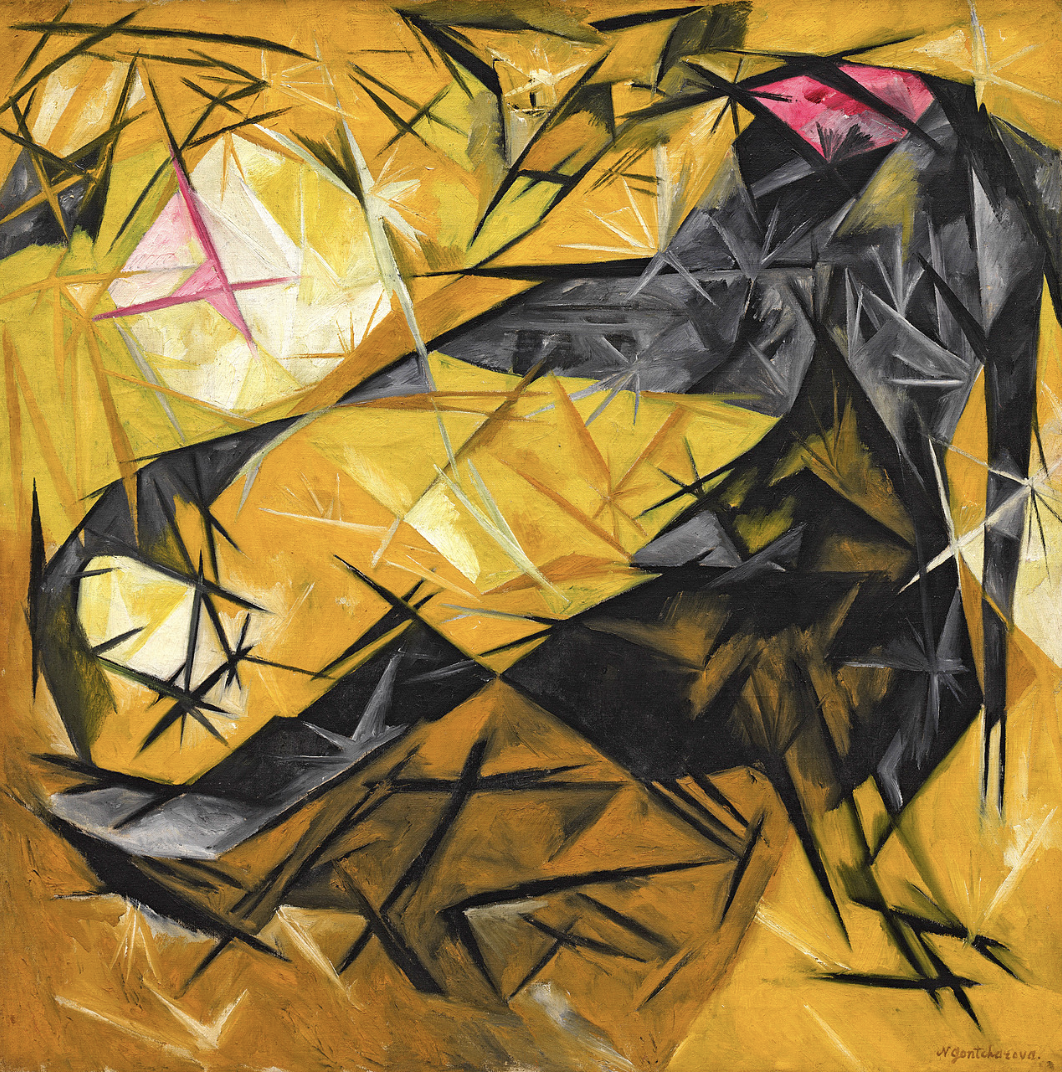
Cara explores how Natalia Goncharova redirects the ambitious, often technologically oriented rhetoric of Russian avant-garde abstraction toward an intimate and playful subject: domestic cats.