May 1, 2026
Opinions
Opinions
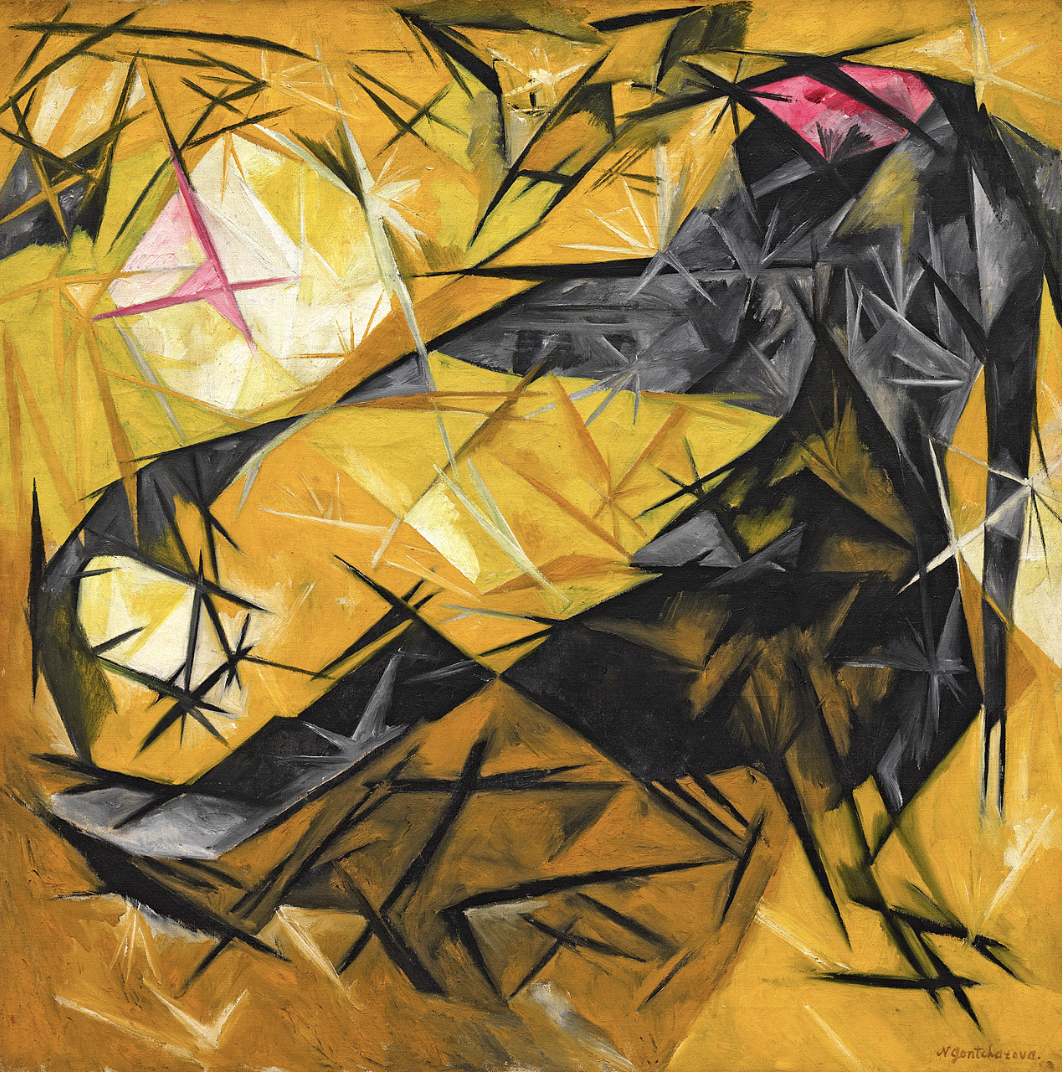
Cara explores how Natalia Goncharova redirects the ambitious, often technologically oriented rhetoric of Russian avant-garde abstraction toward an intimate and playful subject: domestic cats.

Cara explores how Natalia Goncharova redirects the ambitious, often technologically oriented rhetoric of Russian avant-garde abstraction toward an intimate and playful subject: domestic cats.
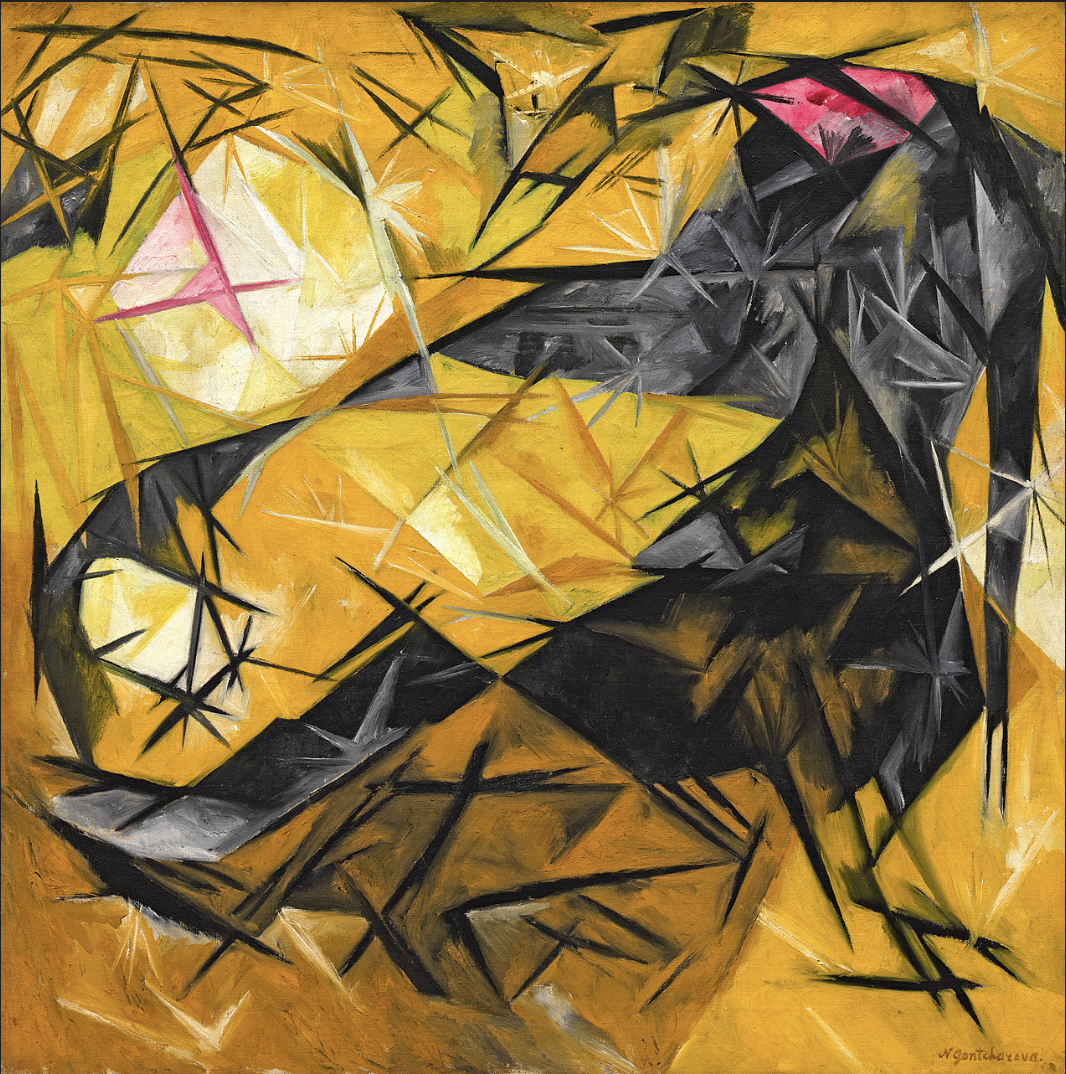

Perhaps best known for Neoprimitivist icon paintings that drew on both modern abstraction and traditional Russian folk art, Natalia Goncharova radically challenged artistic and social norms. Her nudes, religious figures, peasant workers, landscapes, and animals were strung together by a common humanistic thread. In this article, I delight in focusing on her particularly playful depiction of animals, produced in a time of heightened curiosity and anxiety among the Russian avant-garde about future directions of Russian art in an increasingly technological society. Although it formally exemplifies the Rayonist painterly style, which drew on scientific and metaphysical theories to challenge conceptions of a grounded, concrete spatial reality, Goncharova’s 1913 Cats painting (fig. 1) remains fairly referential and retains a warmth and familiarity that distinguishes it from contemporaneous developments in abstraction.
Goncharova’s rendering of cats is considerably stylized, composed of colorful geometries that radiate with energy. The square composition is scattered with diagonal slashes of varying lengths that intersect at their middles or ends, forming triangular crevices. Hues of sunflower yellow and gold contrast with darker areas of black, accented by smaller areas of white. Although the different geometric crevices created by the slashes are generally filled with flat color, Goncharova lets the colors mix together as she swipes her brush diagonally, creating sketch-like patches with visible brushstrokes that add some dimension to the forms. Although they might be hard to immediately discern, the forms of cats soon become clear with the bright pink of an ear and the diagonal strokes mimicking whiskers. Overall, the visual effect is remarkably dynamic, striking, and vivid—the lines are sharp, the picture plane is fractured, and the colors are eye-catching.
These colorful intersecting vectors exemplify the Rayonist style, a style dealing with the effects of light which responded to the emergence of new scientific and metaphysical theories. Einstein developed his theory of relativity, the atom was discovered, x-ray and radio technologies were invented (which both harnessed invisible forces), and Bergson published “Introduction to Metaphysics,” which challenged the notion of a universal reality. Essentially, ideas of a concrete, material reality, space, and time were being destabilized, and Rayonism set out to explore these new metaphysical frontiers. Goncharova and Mikhail Larionov, prominent avant garde painter and partner to Goncharova, penned the Rayonist manifesto in 1913, announcing a new painting style that “[signified] spatial forms arising from the intersection of the reflected rays of various objects, forms chosen by the artist's will.”¹ Rather than paint objects, they painted the beams of light bouncing off of material forms that, only thanks to the light, assumed visible shape. Light thus becomes the subject matter, and objects become dissolved into the space of the background. Larionov described this new sensation in the following way: “The picture appears to be slippery; [imparting] a sensation of the extratemporal, of the spatial.”² From this statement, the theories of a fourth dimension arise, in which the painting’s three dimensions of “length, breadth, and density” are compounded by the fourth dimension of sensation—of the energizing, dynamic rays of light.³
Thus, in visualizing how light reflects off of surfaces, shifting focus from the concrete form of objects to the intangible force (light) that informs our perception of our material environments, Cats challenges conceptions of spatial reality that still existed in movements like Cubism and even Futurism. Goncharova did not completely break from the aforementioned movements—in fact, the manifesto remarked that Rayonism was the synthesis of them (along with orphism).⁴ They shared a general interest in flattening and fracturing forms, particularly through bold, striking use of lines. Yet Cubism was static, focusing on representing multiple perspectives of an object at once; (Italian) Futurism attempted to capture the frenetic motion of modern urban life, with all its new machines and technological developments. While both applied radical approaches to the depiction of observable objects and movement, they still treated objects as substantial forms. They did not challenge the very idea of material reality itself, moving beyond it, in the way that Goncharova’s Cats does. Even though cats are undeniably physical, dimensional beings, they become considerably dematerialized in Goncharova’s rendering of them. I say “considerably” dematerialized, and not “completely,” because the feline figures retain enough recognizability so that the viewer can discern them (moreover, the simple title Cats underscores the referent).
Rather than embody the hyper-masculine ambitions of the Rayonist manifesto (which Larionov enthusiastically embraced) and the grand gestures of avant-garde movements, Goncharova takes Rayonism’s challenges of spatial reality and applies them to small animal companions known for being fast-footed and flexible—a sweet twist that gives the painting a grounded, more humanistic quality. The intersecting rays form burst-like shapes like those formed by light when it hits gleaming surfaces, giving the impression of fast-moving “slippery” forms catching the light at multiple points. If referencing an industrial machine, for example, or leaning towards more pure abstraction, this painting technique might have given the impression of cool, slick, fast-moving technology or impersonal non-objectivity. Yet recognizable cat forms suggest something more warm and familiar. After all, cats are domesticated indoor animals, presumably viewed and painted at home. Goncharova’s Rayonist challenges to grounded spatial reality seem like a fond nod to cats’ abilities to quickly jump several feet in the air, pounce on prey, and also contort their slinky bodies into small nooks and crannies—moving at the speed of light, being very “slippery” creatures. The diagonal, dynamic lines even seem to suggest the cats’ fur standing on end due to static (another invisible phenomenon!). This more personal element aligns with Goncharova’s larger body of work, in which depictions of typical peasant work and life, bodies, and animals recur; her subject matter is more grounded in familiar everyday referents, not striving for the same levels of the non-objective that artists like Larionov attempt.
In the Rayonist manifesto, Larionov and Goncharova note, “that which is valuable for the lover of painting finds its maximum expression in a rayonist picture. The objects that we see in life play no role here, but that which is the essence of painting itself can be shown…”⁵ As I have attempted to convey, Goncharova’s Cats composition definitely aspires towards that painterly style that embraces the flatness of the canvas and rejects naturalistic painted illusions of objects, which is quintessentially Rayonist and similar to other abstract movements, but it is not entirely non-objective. The cats seen in life do play an unusual role in the work. Natalia Goncharova harnesses an adventurous abstract painting style, one that draws on emerging scientific theories to radically innovate a new way of visualizing objects in space, to present a charming depiction of house cats flitting around that retains the element of the natural and everyday seen often in her work. Like her other works which merge emerging abstraction with longstanding traditional folk art, Cats merges the groundbreaking idea of a new spatial reality defined by light with the familiar, timeless subject of a human’s lively animal companion. Goncharova seems to be a master at accommodating both the old and the new, the familiar and unfamiliar—perhaps unlike her more totalizing, absolutist peers.
Notes
(Cover Image: Natalia Goncharova. Cats (rayist perception in rose, black, and yellow), 1913. Oil on canvas, 33 1/2 x 33 3/4 inches (85.1 x 85.7 cm). Solomon R. Guggenheim Museum, New York, Accession Number 57.1484 via the Guggenheim New York)
Cara explores how Natalia Goncharova redirects the ambitious, often technologically oriented rhetoric of Russian avant-garde abstraction toward an intimate and playful subject: domestic cats.

Kate explores how Australian artist Vincent Namatjira redefines portraiture to confront the legacies of colonialism while envisioning a more inclusive future—one expansive enough to embrace all Australians.

Clarke Reynolds (Mr. Dot) talks with the Art Review about interactive art, changing the narrative around blindness, and creating a world where art is more accessible for all.