Roy Lichtenstein made an art of copying. Now, the Whitney is appropriating the appropriator. In Like New, reproduction, reconstruction, and Pop spectacle become curatorial strategies, creating a tribute that looks suspiciously like the museum’s own self-portrait.
I have always had a somewhat pedantic fascination with exhibition titles: punchy, crystallized hooks meant to announce a show’s purpose—a task I find particularly admirable as someone who prefers the long-winded. Roy Lichtenstein: Like New opened October 11, 2026, at the Whitney Museum of American Art. However, the title had lingered in my mind long before the show opened, having first heard murmurs of it this summer while interning in the museum’s Director’s Office.
Co-curated by Whitney Curator Meg Onli and American conceptual artist Alex Da Corte, the exhibition brings together more than 130 works by Lichtenstein (1923–1997) and runs through May 10, 2027. It is the first major New York retrospective of the artist since the Guggenheim's in 1993. As a Lichtenstein-lover myself, I was eager to see how the Whitney would approach this undertaking. But, by the time I arrived on opening day, I was still preoccupied with those two title words: "Like New."
"New" felt intuitive: a retrospective promises to bring an artist's past into the present with fresh relevance. It was the "Like" that troubled me. That little qualifier admits a self-conscious dissonance, asking whether the past can really be brought back, or only a resemblance of it.
Through its shifting spatial arrangements, historical reconstructions, and Da Corte's contemporary installation interventions, Like New stages a meta-homage: the Whitney appropriates Lichtenstein's own strategies of copying and reconstruction as curatorial methods. The "Like" acknowledges a history that cannot be fully restored, while the "New" embraces its irreverent reinvention. Yet this tribute is not without contradiction. The very strategies Lichtenstein used to blur fine art and commercial imagery now allow the Whitney to ultimately assert authority over the celebration, preservation, and transformation of his legacy.
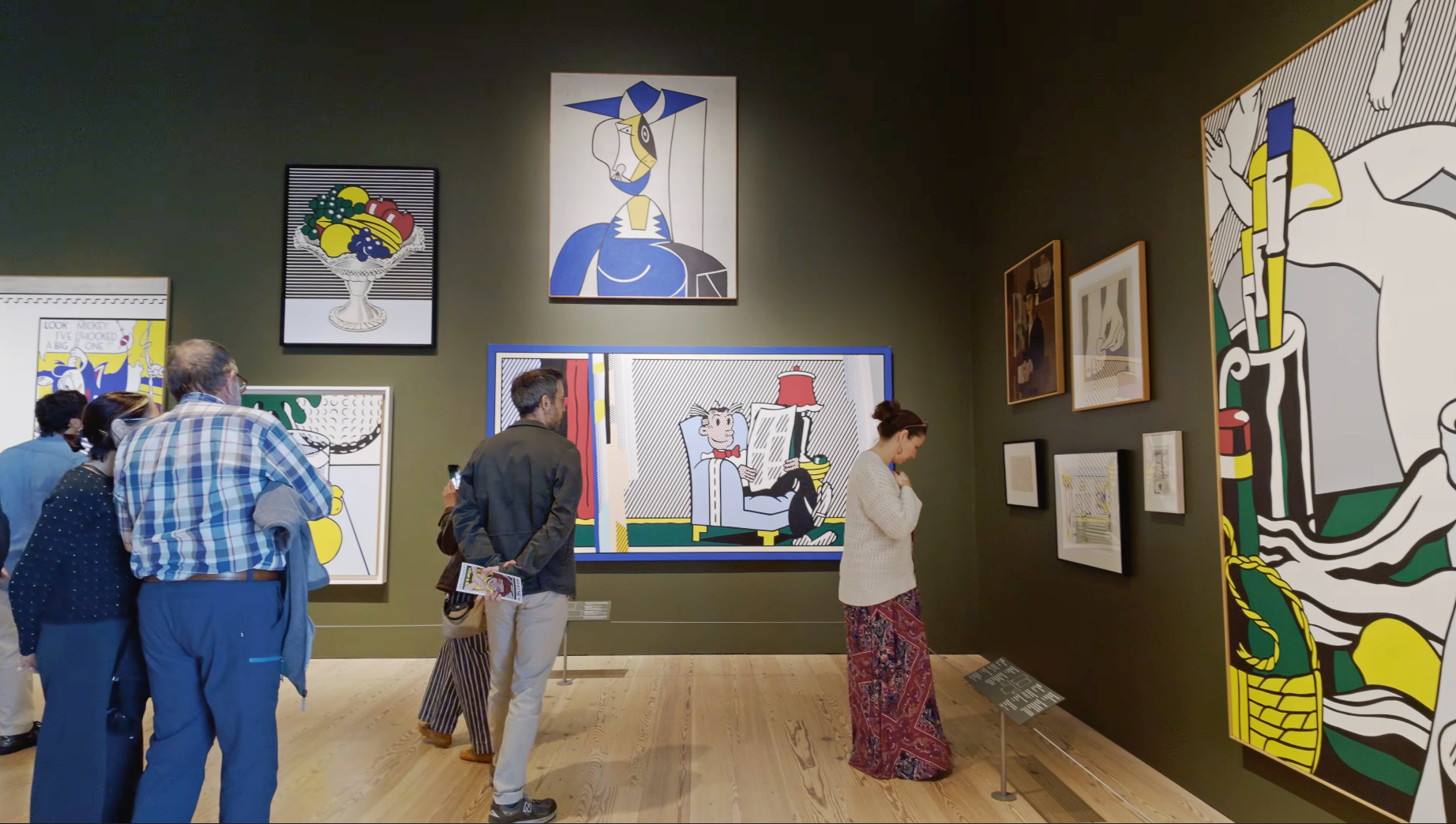
Walking through the exhibition, I immediately noticed its unusual, borderline erratic spatial rhythm. Mary Anne Staniszewski’s The Power of Display (1998) became a useful guide, particularly her lesson that exhibition design is never neutral, but always ideological. Like New borrows from various hanging conventions without settling into a single logic of display, an inconsistency that gradually reveals a logic of its own.
Installation view of the Artist's Studio gallery in Roy Lichtenstein: Like New, Whitney Museum of American Art, New York. (Image from Roy Lichtenstein… Full Walking Tour 4K, video by Pictures of New York / YouTube.)
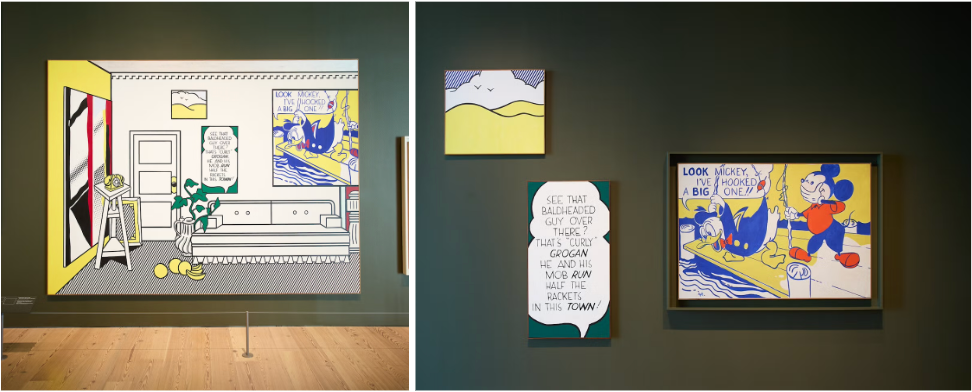
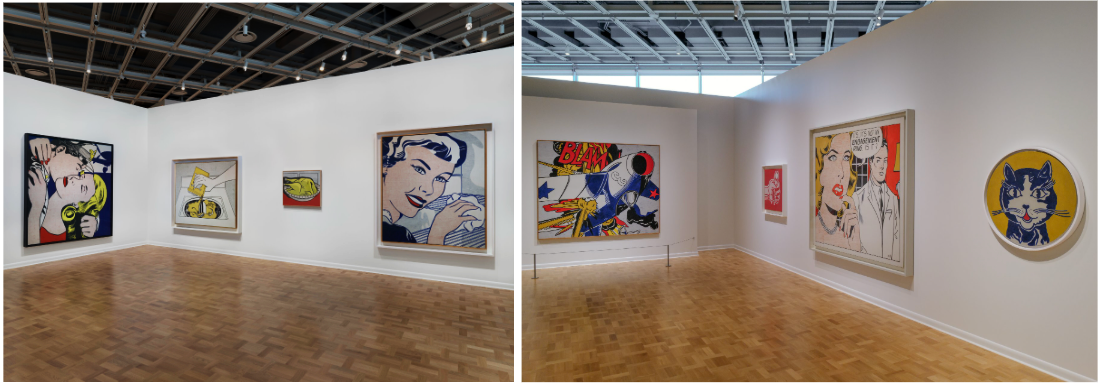
The Artist’s Studio gallery showcases this eclectic hanging, with works arranged at irregular heights, creating an unexpected dialogue across the gallery space. In Artist’s Studio “Look Mickey” (1973), Lichtenstein paints his own earlier works in their natural habitat, seemingly in conversation with one another within his imagined studio. Directly across from the painting hang the very works reproduced within it, including Look Mickey (1961) itself, now joined by Da Corte’s Comic Painting (2026). Realizing a painting that had previously existed only within Lichtenstein’s imagined studio, Da Corte extends Lichtenstein’s own practice of appropriation. By blurring the distinction between copyist and author, the exhibition suggests that an image’s meaning is not fixed at the moment of its creation, but is continually reshaped through its evolving context and conditions of display.
One of my favorite moments was watching a group of kids crowd around Look Mickey (1961), exclaiming, "Look, it's Mickey Mouse!" More than sixty years later, a new generation unknowingly echoed the painting's title. There is something wonderfully circular about the Whitney reversing Lichtenstein’s process here. The arrangement he once reproduced within a painting is now reassembled in physical space, making the gallery itself a Lichtenstein-like composition.
Left: Roy Lichtenstein, Artist's Studio "Look Mickey," 1973. Right: Roy Lichtenstein, Look Mickey, 1961, and Landscape, 1974, installed alongside Alex Da Corte, Comic Painting, 2026. (Image: Marissa Alper / The New York Times)
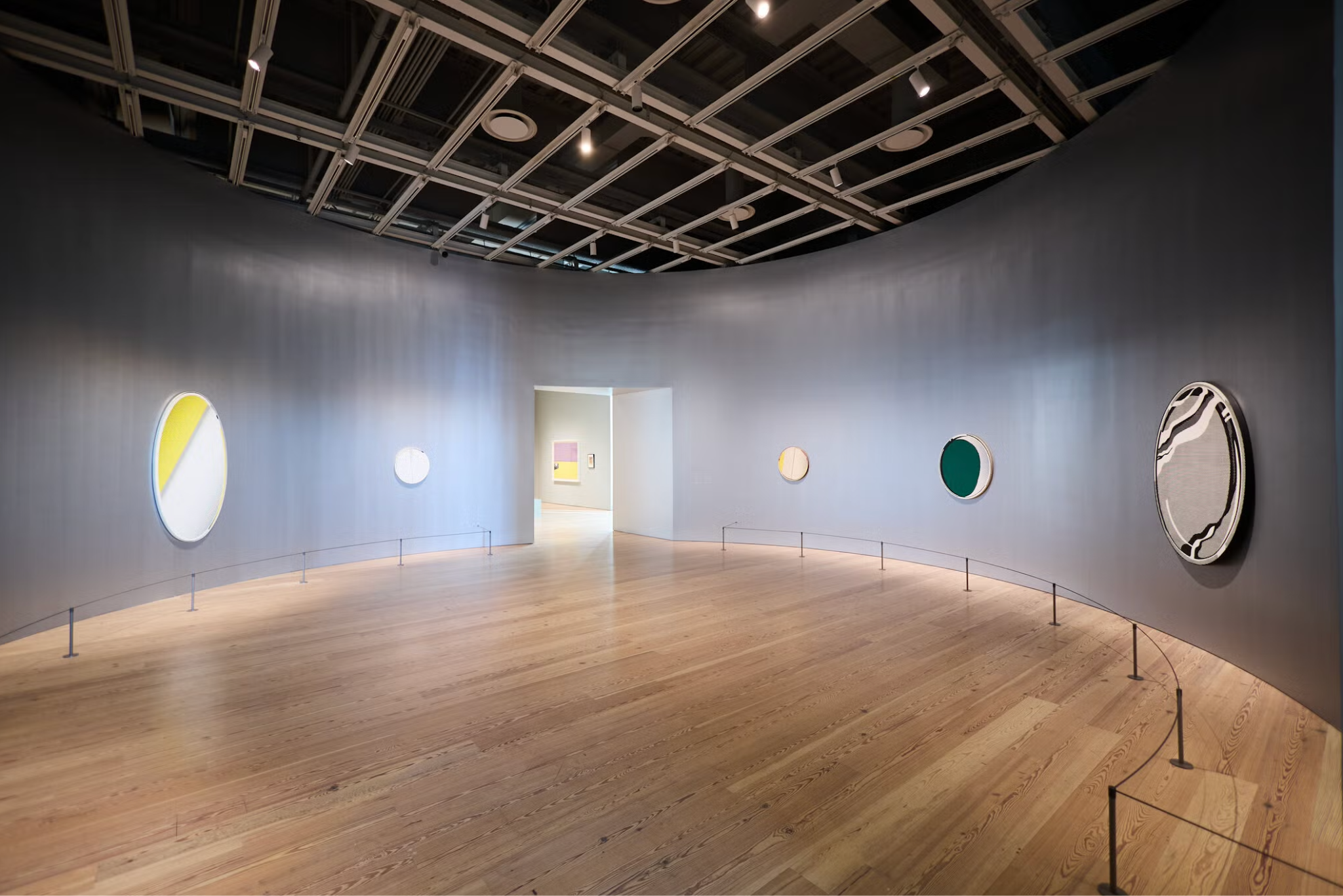
The most dramatic shift in tempo comes in the Anti-Illusion gallery, a curved room sparsely lined with eight of Lichtenstein’s painted mirrors from 1969 to 1972. The room echoes the now-conventional eye-level installations of Alfred H. Barr Jr., the Museum of Modern Art's founding director, which Staniszewski describes as staging an almost anthropomorphic, "face-to-face" encounter between artwork and viewer. Yet standing before the mirrors, I found only dots and diagonal glints where I should have met my own reflection. Lichtenstein reproduces the mirror only to strip it of its ability to reproduce.
Denied our faces, we start projecting them. In Inside the White Cube (1976), Brian O'Doherty argues that the supposedly pristine white gallery is anything but neutral. O’Doherty describes it as an “impure” room, a space that absorbs its audience and becomes a surface off which to “bounce our paranoias.” In this room, I found O’Doherty’s metaphor unexpectedly literal. These mirrors cannot reflect us, yet, in expecting them to, we have already projected ourselves into their illusory and imagined world.
From paintings within paintings to reflectionless mirrors, the Whitney’s spatial choreography does not merely display Lichtenstein's practice but performs it, translating his methods into the logic of the installation itself.
Installation view of the Anti-Illusion gallery, with Roy Lichtenstein’s Mirror paintings, 1969–72. (Image: Marissa Alper / The New York Times)
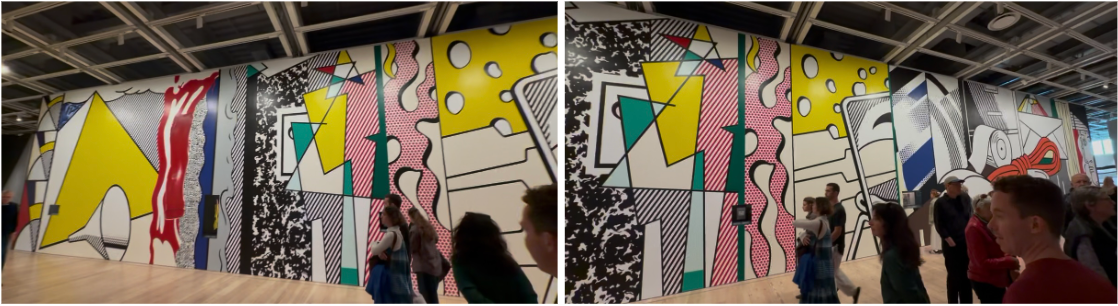
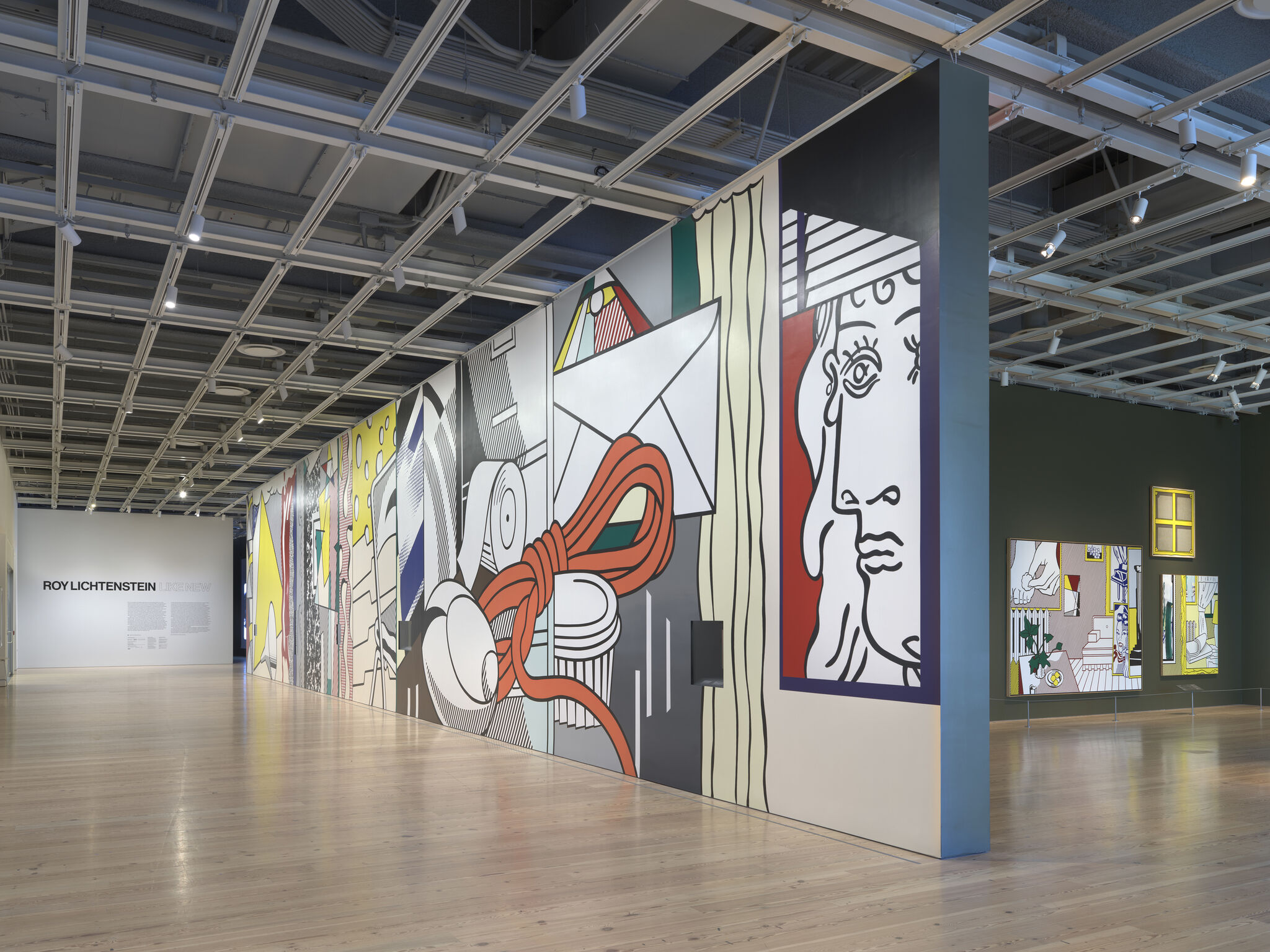
While the exhibition’s design brings Lichtenstein’s artistic methods to life in physical space, can it similarly revive his past? Here we run into the “Like” in Like New, which indulges in the old but concedes to resemblance, not complete return. The cold-opens with a 96-foot reconstruction of Greene Street Mural (1983), a temporary, site-specific work Lichtenstein made for the SoHo gallery of his longtime dealer, Leo Castelli. What was once ephemeral now confronts visitors as a museum monument, freshly “reborn.”
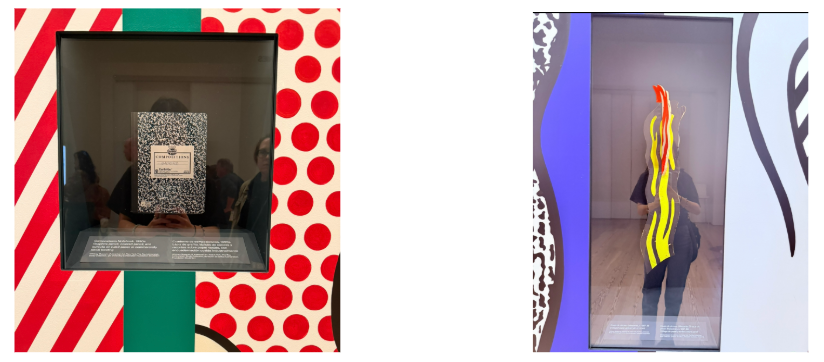
Yet the most fascinating part was not the mural’s colossal presence but the small glass vitrines of studio materials embedded in the wall itself. The museum has directly injected preservation inside the lost mural. Now lit and labeled, its reconstruction is protected against the destruction that once defined it. What survives is not the mural but its likeness.
Roy Lichtenstein, Greene Street Mural, 1983 (reconstructed 2026), Whitney Museum of American Art, New York. (Image courtesy of Phoebe Chun)
Vitrines embedded in the reconstructed Greene Street Mural, displaying Roy Lichtenstein’s Compositional Notebook, 1990s (left), and Coups de pinceau (Maquette), c. 1987–88 (right). (Image courtesy of Phoebe Chun)
The restaging of Lichtenstein’s 1962 debut solo exhibition at Leo Castelli Gallery performs a similar sleight of hand, reuniting all eight paintings from his breakout show for the first time since. After the exhibition’s monumental scale, this small room of modest beginnings felt intimate.
By assembling these works in their original configuration, the Whitney invites viewers to imagine their lineage but offers only a semblance of historical authenticity. The exhibition thus exposes the museum’s role in shaping art historical narratives: paintings that once signaled a disruptive commercial incursion into fine art are now safely enshrined as canonical masterpieces, underscoring the impossibility of recapturing the charged historical moment of their original debut.
In Museum Memories: History, Technology, Art (1999), scholar Didier Maleuvre warns that when museums extract artworks from their original contexts they leave them like “corpses in an ossuary,” stripped of their “living history.” The reconstructions of both the mural and the gallery preserve the appearance of history while inevitably transforming its context, and, as O’Doherty reminds us, a change of context is a change of content. Perhaps this is what the “Like” warned us of: the past is not revived, but self-consciously copied and pasted into present display.
Installation view of Castelli Gallery, February 10–March 3, 1962, a recreation of Roy Lichtenstein’s 1962 solo exhibition at Leo Castelli Gallery. (Image: Jason Lowrie / BFA.com)
If the “Like” mourns, the “New” arrives with a regenerative spirit, largely through the contemporary artist and co-curator Alex Da Corte. The roles of artist and curator have been tangling for decades. In The Culture of Curating and the Curating of Culture(s) (2012), curator and scholar Paul O’Neill traces how the two have converged since the 1990s, as artists take up curating and exhibition-making as a medium of their own practice. Da Corte embodies this fusion: rather than simply presenting Lichtenstein’s works, he produces new ones to be curated alongside them.
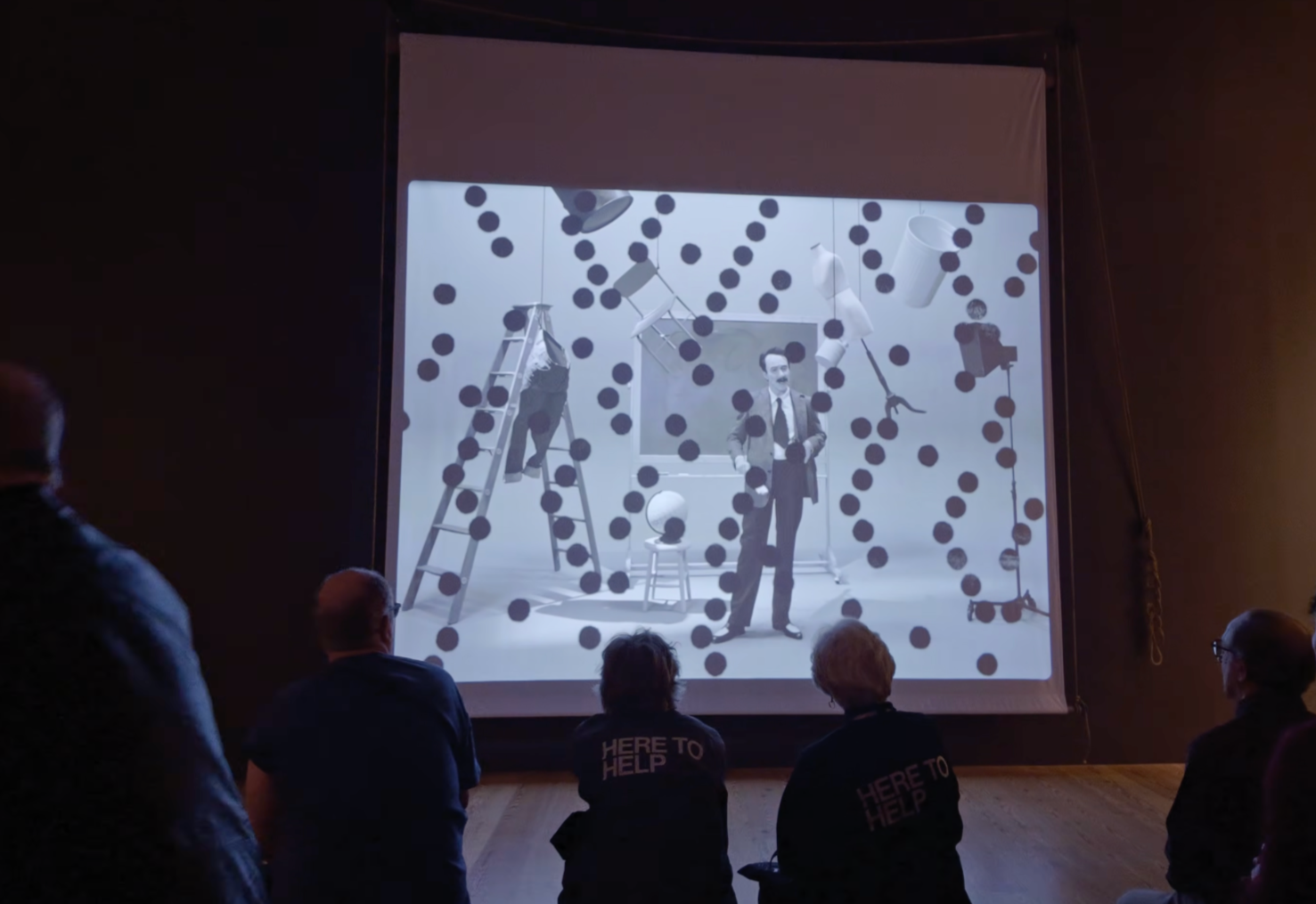
In Drawing by Seeing (2026), the nearly 15-minute film in the exhibition’s first room, Da Corte impersonates Hoyt Sherman, Lichtenstein’s art professor at Ohio State University, reinterpreting history through artistic performance. Da Corte relishes his idiosyncratic touch, flouting what art historian Terry Smith, in Thinking Contemporary Curating (2012), calls “the usual rule that curating be unobtrusive.” Yet his authorship operates within the Whitney’s institutional reins: the artist may frame Lichtenstein, but only as long as the institution frames the artist.
Alex Da Corte, Drawing by Seeing, 2026, (Video, color, sound, 14:43 min., Whitney Museum of American Art, New York). (Image from Roy Lichtenstein… Full Walking Tour 4K, video by Pictures of New York / YouTube.)
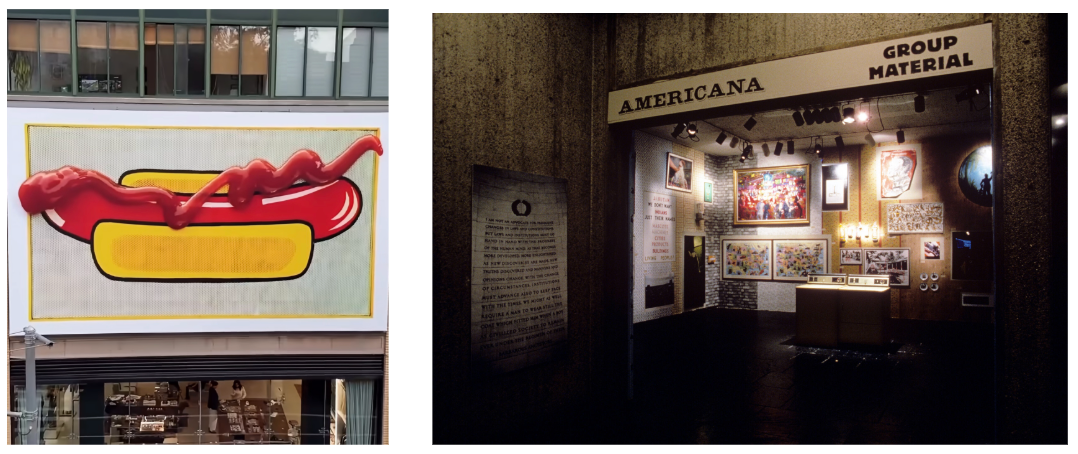
Is it bad to admit that my favorite work in Like New was not even technically inside it? Across Gansevoort Street, Da Corte’s billboard Hot Dog with Ketchup (2026) enlarges Lichtenstein’s Hot Dog (1963), now condimented with a sloppy streak of ketchup. The billboard is a delicious reversal of Americana (1985), an installation by the New York artist collective Group Material. As art historian Claire Grace recounts in Spoils of the Sign (2014), Americana turned part of that year’s Whitney Biennial into a shopping mall of “clichés of Americanness.” Taking over the museum's public first-floor lobby with posters and washing machines galore, it challenged the distinction between popular consumer culture and fine art, asserting that both are equally deserving of the designation “culture.” Where Americana brought consumer products into the museum to blur the line between art and commerce, Like New reverses the gesture, sending art back out into the public landscape of advertising.
Rather than merely exposing the market, the Whitney explicitly indulges in it, and the billboard becomes another wall of the museum. This Gansevoort Street billboard has long been commissioned by the Whitney, cycling through artworks as part of its public art program, yet its format remains an unavoidably blasé symbol of consumerism. Here, the boundary between artistic critique and advertisement becomes increasingly difficult to distinguish, and the exhibition is perhaps at its most compelling.
Left: Alex Da Corte, Hot Dog with Ketchup, 2026, (Inkjet on vinyl, Gansevoort Street, New York). Right: Installation view of Group Material, Americana, 1985, Whitney Biennial, Whitney Museum of American Art, New York. (Photograph by Geoffrey Clements / Whitney Museum of American Art)
By the time I reached the museum store, the irony was almost too perfect. Browsing the Whitney’s collaboration with Gap, I noticed that the copied, ketchup-splattered hot dog had been reproduced once again, this time as a postcard. At that moment, I found closure in the exhibition’s self-referential title. The retrospective had ended for me much as it began, with Da Corte in prosthetic disguise: an impersonation.
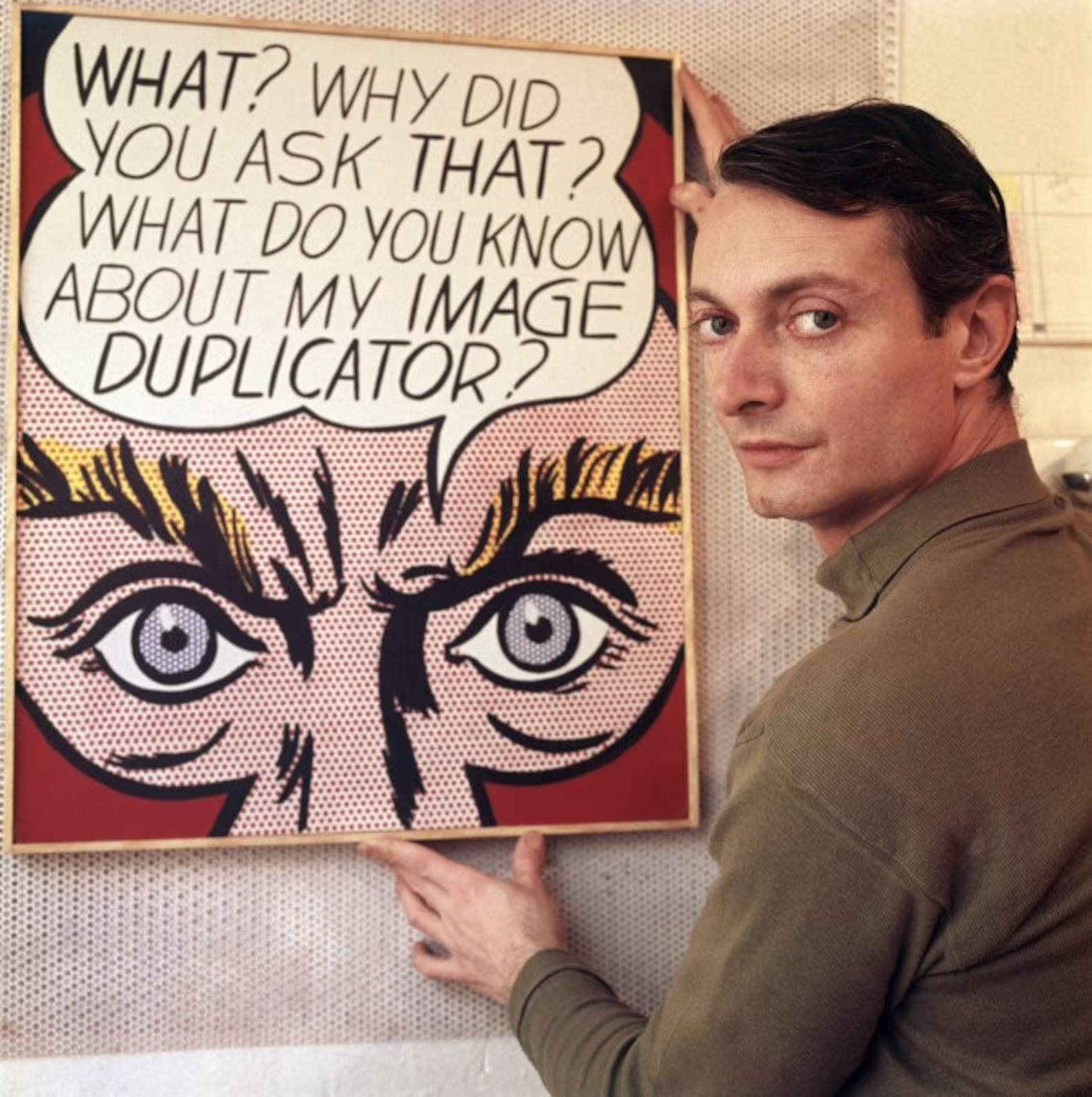
But the retrospective’s most convincing impersonator is the Whitney itself. Lichtenstein made his name lifting images from comics and advertisements and remaking them as art. Now, the Whitney lifts from Lichtenstein, turning his art back into a viral, “pop”ular spectacle. I thought back to one of the first works I saw, Image Duplicator (1963), which Da Corte notes is often read as Lichtenstein’s self-portrait. For me, the show, in all its duplicity, can be read as a portrait of the museum itself.
It is a fitting tribute, though hardly an innocent one: in making Lichtenstein like new, the Whitney makes itself like Lichtenstein.
Roy Lichtenstein with Image Duplicator (1963), New York, 1963. (Photograph by John Loengard / The LIFE Picture Collection)
Roy Lichtenstein made an art of copying. Now, the Whitney is appropriating the appropriator. In Like New, reproduction, reconstruction, and Pop spectacle become curatorial strategies, creating a tribute that looks suspiciously like the museum’s own self-portrait.
Elise Ansel talks with the Brown Art Review about her experiences at Brown and engagement with art history within her work abstracting Old Master Paintings
Through their personal experience, Alex guides us through a vision for a personalized way of appreciating art, demonstrating that the value of art is not in the work, but in our hearts, joyfully entangled by context and life.