May 1, 2026
Opinions
Opinions
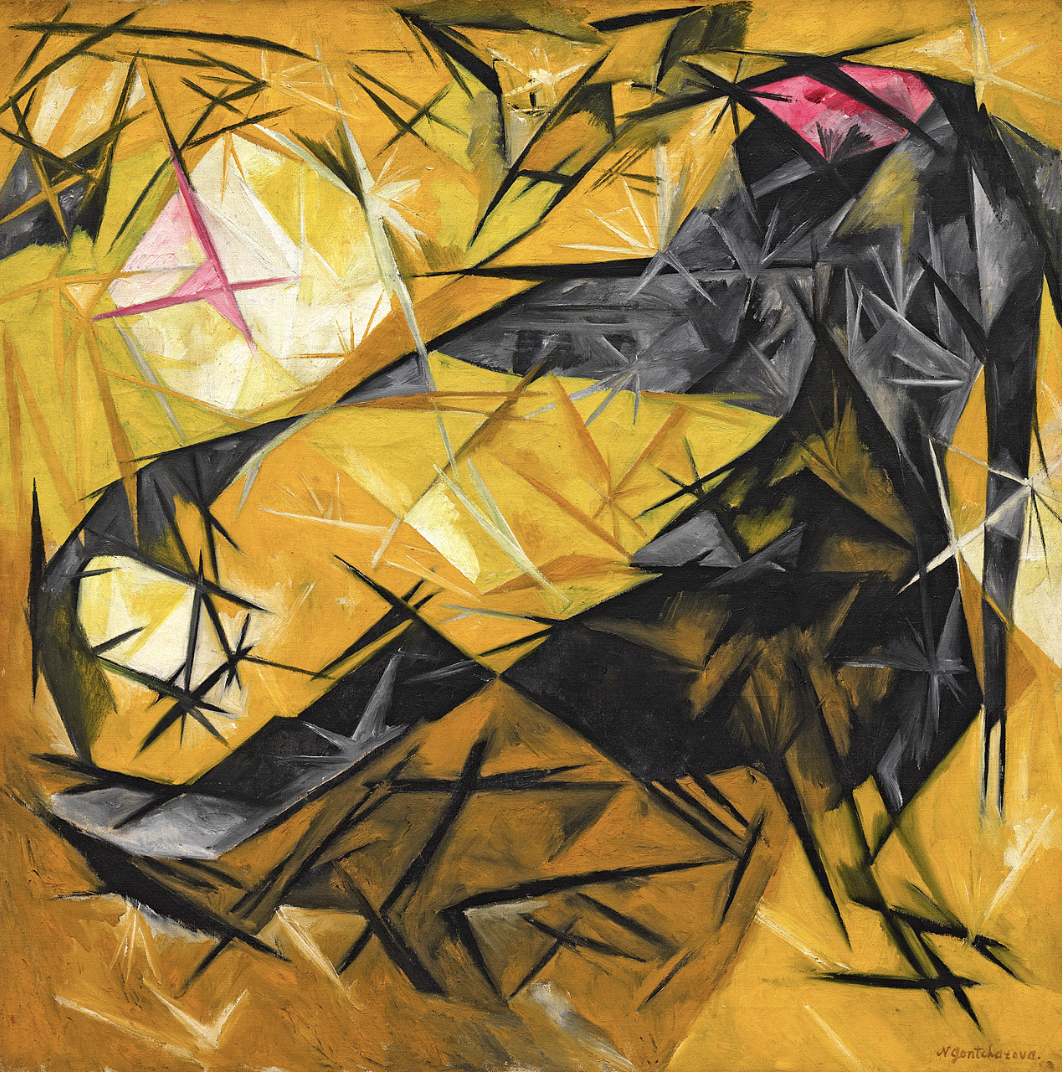
Cara explores how Natalia Goncharova redirects the ambitious, often technologically oriented rhetoric of Russian avant-garde abstraction toward an intimate and playful subject: domestic cats.

Clarke Reynolds (Mr. Dot) talks with the Art Review about interactive art, changing the narrative around blindness, and creating a world where art is more accessible for all.


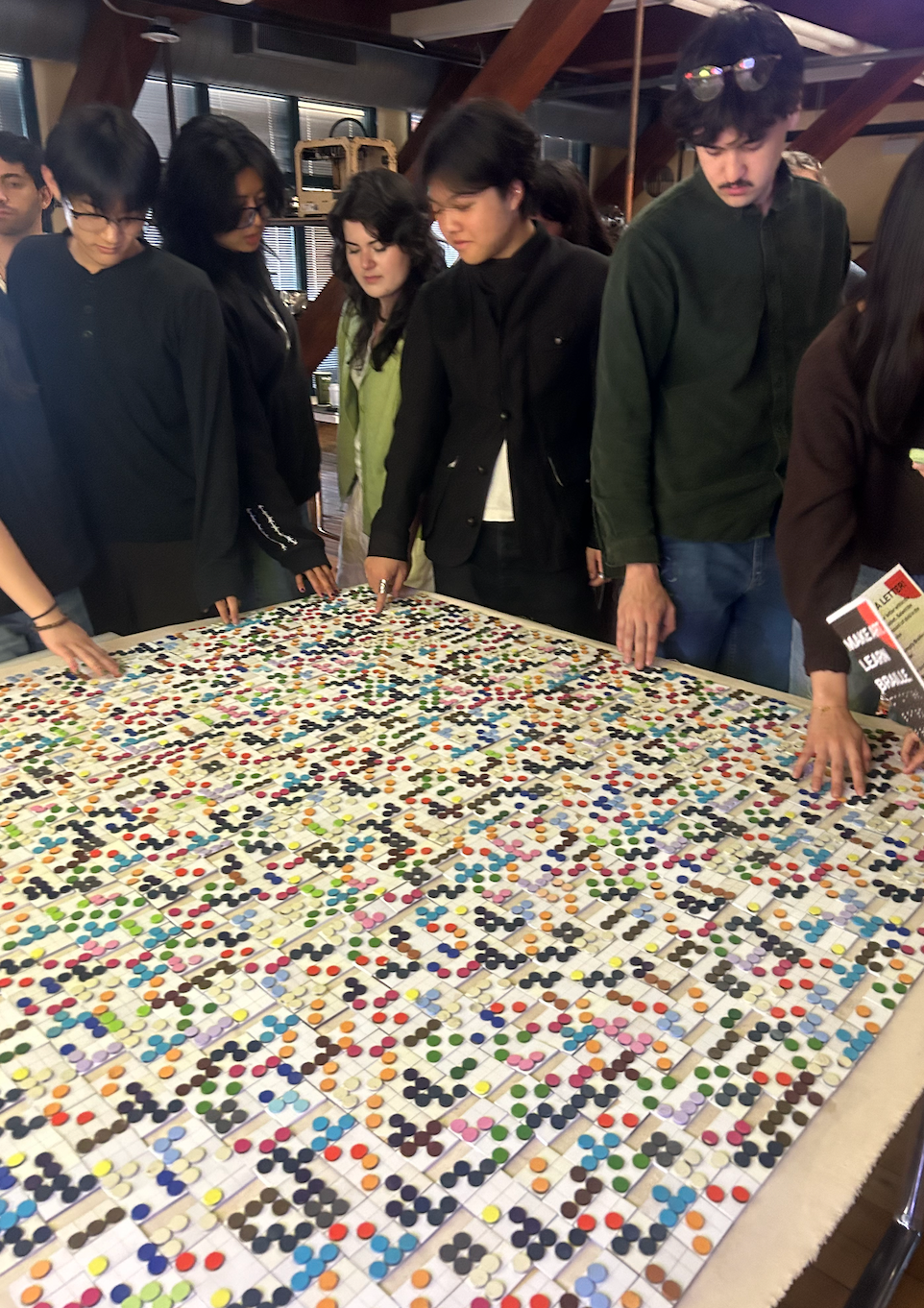
Over the past year, I had the privilege of collaborating closely with UK artist Clarke Reynolds, also known as Mr. Dot (@mrdotofficial), on a project for the Brown | RISD club Design for America. Together, my team and I created a 150cm by 130cm braille artwork of the Declaration of Independence, guided by Mr. Reynolds. Throughout this interview, whenever I refer to a piece or discuss making an artwork, I'm referencing the collaborative work we developed with Mr. Reynolds, titled “A Tale of Two Dots,” as I was immersed in this project during our conversation.
As the leading braille artist, Mr. Reynolds has a unique ability to transform braille into vibrant, expressive pieces that bridge the gap between blind and sighted audiences. His mission revolves around creating inclusive spaces where disability is viewed not as a limitation but as a valuable perspective. Mr. Reynolds has been honored with the opportunity to represent the UK at the 2026 Venice Biennale.
Ella Blanco: Let's get started. So would you mind just introducing yourself? I know you've done this a million times for us, but introducing yourself, talking a little bit about your work, a little bit about your passions, and we'll go from there?
Clarke Reynolds: Of course. Yeah. So my name is Clarke Reynolds, aka Mr. Dot, and I am the leading braille artist in the world. But how did, how did Mr. Dot become Mr. Dot? That's the dot, isn't it? Really, that's the question. I've always wanted to be an artist, from the age of six, I lost my sight in my right eye from the age of four to six. But, back in the 1980s, no one talked about sight loss. It wasn't a topic of discussion. You wore the dodgy NHS glasses, which people are now wearing, now as fashion statements. So I was ahead of my time, and my school took me to an art gallery called Aspects, and I knew then that I wanted to be an artist. I don't know where it's come from; there's no creativity in my family, no one is an artist, so there's no one to copy. And so, I grew up, you know, art is a big part of my life.
And then I got ill in my early teens, really, bad kidneys, and I had to leave school at the age of 14, got back into higher education, got an NPQ and a diploma in art design, did a first year of fine art. I was talking about drawing and painting, which always come from the heart. And so I managed that you could do a degree in model making, that's quite fascinating, you know, I love my movies now. I can use my skills for my for my movie day, you know, and then become a production designer. And that was, that was the goal, that was the dream, to come use my creativity, gain a skill, and come production timer. So I got my degree in model making and graduated in 2006, just as the crisis happened around the world, the financial crisis, and all I could do with my degree was stack shelves in supermarkets. It still wasn't very glamorous, but I never gave up on being a creative. I did art in my spare time. Then, finally, I got a job as a dental model maker. And it's like one of those players when you grow up doing, oh, I'm going to be an architect, or I'm going to be an archeologist, or a graphic designer, don't go thinking, you know what? I'm going to be a dental model maker. So it's fascinating. It was great, you know, I really enjoyed it. I used my skills. It was great—It didn't feel like work.
And then 18 months into the job, and that was a dark shadow in my good eye, and I was 31 at the time, and I thought, I just need a single pair of glasses, really. And so I went to the optician's. Opticians took me to, sent me to the hospital, hospital did all the tests, you know, the gut, look down the left foot, right. And they said, Mr. Reynolds, do you drive? I said, Yes. And they said, Hand your license over, you’ve gone blind. And that's how you're told as an adult, it was crazy. You think, you know, oh, do you need support? And there is no support. From the age of 30 onward, if you end up with some kind of disability, especially in the UK, you're left to your own devices. From the age of, like, 18 to 30, they’ll help you on, but from 30 onwards, no, no chance. So I lost my job, lost a rental home that I was living in because the landlords sold it out from under us. And my daughter was diagnosed with mild cerebral palsy. So you'd think, Oh, my life couldn’t get much worse, really.
And so I moved back to Portsmouth with my mum, and the first thing I did was Google disability arts, because I didn't know if there was such a thing. And I found this organization called Outside-In, which will come in our story later. And I signed up for them, and I went for a few talks and spoke to a lot of people, and also they asked me to do a talk about my art, which is great. And at that time as well, I didn't know any blind people. So I joined a sports team, so I played professional cricket for the VI, and did it. Won the 220 finals in 2019, so it's proper professional. But one thing is always made constant in my artwork, from like when I was six years old, I was a big fan of pointillism. I've seen pointillism because I used to say how I used to see out my eye was like, because they're 1000 dots, so those pixelated images became real to me, and that's how my eyes worked. So I've always used dots in artwork. And it was like, how do I—before I learned Braille—it was like, how do I communicate art if you can't see it.

So I explored touching art, and sounds, and speech, and then, and then the gallery that I mentioned before, the Aspects gallery, I signed up with them for their mentoring thing. And I think it didn't click. It's the same gallery, because after, you know, after 30-odd years, I never thought I would know it'd be the same one, because there's been a different building, and then I got to know it was the same one. And I worked really hard, like with the mentoring, had an artist ready to see there, I created a womb. One of my first projects was-, I created a tent, which is a womb, and it was sound-related, so I got a sound engineer to create a sound as if I was the baby inside the womb, and what could I hear? And then I sewed inside the tent all these furry kind of textures to feel like, you know, how cozy and comfortable it could be. And it was like, it was me being reborn as a blind artist. So I did that. And I did a project called I See Squares 2020, which was a community project where everyone got a square 20 by 20, which represents 20 20 vision. And because I live by the sea in Portsmouth, they had to create a patch on that 20 by 20 of what they thought about the sea. But I didn't want like, you know, typical, there's a sky, there's a sea, there's the sand. I wanted, like abstract. Now, I thought only 100 people would do this project. Right? It turned out that over 1000 people made a 16-meter-long tapestry. It took me 400 hours, 400 hours to sew by hand, and it was amazing.
And then from that, a gallery just opened up across the road for me and asked me to host my first solo exhibition. So I had all this work about exploring touch and sound, and we had the exhibition, and I was just playing around with dots at the time, lots of circles, because, again, it was kind of like a window. When you talk about tunnel vision, it is like, you know, when you see them, dots are really important. And my friend, with whom I played cricket, had a Perkins Brow typewriter, and eight years ago, he gave it to me, and I learned braille in three weeks, because I did see it as a pattern. Now I didn’t see it as a letter. I saw it as a pattern. And as a creative, our brains are geared to patterns. So within three weeks, I learned the braille, and I did a piece using buttons, and the buttons were about two centimeters each, and there, well, there's the alphabet in braille. I put my Rosetta Stone, and I took it to someone who could read braille, and instantly, just by them touching, they said, Oh, this is A-Z in braille, and that was a light bulb for me, like, well, you know what? Why can't Braille be an art form? And fast forward, you know, eight years now, I've had multiple solo shows across the globe, from India to America, London, and now, like I say, I'm the leading Braille artist in the world.
I'm just about to go to the Venice Biennale, the first blind fellow in the history of the British Council. And I got that through Outside-In, which I mentioned earlier in my story. So, Outside-In, I became an ambassador. And so I'm taking part in the Venice Biennale in September, so I’ll be there for the month. I just got the Arts Council-funded project, which is my biggest to date. So I've got 30,000 pounds to create Mr. Dot’s Dot Shop. So a shop installation like you play shop, where there'd be no Latin, everything will be Braille, from the brand to the money to the signage. And I'm really looking forward, because not only am I an artist, but I released a children's book last year, called Mr. Dot and his Magical White Cane Adventures. Because what this Dot does is I go into schools, and I teach braille as art, and I break down the stigma attached to sight loss for the use of Braille. And in the past four years, it's come up to nearly 35,000 kids that I've taught Braille in various schools across the country.
And that's the biggest achievement, because if you told me, you know, 13 years ago, when I got that diagnosis about my sight, that I would be inspiring the VI children across the globe and an ambassador for a major charity, I would never have believed you. And look at what we're doing today. We create a project, and I'm not even there, and you're recreating my color-coded braille that I created, and it's a way for you, for sighted people, to learn braille through color association. Now, people think, because I don't have an MA or PhD, I'm a hobbyist in the disability art world, you know, but you can see from like my brow scrabble that I did in Wichita, to the world searches, to my color-coded Braille, I think very analytical about what art is about, you know, and the colors aren't random. So now I looked at the commonality of letters of hearing a word, and used color theory, so the brain will start seeing pairings and patterns like you see words. And that's how I came up with a color-coded braille.
EB: Could you explain that a little bit more? How exactly does that work? Because obviously, you were talking a lot about how it's pattern-based. I'm curious about how exactly to come up with the colors. Obviously, we're using them.
CR: So, so you mentioned, when you learn to read, you start seeing patterns like, because letters are just patterns. It's just that we took, we give them a name, but A and D, and so the brain, you still see the letter. When you speed read, you'll just read a certain letter, and then your brain will fill in the blanks, because it knows it's a pattern. So the idea is, I looked at how painters paint, you know, portraits and landscapes, and use color theory. So complementary colors, shades of colors. So, for instance, E is the most common letter we use in our vocabulary. So E is orange, because E is a complementary color that goes with blue. And if you look at R is blue, T is blue, D is blue. So they are, you know, they're like marriages made in heaven, like E-R, E-T, E-D, and they always pair up when you see words.

So the idea is you start to see those pairings when you start to see my Braille. And the same with shades of color. So P and H, so P is lilac, and H is purple. So you get the shader color and twist, and if you put all the colors together, look, they don't overencroach on each other. So, for instance, A is only one. So I knew A was going to be the brightest color, which was yellow, right, T and N outside the vowels are the most letters we use. So T is the darkest, which is navy blue, and N is the lightest, which is a cream color. So when, if you imagine, when you put this artwork together, you will see all these variations of patterns. And if you told people, it's Braille, their brain will start to engage with it in a new way, without physically touching it.
EB: That is fascinating. You know, I would never really notice that, but it does make sense: the colors, how they combine, complementary versus contrasting. It does give a very clear kind of association, even if we're looking at it visually. But something that we were talking about, and even just in that, it's your artwork is not only a visual experience, it's also a tactile experience, but most importantly, it's an experience. And you're talking about how part of that experience is teaching. So, can you talk a little bit about how you create these experiences, or how experience is important to your artwork?
CR: It really is. You know, the idea of being told not to touch artwork is, you know, it's a major thing in galleries, you know, but the idea is, when I have exhibitions, I want them, I want the people to explore. It doesn't matter if they don't know braille. It's about the idea of physically touching a piece of artwork and then taking that information. If they want to learn braille, they will. So visit the braille scrabble guy created in Wichita in the Evision Gallery. It transcended all. But it's not just about the blind. It was, you know, you have that familiarity of playing a game with Scrabble, but the sighted people will play through color, and you've got the vision pair people playing through touch. But the idea is also non-verbal, you know, highly autistic, because of nature of it being words and color, it does something to the brain. And that makes it engaging, you know, and that's, the idea of color is such an important thing in art history, you know, from the (Piet) Mondrian’s to the (J. M. W.) Turner’s, there's, you know, the idea of them playing with color, and I play with color.
It's that I can tell a story through the color and and that's what's really important with my my color coded Braille when I go to schools, and first thing I do is everyone knows what their name looks like. You know, we talked about letters being patterns. But what does a name look like? So when they do it in Braille, it, it creates this abstract dot image. But the idea is, when you're reading it, you're not reading the dots, blind people are reading negative spaces. So if you've got, but when you have those are sentences, like the things you're doing now, yeah, it's a maze. It's that negative space that your eyes will pick up on, but then your fingers will as well, and it's almost like a metaphor for blindness. You know, live in a world that's a maze in a way.

EB: That really is interesting. And I think that, as we're making this, I think we're starting to understand that as well, just from looking at the colors, from looking at the pieces, learning the patterns, recognizing them, the empty spaces in the cell. Currently, I'm working on the letter M and learning where the dots goes, and then also how the cells are made empty and where the dots go. It's all very visually engaging, but it's also imprinting the pattern, as you were talking about in my brain, which is very interesting. But I want to ask you a question about, as like the leading Braille artist in the world, you have any thoughts on making art more accessible and how to do that? Or just in general, what does it mean to make art accessible?
CR: You kind of do, in a way. And obviously, it's down to how the scenes are. So a great example is sculpture. You know, if sculpture was in a park, like, like your Barbara Hepworth, or your Henry Moore sculpture, it's in a park, you go up to it, you do feel, you can touch it all you want. As soon as that sculpture is taken out of context and put into a gallery setting, all of a sudden there's this barrier that you can't get nowhere near, not even four foot away. And it's bizarre, those two different settings. It's the same piece of artwork. Just because it's in a different room, it becomes “you can't touch it.” Now, why is that?
So when it comes to art in that gallery setting, especially with modern art, with living artists, I think they've got a responsibility to put themselves in an inclusive world. So not just putting their artwork up. I think the idea is, if they can leave something, it doesn't really physical art, they can leave something in a box that we touched by everyone, not the blind community, but everyone, and even a one minute audio description of their voice, not not the curator, not the gallery owner, but their voice of explaining what their art is about in one minute, because words are important. And you know, a voice can go up and down and left and right, and if they're passionate about what they've just created, that passion should come through in the audio description. And that's what I'm really passionate about, the idea that the most cost-effective way of art to be engaged by everyone is a one-minute audio description by the living artist, and have emotion. Don't go, don't follow this idea that we've got to stay neutral because you've got to keep it neutral because of people's perception of it. If you love the art, right? It should come through in that voice. And that's really important.
EB: Would you perhaps be willing to, maybe, choose one of the favorite artworks you've made, and give us a one-minute description? I know I'm kind of putting you on the spot, showing your passion for one of your favorite artworks that you've made, talk a little bit about it as an example?
CR: Yes, of course, I'm just trying to think about so many. Okay, so we do my color-coded braille, right? And so we do the first piece that we made, which was… So basically, it was a yellow canvas. A yellow Canvas depicting a word amplify, because I amplify the dot and in those color, in those multicolored dots, as your hand caresses across it, it doesn't matter that, if you can't re braille, what you're doing is having the experience of physically touching the touching a piece of artwork, navigating it through the negative spaces, because as your finger caress that wood and it dips into the canvas. That's what you're feeling. And as you navigate that unmanageable maze, just put yourself into someone who can't see. And touching that art, you are reading, amplify, even if you can't physically see or know, growing. There you go.
EB: Fantastic. Thank you so much. That's very engaging. And I think it definitely shows how passionate you are for your artwork through the way that you describe it, through the words that you use, and just really how you want people to engage with your art.
I suppose my other question goes back to the conversation we were having slightly earlier, about interacting with artwork, especially that which is in the gallery. And one thing that I've been quite troubled over is, how can we make old masters’ artworks—I'm thinking, like the Mona Lisa, Starry Night—accessible? How can we make those accessible, especially when they're there, they're always under, you know, like they're either with a protective glass, or you have to stand so far away. But they're also really old artworks, and I mean, the oil on our skin could degrade them, but also, if someone were to create a new version, it would be technically a forgery. So, how do you think we can navigate spaces like that so we can make all artwork accessible?

CR: Well, with the technologies that are there and organizations are doing this, you know, you can literally take a 3d scan of a major art piece, or a photograph, and that could be 3d printed, so you get a relief, right? And that relief just kind of be a postcard thing, postcard size. And what I would do if I had the money, right? You know, if galleries had the money, especially those major museums, like the Louver, is, you take those iconic works, like the Mona Lisa, you get scan, you then create a relief in material, but then to preserve it so 1000s of people, millions of people would touch it over time. You cast it in bronze, you cast it in a great material, and it has a time and place, so it would outlast me, and it would have a legacy. And that's what should happen at these great museums across the country, across the world, that they should take a certain amount of these iconic art pieces and redefine them for a modern age.
EB: You know, that is fascinating. I wrote an article, I think it was last year, on this company called Tactile Images, I believe. And they do that very same thing. They make 3d like printed models of famous paintings, but they embed sensors that, when your fingertips brush over them, they actually give you information about what you're touching. So, for example, over a face they'll tell you what the face looks like, where are the eyes looking, what is the direction of the face. So it's all very fascinating. I feel that there are a lot of people who are moving into this sphere, and if not tactile or images or recreation of these artworks, there are also other sensory experiences, whether that be auditory. Also, I was doing some research, and it's olfactory. Could you believe it? Going back and looking at how, I suppose, paintings from a certain period in time or depicting a certain scene, you can create an olfactory response through these necklaces that viewers wear as they walk through museums. So they, I believe that these were used on sighted individuals, but it was as a way of enhancing their experience. How interesting is that?
CR: So, I mean, when I go to galleries now, I don't bother about auditory description, because I find it patronizing the idea that the voice is just, you know, when you go and see a massive piece of artwork, like a Lichtenstein, right? You know, they're huge pieces of artwork. I remember them, right? And the first thing I want to come out of all description for that is, “oh, my God, look at the size of that painting,” right? Because it instantly puts an image in my head. If God, someone's describing it in those words, it must be massive, right? But now I use the Meta Ray Bans and the AI technology, it gives an emotional response. So I get Dame Judi Dench to describe art to me when I go to galleries, and if it's a well-known artist, she will say, “Would you like to know more about Monet?” or “Would you like to know more about this?” So the technology is amazing now.
EB: Wait, that is actually really interesting. Could you explain a little bit more about how that works?
CR: Yeah, so obviously, Meta, yeah. You can buy a pair of Meta glasses in America, right? And you would have American voices. I think you've got John Cena as your go-to, and you go together, and you go, “Hey, Meta, look.” And it gives you a brief description. And you can say, “Hey, Meta, describe more,” and then it will go to nuances, and then if it picks something up. So I was at an actual motorsport museum called Beaulieu. You can check this out, and it's the largest like motorsport Museum, probably in the world, to be fair, and those are Formula One cars. And I've never, I've always my favorite sport, and I never been up close. And I was allowed to physically touch everything on this formula one car. I had access galore, but now I used the glasses, and the glasses knew that it was Damien Hills’ car, old car. And then she said to me, “would you like to know more about Damien Hill?” And I didn't know about that feature. Yeah. So, you know, these classes are getting updated every couple of weeks, and I know they're, they're actually working on, like a museum kind of mode. So you go to museum mode, and it would scale the internet for when you're looking at something like those old masters, and it would give me a voice to that old master.
EB: Wow, that is intriguing. That really is interesting. I feel like there's especially such a dilemma with AI and art, and especially when it comes to creating art. And I feel like people have, rightfully so, a very big issue with, you know, intellectual property and that stuff. But it is fascinating to consider how AI can be used as a way of understanding art rather than, or as a tool to understand art, rather than a tool to create art. So I think that there's so many applications, and that's really fascinating, because I did not, I'm not very knowledgeable about the the Meta glasses, so I did not know that I was something that they could do. That is fascinating. That is really interesting. That could be the new audio description—museum could just have a bunch of metal glasses. They could just ask, “hey, just do this.”
CR: Yeah. But the thing is, so galleries could have them as rental so, you know, we talk about the idea, if you go around the group and someone describes it, but they kind of like they do it in such a way that it's not layman's right? And so you have the option now, you know, as a blind person, I have the option of go around a gallery and having that, that personal response, just me, know, and I do laugh in my head, because I get, I'm getting so much the wording is, is not, it's not robotic. It's it's humanoid. Now, you know, it feels like someone is telling me a story, and every art piece tells a story.

EB: Wow. That is, that is so awesome. That is truly incredible. I'm trying to think, sorry for the noise it is. [The BDW] is definitely a busy place right now. Everyone is in the midst of midterms or projects and every- everything is just a little hectic. But that is, that is truly fascinating. I think my last question for you is, as the leading Braille artist, what is your advice for other disabled artists, or disabled museum goers or art enjoyers? What is a message you would leave to them?
CR: The message is: art is for everyone. You know, there's no heirs and graces on me. You know, I've not gone for Oxford or Cambridge. I've not got Art History degree. I, you know, I love art. I love it with every bone in my body. And it shouldn't matter that I haven't got sight anymore. And now I'm engaging,yYou know, the idea, when I do my artwork, I'm engaged, even though I don't see the whole piece, I know, like you're doing now, I’ve glued every single dot, right? So I know every single.is part of me, and it doesn't matter if I can't see it. And the idea of going to galleries now, we've got all this new technology just discussed with the printing, touch, tours, audio, hopefully there's a shift. There's a shift in the engagement. You want to bring everyone in, like kids to 90-year-old grandmas. No, it doesn't have to be elitist anymore.
EB: Yeah, very true, very true. Well, thank you so much. And would you mind just sharing with us, if there's any way for the readers to see your artwork, interact with your work.
CR: Yeah. So my website, is mr.uk.com and my website is great. It's a comic book, because it feels that, as a blind person, it feels like living in a comic book strip. So you all that stuff that I talked about my life. It's all there under origins. You've got all the projects, the exhibitions. I want you to explore it, and you know, and you see some art, but if you want to find out, you know, who I am as a person—we talked about spending time with art in a museum—you spend time on my website, reading what I've been doing, and you get to know me as a person, and I think that's really important.
EB: Yeah. Well, thank you so much for sitting with us, and, of course, again, for collaborating with us!
(Cover Image: Mr. Clarke Reynolds posing in a bright yellow suit with braille letters next to his exhibition, The Power of Touch, which comprises 18 vibrant paintings depicting popsicles through braille letters via mrdotuk.com)
Cara explores how Natalia Goncharova redirects the ambitious, often technologically oriented rhetoric of Russian avant-garde abstraction toward an intimate and playful subject: domestic cats.
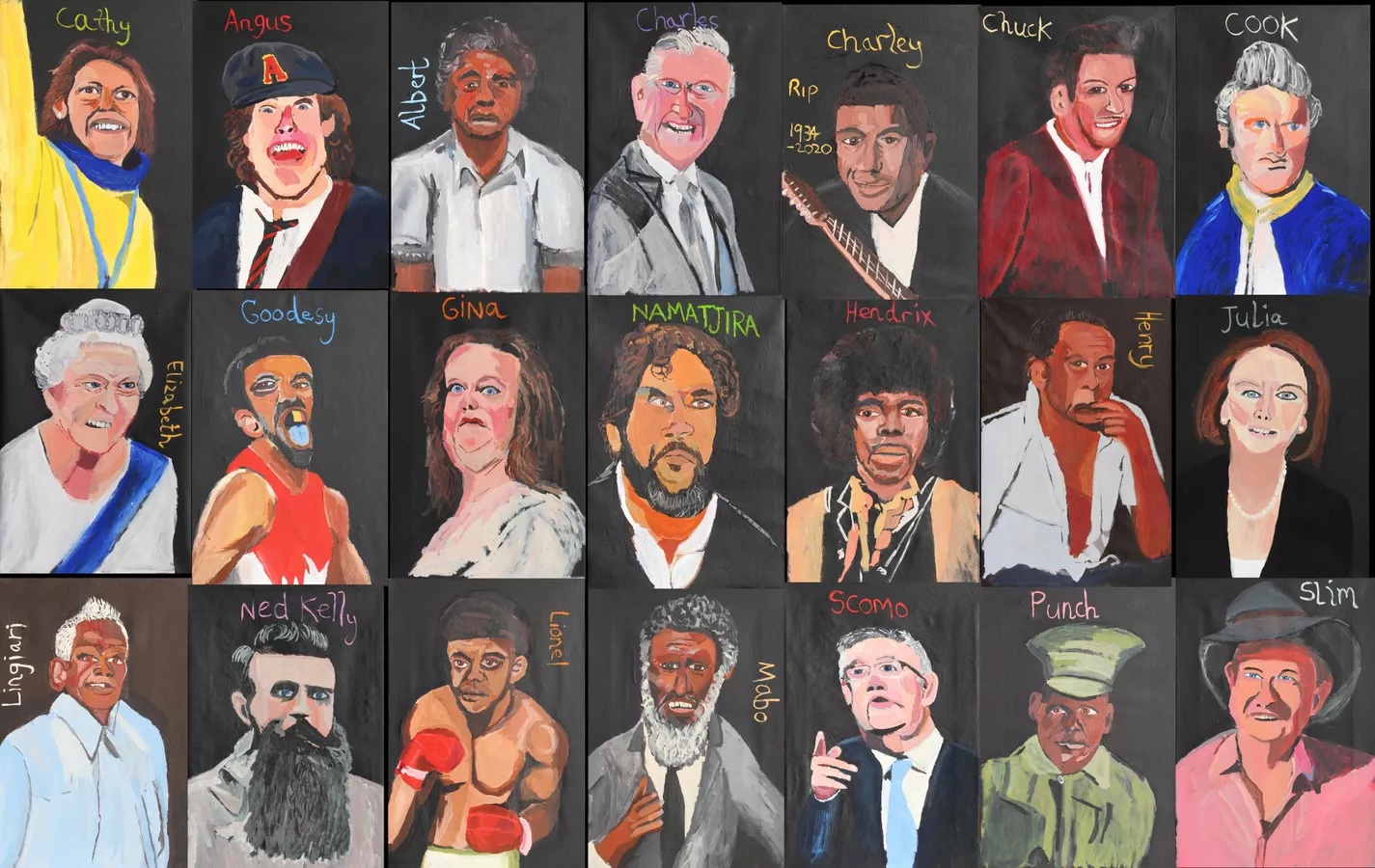
Kate explores how Australian artist Vincent Namatjira redefines portraiture to confront the legacies of colonialism while envisioning a more inclusive future—one expansive enough to embrace all Australians.

Clarke Reynolds (Mr. Dot) talks with the Art Review about interactive art, changing the narrative around blindness, and creating a world where art is more accessible for all.