May 1, 2026
Opinions
Opinions
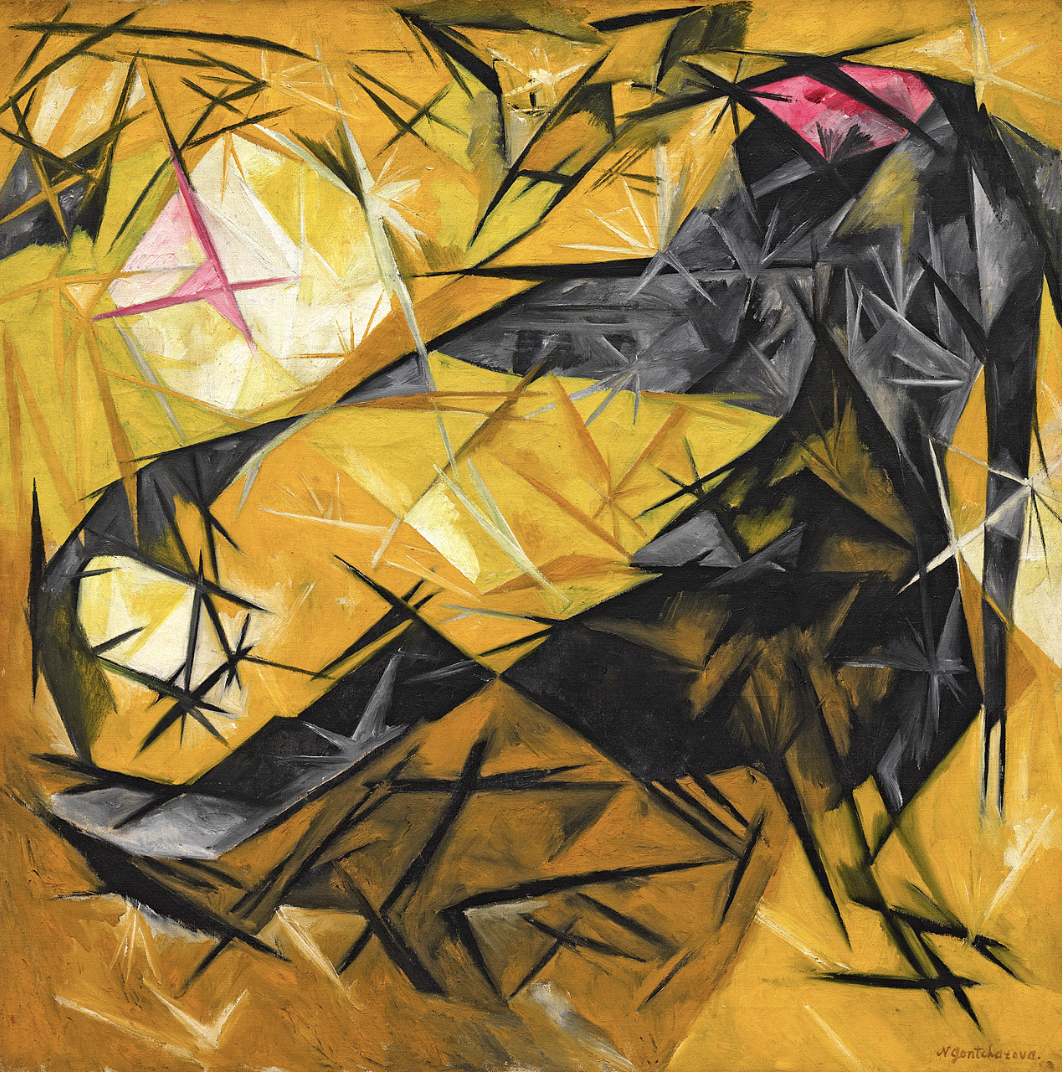
Cara explores how Natalia Goncharova redirects the ambitious, often technologically oriented rhetoric of Russian avant-garde abstraction toward an intimate and playful subject: domestic cats.

Kate explores how Australian artist Vincent Namatjira redefines portraiture to confront the legacies of colonialism while envisioning a more inclusive future—one expansive enough to embrace all Australians.

Since 1921, Australian artists have been vying for the chance to win $100,000 Australian dollars and lifetime recognition through the country’s most illustrious portrait painting award, the Archibald Prize. In 2020, Vincent Namatjira became the first Indigenous Australian to win the prize for Stand Strong for Who You Are, his portrait of Adam Goodes, an Indigenous Australian Football (AFL) player. When accepting the award, Namatjira stated, “It’s a bit hard to forget the past but we just have to keep on pushing forward. That’s what I want to say about the past, it’s way too hard to let go.” In his paintings, Namatjira does precisely this: his work is not divorced from Australia’s complicated history but instead utilizes it as a means of constructing a more optimistic, equal, and diverse vision of the nation. Largely painting portraits of cultural icons, Namatjira constructs a visual language that is both recognisably Australian and critically engaged with its histories.
By grounding his portraits in this shared popular imaginary, Namatjira makes a claim that traditional Australian portraiture has never been able to make: Indigenous experiences are not separate from mainstream Australian culture but are undeniably woven throughout it. In doing so, Namatjira reframes portraiture from a genre that has historically promoted colonial power into one capable of articulating a shared national identity. It is through precisely this reclamation, of a colonial genre remade in the visual language of everyday Australian life, that Namatjira's art feels uniquely, productively Australian.
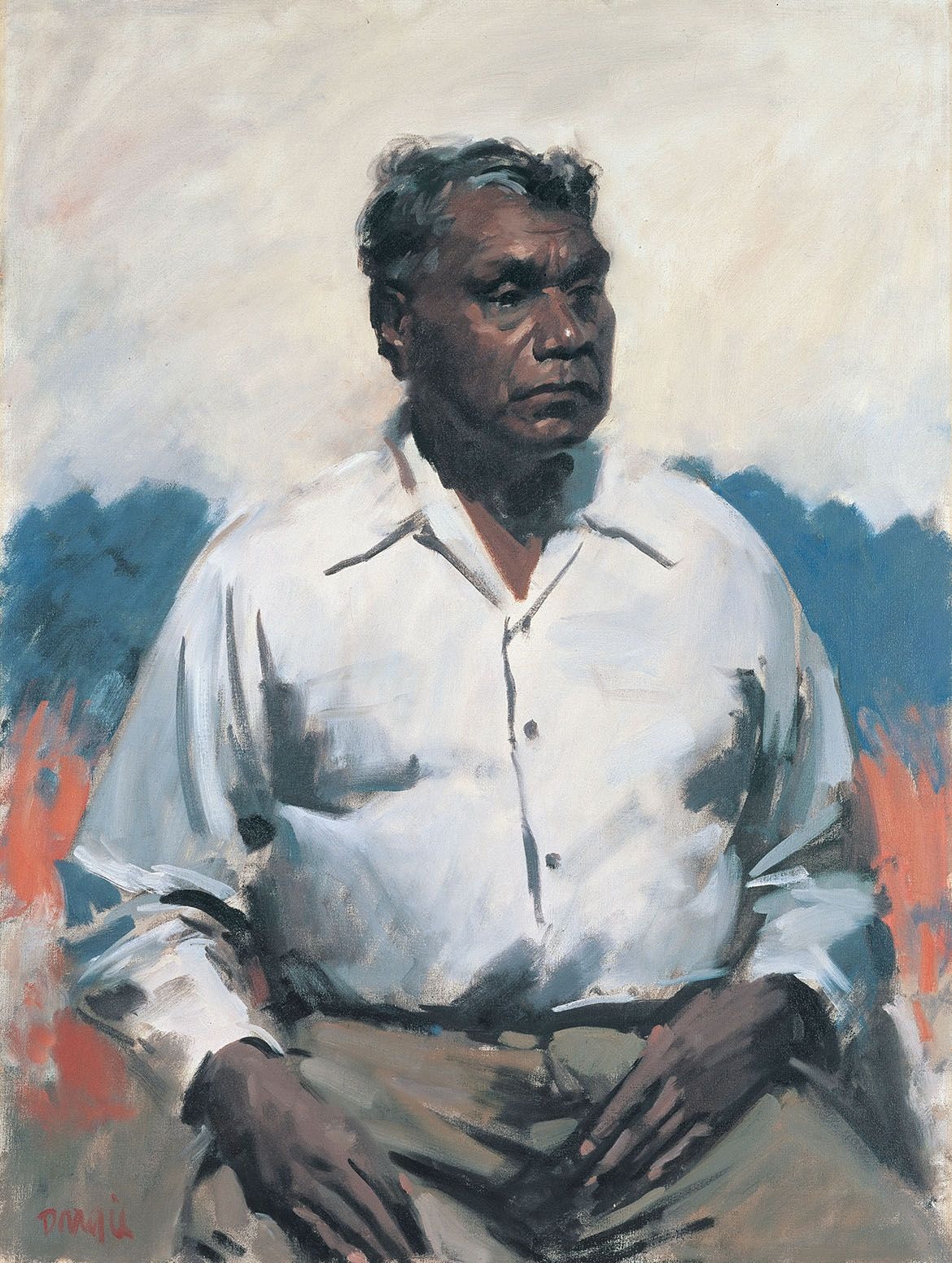
To understand the significance of this reclamation, it is necessary to understand what came before it. Vincent Namatjira is not the first artist in his family, nor historically the most widely known. In 1956, William Dargie’s portrait of Namatjira’s great-grandfather, Albert Namatjira, won the Archibald Prize, marking the first time a portrait of an Aboriginal person won the prestigious award. The elder Namatjira was a famed watercolorist who rose to popularity throughout the mid 20th century for his romantic depictions of the rugged Australian bush. Working in an era of intense tensions and state-sanctioned violence against Indigenous Australians, Namatjira faced many challenges throughout his career. However, his work was eventually recognised and praised by the masses, such that in 1957, he became the first Indigenous person to be granted Australian citizenship.
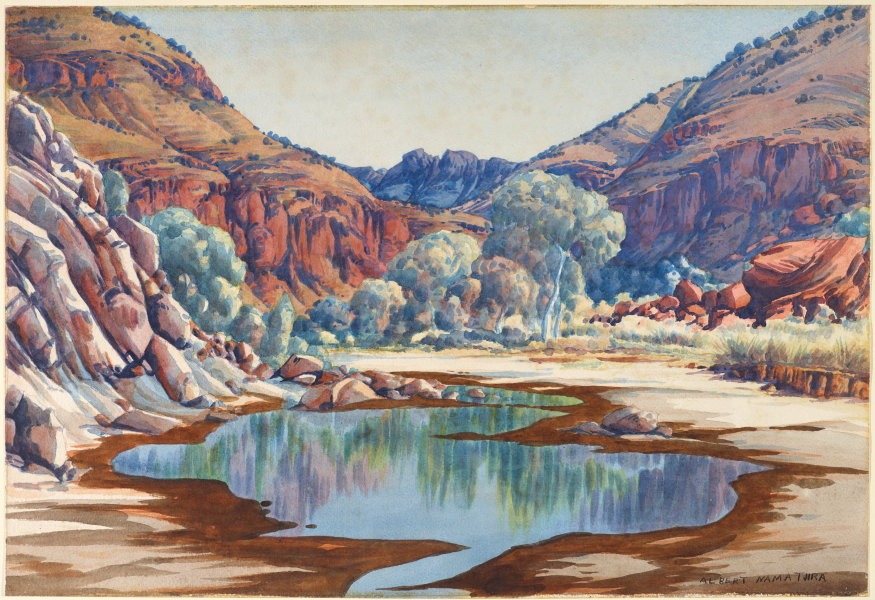
This success undoubtedly broke down cultural barriers within Australia; however, deep injustices remained ingrained within Australia’s aesthetic and political cultures. Namatjira gained recognition from his colonial audiences through rendering the rugged Australian landscape as romantic, vast, and unpopulated. That Namatjira’s paintings were welcomed into white middle-class living rooms, and even gifted to the British royal family, speaks less to a genuine reckoning with Indigenous presence than to the palatability of a tradition which appeared to confirm the land as open, available, and aesthetically familiar.
Portraiture, meanwhile, remained an entirely different and more explicitly political matter. A tradition arising out of European royalty and aristocracy, portraiture has long functioned as a means of cementing the authority, lineage, and social rank of those it depicted. As Europe extended its powers throughout the globe, portraiture followed. Elegant portraits of governors, generals, and colonial administrators established a visual hierarchy of who mattered in the new order. Where colonized subjects did appear within the genre, they did so not as subjects of power but as objects of documentation and ethnographic study.
Hence, as a new generation of Australian and Indigenous artists has risen to prominence, many have shied away from these genres steeped in colonial power dynamics. However, Vincent Namatjira has faced these issues head on, grappling with both his own lineage, and that of his country, through the traditions of oil painting and portraiture. Namatjira utilises the medium as a means to ‘look at [my] identity and [my] family history. It’s also a way for [me] to look at the history of this country, to ask who has the power, and why?’
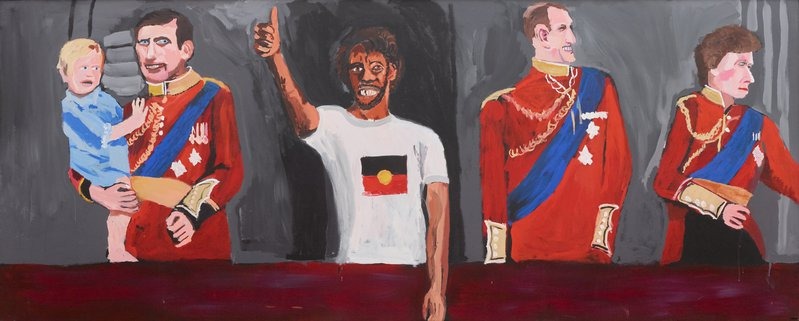
In his Royal Tour series, Namatjira reimagines Queen Elizabeth II’s 1953 coronation tour of Australia, during which the monarch bestowed Namatjira’s great-grandfather with the Queen Elizabeth II Coronation Medal for his contributions to Australian culture and arts. In these paintings, made during the COVID-19 pandemic, Namatjira utilized magazines, books and other mass-produced paper works featuring the British royal family. However, Namatjira brings his quintessential humor to the works by either inserting the royal family into the Australian outback or, conversely, inserting himself into scenes of royal pomp and ceremony. In The Royal Tour (the balcony), we see Namatjira on the famed balcony of Buckingham Palace—grinning, giving a thumbs up, wearing the aboriginal flag—no different than the British royals alongside him.
Rendered in Namatjira’s distinctive style, where expressive exaggeration veers on caricature, this painting presents a satirical assertion that Indigenous histories are equally as important to Australia as that of the British monarchy. In placing an Indigenous body in an environment where they are usually rendered invisible, Namatjira challenges the traditions of portraiture, as well as the audience’s assumptions of power, inserting himself into the iconography of empire with the ease of someone who was always meant to be there.
In another image from the series, The Royal Tour (Vincent and Elizabeth on Country), Queen Elizabeth II and a royal carriage are transplanted into the Australian outback, set against Uluru, surrounded by icons of Indigenous life, and joined by Namatjira himself. Where The Balcony inserts an Indigenous body into the heart of the British empire, this work inverts that gesture. By bringing the crown onto country, and stripping it of its typical ceremonial grandeur, the monarchy looks not powerful but displaced. Hence, Namatjira reminds Australian audiences where the nation's true foundations lie: not in distant colonial rule, but in the land, its people, and the culture that has always belonged to them.
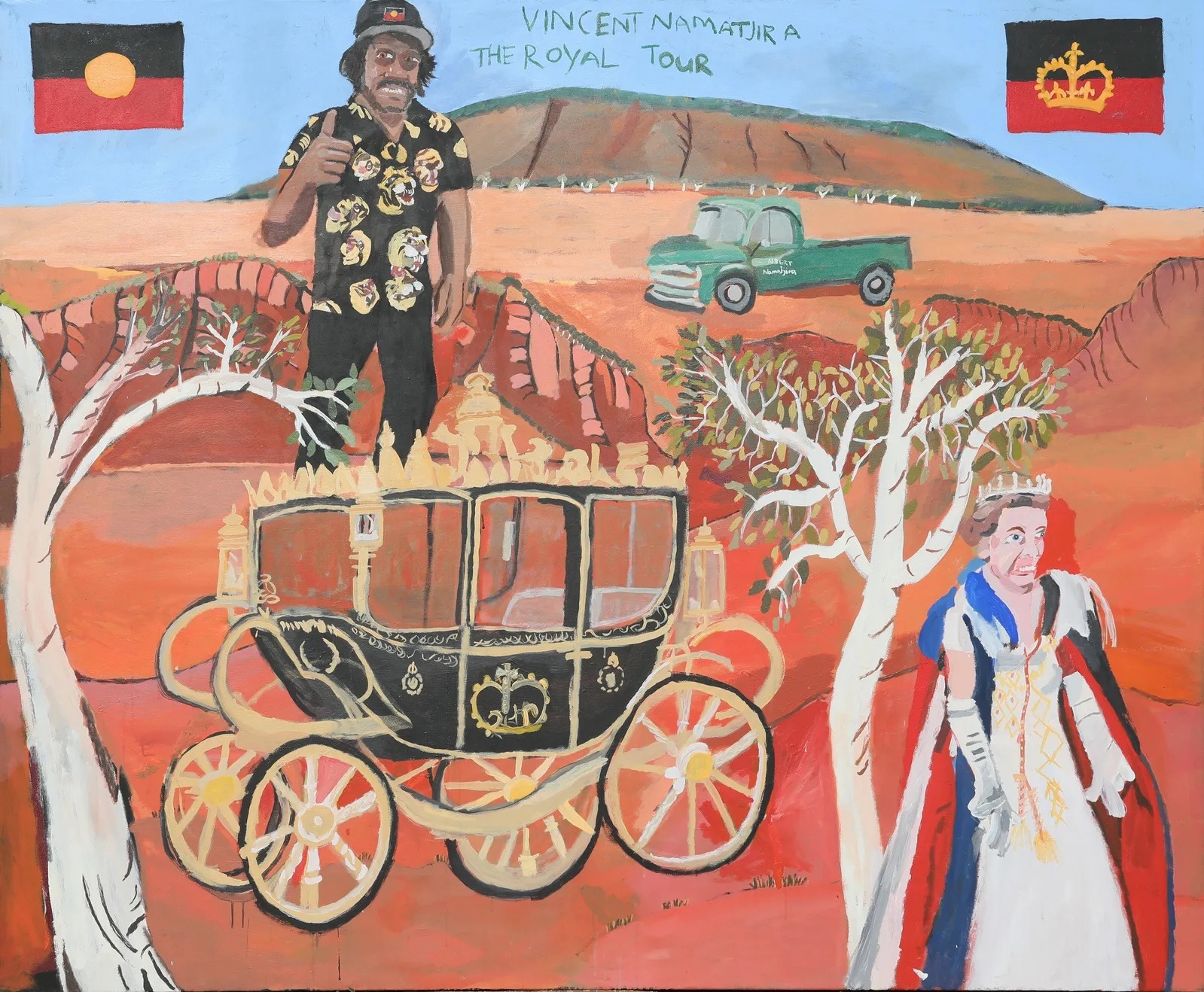
When speaking of the Royal Tour series, Namatjira states that “whenever [I] paint powerful figures like the royals, [I’m] trying to take away some of their colonial power and ownership.” These paintings disrupt the traditions of royal portraiture which typically extoll the power and grace of these figures. Instead Namatjira highlights the stark juxtaposition of their colonial rule with the reality of the nation, while asserting the importance of Indigenous Australians. Yet this message remains engaging, even optimistic, due to Namatjira’s style and the undeniable absurdity which characterizes these scenes.
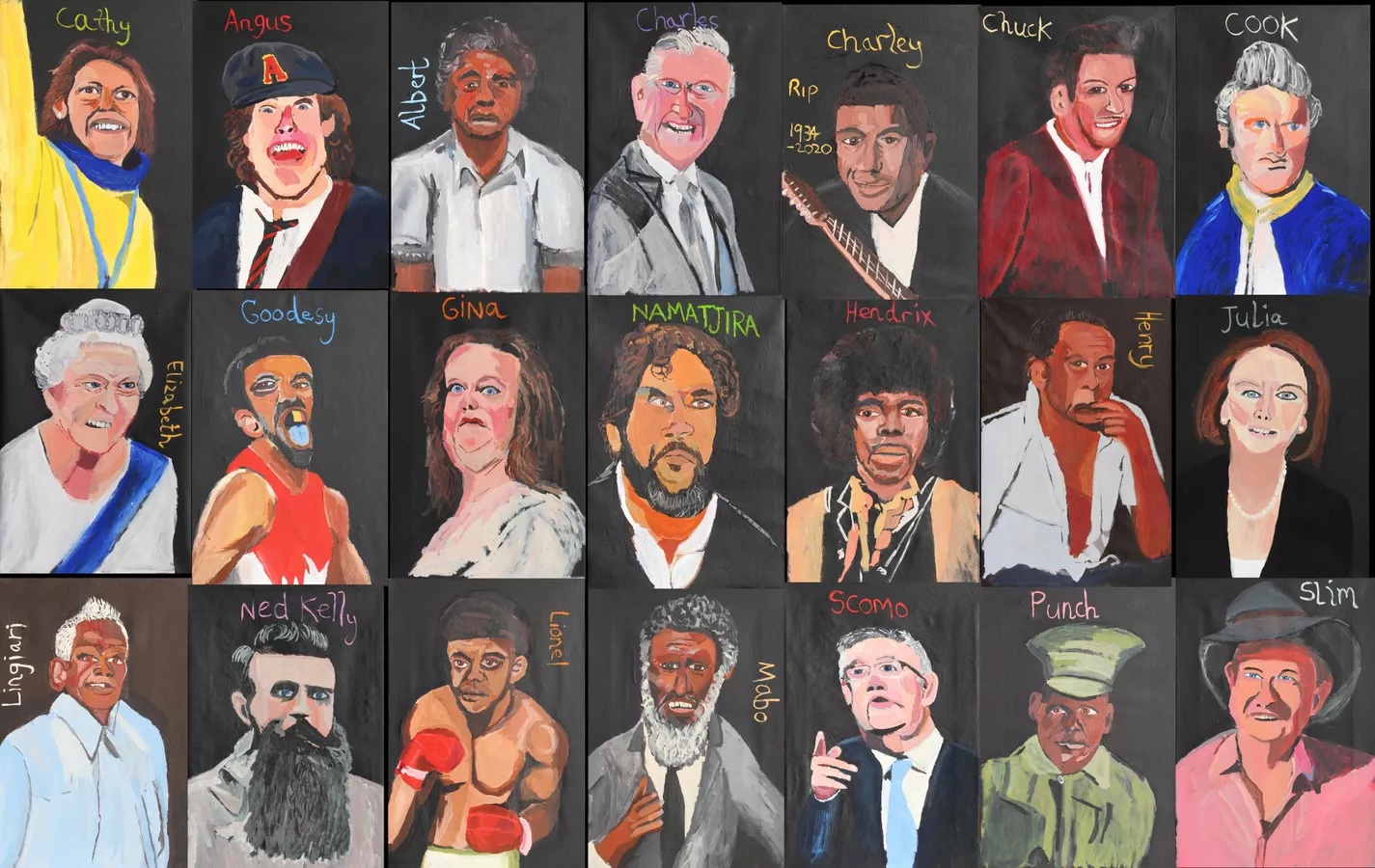
It is in his depictions of iconic figures from Australia's past and present that Namatjira most directly confronts the question of what it means to be Australian in the 21st century. Australia in Colour is a series of 21 portraits depicting significant people including politicians, historical figures, athletes, and musicians from Australia and overseas who Namatjira considers influential to either Australia or himself personally. The figures, ranging from Captain Cook to Eddie Mabo, dominate the canvas, and are each portrayed against a black background, identified by a first, last, or nickname. In this format, Namatjira presents a compelling argument that each of these figures are of equal importance. In his words, “it doesn’t matter whether you’re the queen of England or an old Gurindji man fighting for his land. Whether you’re a mining magnate, sportsperson, politician, musician, whatever – we are all equal here.”
However, Australia in Colour was not received without controversy. Gina Rinehart, Australia's wealthiest individual, demanded her portrait be removed from an exhibition at the National Gallery of Australia, objecting to its unflattering depiction. Her protests inevitably backfired, drawing greater attention to the artwork and to Namatjira’s practice. While his portrayal of Rinehart was undeniably uncomplimentary, this depiction merely followed the characteristics of Namatjira’s now-iconic style, applied consistently to all twenty-one subjects in the work. This manner is not merely offensive or naïve but is a highly intentional and integral element of Namatjira’s practice. Marked by flatness, bold color, and expressive exaggeration of figure’s faces, Namatjira departs from the visual grammar that traditional portraiture uses to confer authority and gravitas. Through this, Namatjira refuses to exempt the powerful from the same humanizing scrutiny he extends to everyone else, making the style itself an argument about equality rather than simply an aesthetic choice.
The result is that Australia in Colour (cover image) operates not merely as a collection of portraits, but instead as a portrait of Australia, as it has been shaped through influential figures over the past 200 years. In rendering them all equal, the colonizer and the colonized, the magnate and the activist, Namatjira neither dissolves nor disregards tensions in Australian history. Instead, he demands these figures be faced as equals alongside one another.
While Australia in Colour gained global media attention for its controversy, Namatjira’s status was cemented with a piece that the whole country could stand behind, the Archibald-Prize winning painting, Stand Strong for Who You Are. At its centre, Goodes and Namatjira clasp hands in the foreground, their bodies turned outward toward the viewer in a gesture that is less a private exchange than a public declaration. Behind them, three depictions of Goodes occupy the background: mid-game in his Sydney Swans kit; lifting his jersey in a gesture of defiance echoing Nicky Winmar's iconic 1993 stance; and on the far right, holding the Aboriginal flag up high.
Namatjira's decision to paint Goodes is twofold. As one of the most celebrated AFL players of his generation, Goodes represents the form of cultural expression around which ordinary Australians rally. Unlike fine arts, which has long been reserved for the educated elite, sport is the medium through which many Australians relate to one another and come together as a nation. Yet Goodes symbolises more than the importance of sport in Australia, his career having been marked by a number of racialized controversies. Namatjira's decision to place Goodes at the centre of Australia's most prestigious portrait prize, restores to him the public dignity that he was so loudly denied.
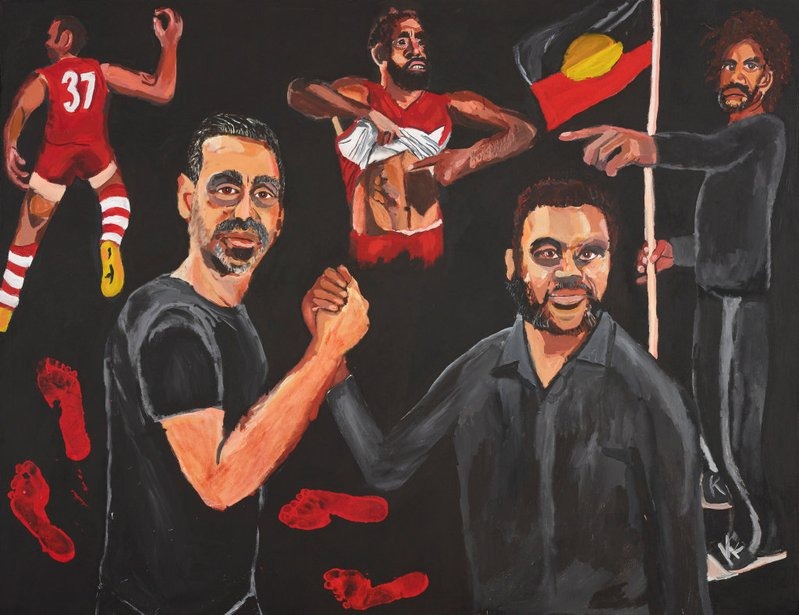
At the centre of the work, Namatjira and Goodes shake hands, thus engaging in an act associated with centuries of colonial assimilation. Here, Namatjira inverts the power dynamic: it is the Indigenous artist who extends recognition to the Indigenous subject, in his own visual language and on his own terms. Rather than positioning Indigenous Australians as passive recipients of representation, Namatjira insists on their active role in constructing it.
This scene, and its subjects are rendered almost exclusively in shades of black, red, and yellow, the same shades that make up the Aboriginal flag. The flag holds great symbolic weight, which Namatjira here uses to transform the painting from a personal portrait into a statement of collective identity. This palette, as well as the red footprints which trail through the canvas’s lower third, evoke long histories of the connection between Indigenous Australians and the Australian land. Through these associations, Goodes as a subject, and Namatjira’s accessible and distinctive style, Stand Strong for Who You Are achieves what the Archibald Prize has long promised but rarely delivered: a portrait of Australia that belongs to all of it.
That Stand Strong for Who You Are was celebrated by the very institution whose genre it sought to challenge is itself a significant cultural moment. The Archibald Prize, the National Gallery of Australia, and the broader apparatus of Australian fine art were built to serve a particular vision of the nation. That Namatjira's work has been embraced by these same institutions is testament to the fact that Australia is a different nation to that which his great-grandfather endured, and that its art is rapidly coming to reflect this.
By appealing to the imagery and subjects of the popular Australian imaginary, Namatjira speaks directly to audiences who have otherwise been alienated by the often abstract and esoteric concerns of contemporary fine art. His work does not demand that Australians confront their history with shame, but instead he promotes a national identity which encourages productive discourse and equality between all. In doing so, Namatjira has achieved something rare: an art that is politically serious and genuinely popular, that carries the weight of the past without being crushed by it, and that imagines a future capacious enough to hold all Australians within it.
(Cover Image: Vincent Namatjira, Australia in Colour, 2021, synthetic polymer paint on linen, 237.5 x 379.5cm. via National Gallery of Australia)
Cara explores how Natalia Goncharova redirects the ambitious, often technologically oriented rhetoric of Russian avant-garde abstraction toward an intimate and playful subject: domestic cats.
Kate explores how Australian artist Vincent Namatjira redefines portraiture to confront the legacies of colonialism while envisioning a more inclusive future—one expansive enough to embrace all Australians.

Clarke Reynolds (Mr. Dot) talks with the Art Review about interactive art, changing the narrative around blindness, and creating a world where art is more accessible for all.