May 1, 2026
Opinions
Opinions
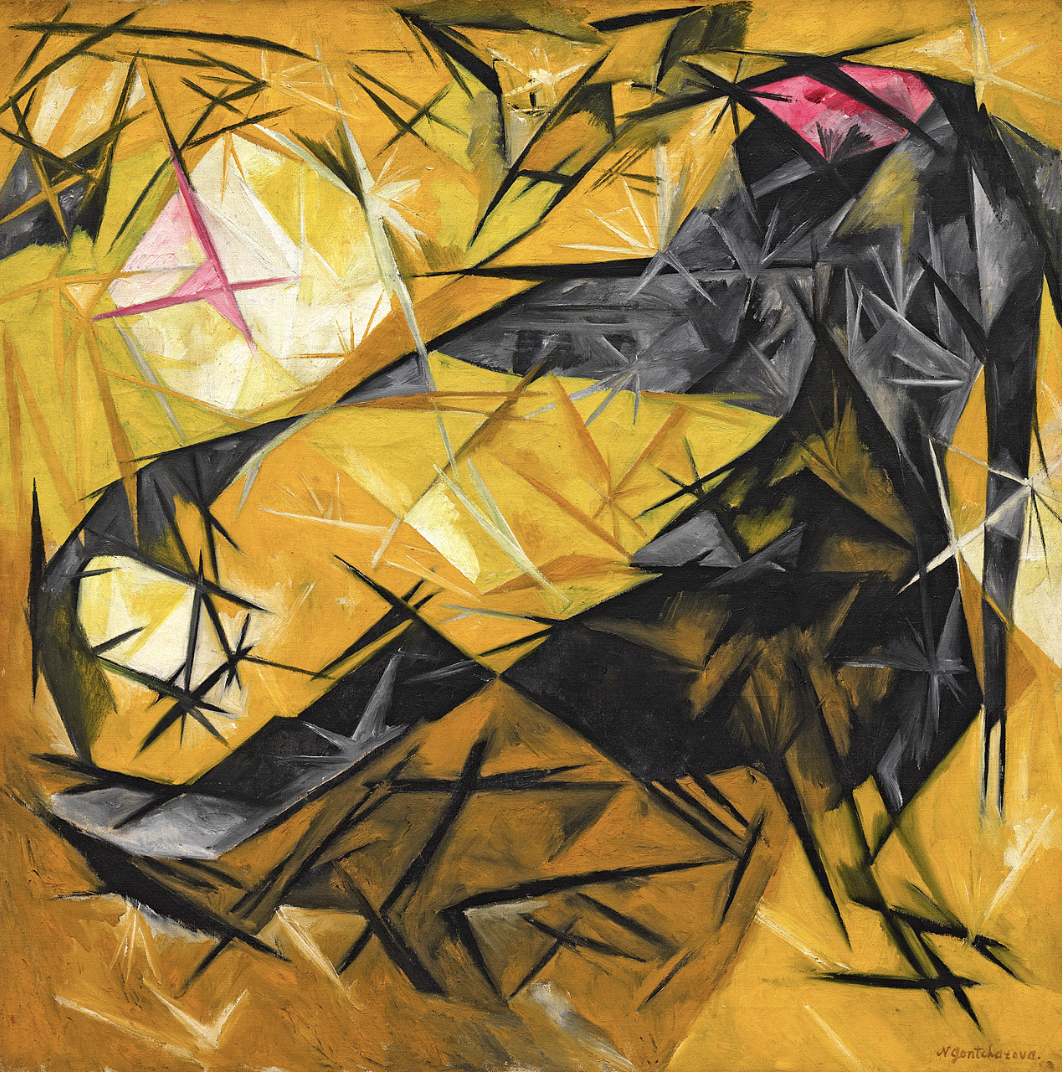
Cara explores how Natalia Goncharova redirects the ambitious, often technologically oriented rhetoric of Russian avant-garde abstraction toward an intimate and playful subject: domestic cats.

The many visual elements of Camille Pissarro’s Field and Mill at Osny (located in the RISD Museum) express the conflicts present between humanity and nature during the Industrial Revolution at the end of the nineteenth century.


Field and Mill at Osny (Figure 1) is an oil painting on canvas, created by Camille Pissarro in 1884. It was painted in France and now resides in the Rhode Island School of Design (RISD) Museum in Providence, Rhode Island. The artwork is 21 ⅜ by 25 13/16 inches in size. The composition of this work is divided into three sections: the field, the trees and building, and the sky. Moving through these sections, the viewer is drawn in and prompted to reflect on humanity’s relationship with nature, in light of the growing Industrial Revolution during the nineteenth century.
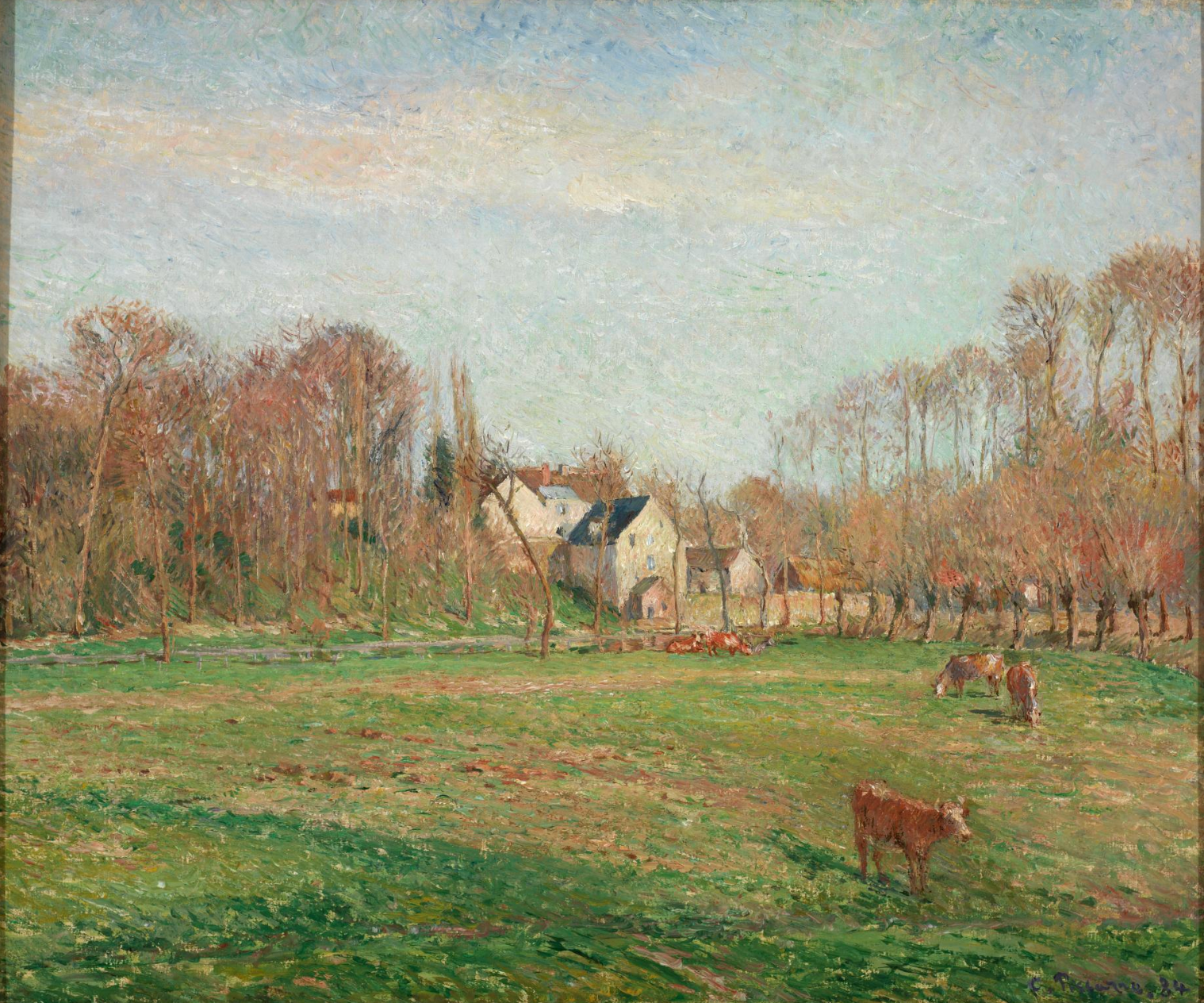
The preliminary entry point into the painting, a foregrounded field, creates an initial feeling of both distance and intrigue for the viewer. There is intentional variation in the field, showing where the grass has become worn and faded, as well as where the cows have compacted the land down to mud. Shadows outline modest rolling hills and bumps along the turf, one of which the viewer is set to rest on, looking slightly downwards at the scene. The grass around the viewer is particularly pristine and luscious, implying their distance from the worn-down agricultural land. The field is both detailed and obscured at the same time; the brushstrokes are obvious but quite small, creating a somewhat misty, yet still precise image. Three groupings of rusty, red-orange cows are a complementary color to the vibrant green grass, providing another stark contrast. The furthest group grazes in front of the house. Two stand slightly more forward on the right side, with heads absorbed in the field, drawing the viewer's attention to the expanse of grass. The foremost cow is the clearest, and is looking up at the viewer. It has a seemingly sceptical eye for the viewer/artist infiltrating its space.
All of this displays the simultaneous beauty and uncertainty of agriculture. Pissarro paints this field in a way that shows the field’s imperfections in an alluring light. Humans have always relied on nature and animals to live, but the Industrial Revolution began to shadow this fact with the growth of industry and reliance on new technologies and machines. Yet, in this painting, Pissarro reinforces these innate truths about nature. He shows, in this field, that although a life of agriculture may not be as prominent as it once was, it still has a space in the world and is a necessary and prepossessing thing.
Above the field, a line of scraggly trees encompassing the mill shows potential problems with humanity's imposition on nature. The barren trees are quite thin and appear to be blowing in the wind. Some are even bent at the trunk. The trees are taller at the edges of the painting, and are shorter and more sparse towards the center. This draws the eye inward towards the mill, which looks sturdy and solid amidst the weak trees. The white of the house contrasts starkly with the setting’s natural tones. This mill represents human presence on this land. While this building is the headquarters of this property, it is also where the biggest threat to the space is located - humans. With the expansion of cities in the Industrial Revolution, places such as this field were commonly taken over with more and more buildings, eventually consuming the land and driving away nature. Pissarro presents this tension in the sparse tree line, which is interrupted by the central mill. Its presence is foreboding amidst this tranquil scene. The mill’s sharp outlines and artificial white color stand out against the natural subtleties elsewhere in this view. This ultimately reflects on the human impact, showing its imposing nature.
The final section of this work is a long and serene sky, a simple and peaceful area untouched by human hand. Pissarro places this horizon line about halfway across this painting, allowing the sky to consume the upper half of the work. It is a pale shade of blue, with a few sweeping cream clouds straddling the atmosphere. The upper line of the sky is more deeply colored; this mirrors the darker edge of the field line and further draws the viewer’s eye in toward the center point. It creates a sense of symmetry, making the painting feel more cohesive. Additionally, Pissarro’s poignant brush strokes sweep in different directions across the sky, creating the illusion of wind, which further adds to the immersiveness of this scene. The sky is quite simple, but that adds to its beauty.
By including so much sky, Pissarro emphasizes that this atmosphere is one place where humans cannot build or create concrete changes. Even with all of the changes happening due to the Industrial Revolution, the sky remains faithful to how it has always been, and it acts as a symbol of solace despite the shifting world. While the prominence of smog may have grown in cities, it is not the same effect as a permanent building. The sky cannot be functionally altered. The viewer is left with a sense of peace and hope in the natural world.
In conclusion, Pissarro’s Field and Mill at Osny from 1884 guides the viewer to contemplate the importance of nature for humanity. Especially considering the Industrial Revolution’s growth during the nineteenth century, this painting's visual composition directs spectators to meditate on their relationship with nature. The three sections each have a different function in this goal. While the bottom field represents humanity’s reliance on nature in the form of agriculture, the middle tree line surrounding the mill illustrates the impact of intrusive human presence. Above, the sky provides a sense of hope in an unchanged atmosphere, reconnecting viewers with the beauty of the natural world. This painting is a captivating meditation on our human reliance on, effects, and perceptions of nature.
(Cover Image: Camille Pissarro, Field and Mill at Osny, 1884, Oil on Canvas via the Rhode Island School of Design Museum, Providence, RI.)
Cara explores how Natalia Goncharova redirects the ambitious, often technologically oriented rhetoric of Russian avant-garde abstraction toward an intimate and playful subject: domestic cats.
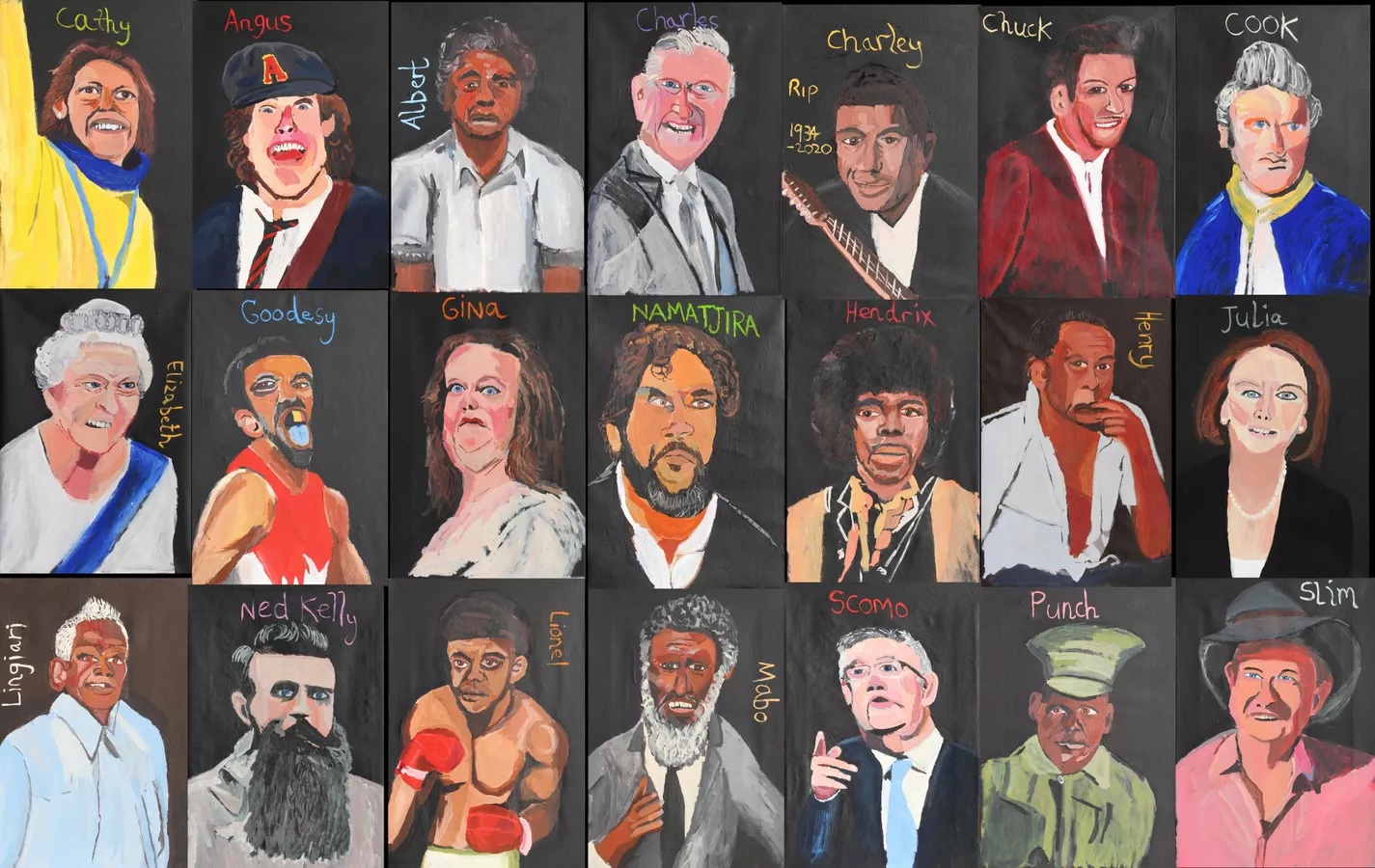
Kate explores how Australian artist Vincent Namatjira redefines portraiture to confront the legacies of colonialism while envisioning a more inclusive future—one expansive enough to embrace all Australians.

Clarke Reynolds (Mr. Dot) talks with the Art Review about interactive art, changing the narrative around blindness, and creating a world where art is more accessible for all.