_(ADVERT_137).jpeg)
May 1, 2026
Opinions
Opinions
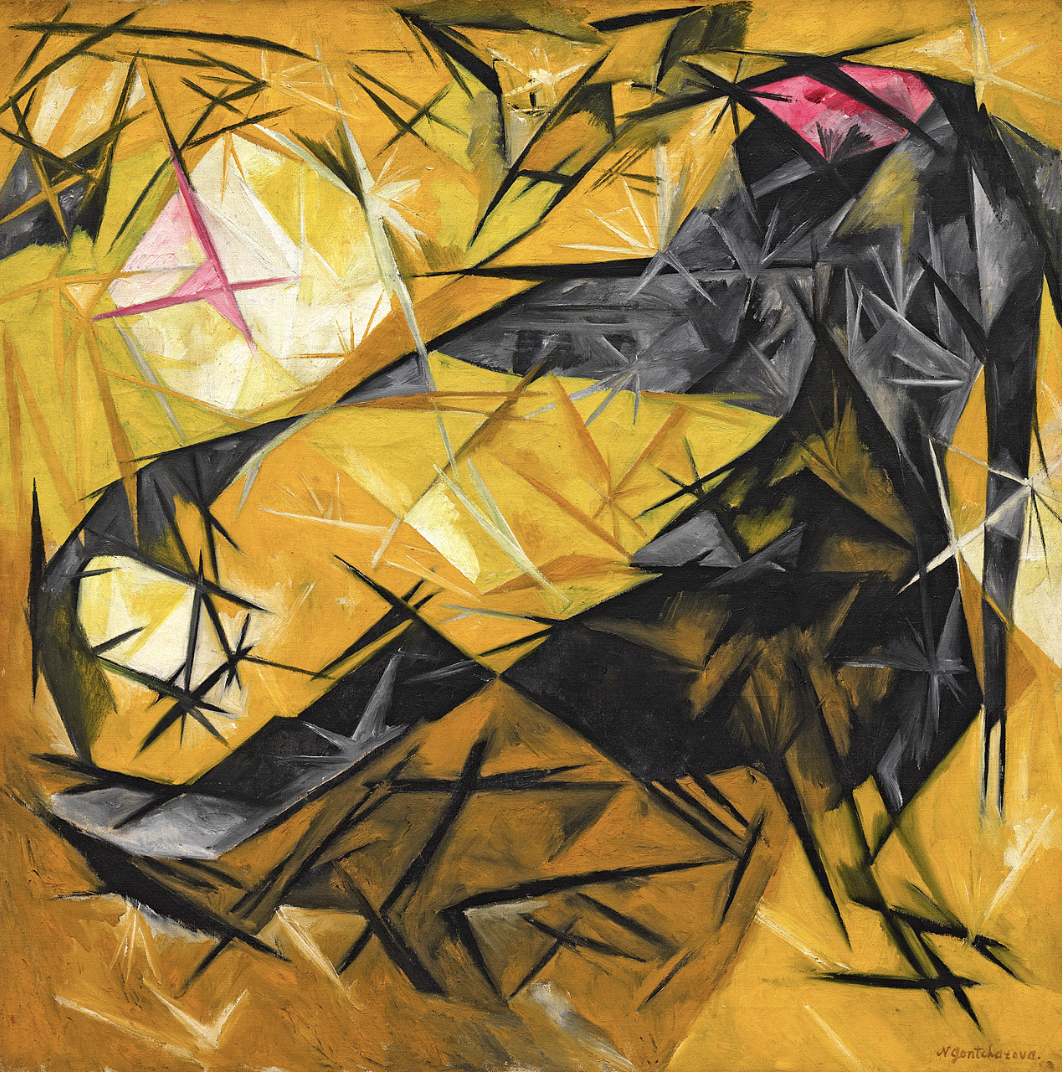
Cara explores how Natalia Goncharova redirects the ambitious, often technologically oriented rhetoric of Russian avant-garde abstraction toward an intimate and playful subject: domestic cats.

At the "Wuthering Heights" UK Premiere, Margot Robbie divided the internet with her outfit: a dress made of hair and a replica of a piece of Victorian mourning jewelry made from Emily and Anne Brontë's hair. Camille looks to the RISD Museum's jewelry collection, investigating how 19th-century families turned locks of hair into sentimental, stunning jewelry and unravels a 200-year-old mystery buried in braids, brooches, and one forgotten little girl.
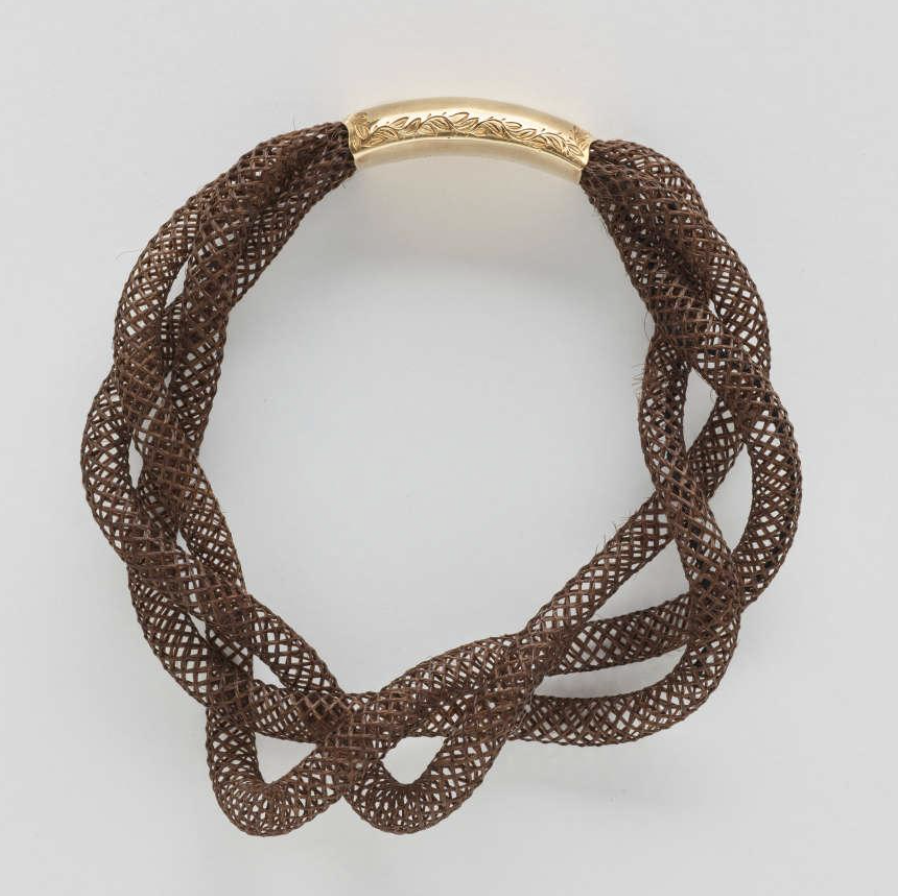

Is that…real human hair? In a museum collection? Yes, it is, but don’t click away just yet!
Between the 1830s and the early 1900s, jewelry made from human hair adorned the necks, wrists, and lapels of many Victorian-era (1837–1901) men, women, and children. Hair jewelry (also called hairwork) was a common, if not beloved, form of memory-making in Victorian times; it could be used to signify one’s friendship or mark important events, among many other functions. In Chapter 27 of Anne of Green Gables, Anne Shirley begged her friend Diana for “a lock of thy jet-black tresses in parting to treasure forevermore.” Queen Victoria had a bracelet, gifted to her by Prince Albert, that celebrated each of her children’s births with a lock of their hair contained in nine separate enamel lockets. Even Napoleon wore a watch chain of Queen Marie Louise’s hair and instructed, in his 1821 will, that pieces of his own hair be preserved and passed down to his son and wife. But as much as hairwork jewelry flourished in Europe, it had its own strong presence in the United States.
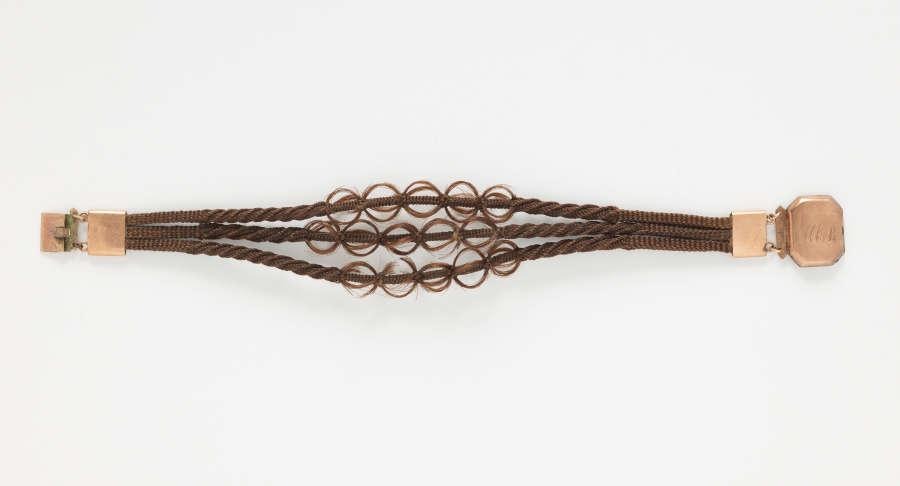
In the RISD Museum’s collection, we have more than 30 pieces of hairwork jewelry, ranging from finely woven bracelets (10.099.1) to decorated brooches (02.009). Three portrait miniatures in our collection, depicting Helen Metcalf (2012.107), Lydia Allen (09.122), and Captain Samuel Snow (1998.22), actually contain the hair of the sitter and were made when they were still alive. Many accessories like these were meant to be keepsakes and tokens of remembrance, familial affection, or love.
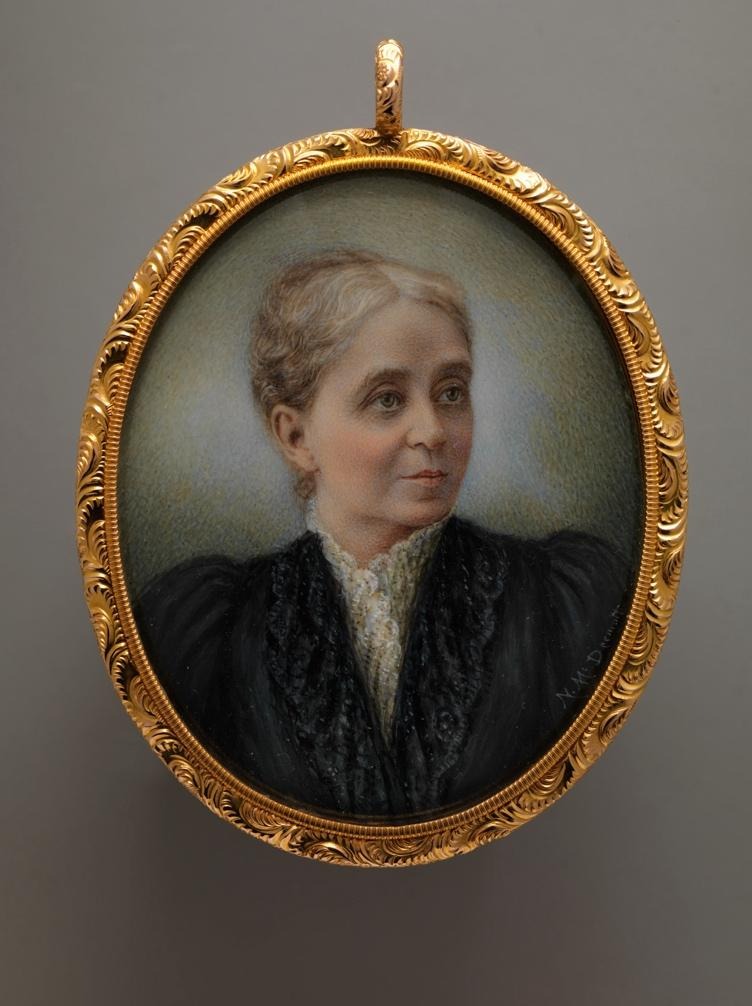
The most common form of hair jewelry that we are familiar with today is a subset called mourning jewelry. While many examples of mourning jewelry depicted symbols of death like skulls and weeping willows beside graves (also known as memento mori) within their intricate and widely popular designs, some pieces of mourning jewelry simply contained the engraved names and death-dates of the departed. Though they were simple, this does not mean that these pieces of mourning jewelry were any less important to their wearers. Most of the time, hair jewelry was a custom relegated to the upper classes of Victorian society, since many of the materials involved in making hair jewelry (e.g., gold and mother-of-pearl) were expensive. Following in the strict traditions of Victorian mourning custom, locks of hair were often, but not always, worn as part of mourning attire as public expressions of private mourning and tangible ways to immortalize a deceased loved one.
Sometimes, pieces of hair jewelry would be given to family members or very close friends: a notable example is when Eliza Hamilton gave Nathaniel Pendleton (1756-1821, Hamilton’s second in the Burr duel) a mourning ring with a lock of her husband’s hair. As hair does not decay, this act of giving hair jewelry served to immortalize and memorialize the departed in Victorian cultural memory. As mourning jewelry grew in popularity during the mid-19th century, it fostered the growth of an international market, with many skilled hair jewelers offering their services through newspaper advertisements.

Five pieces of mourning hair jewelry (62.086.1, 62.086.2, 62.086.3, 62.086.4, 62.086.5), including the necklace pictured at the beginning of this article, were donated to the RISD Museum by Mrs. Margaret Elisabeth Hamlin, née Beck, (1907-1999) in 1962. Interestingly enough, none of the jewelry in Mrs. Hamlin’s collection seems to have been passed down from her side of the family. Based on their inscriptions, it appears that most (if not all) of these pieces were passed down from her husband’s side, which descended from Hannibal Hamlin (1809-1891), Abraham Lincoln’s Vice President from 1861 to 1865.
How do we know this? While jewelry does not typically have the same makers’ marks or provenance (ownership history) records that other ceramics or paintings in the museum’s collection may have, three of the five pieces of jewelry from the Hamlin collection do have identifiable marks, including pictures, names, and dates related to the presumably deceased.
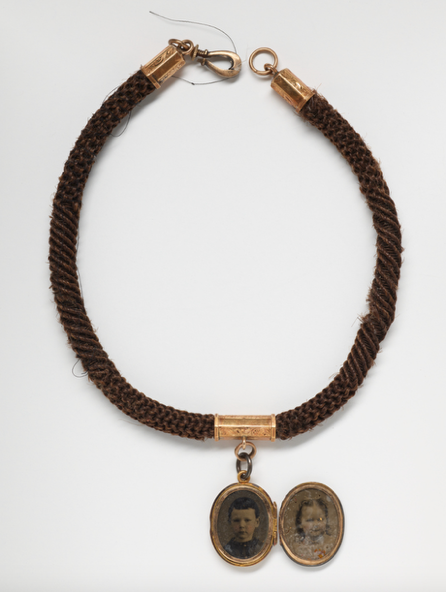
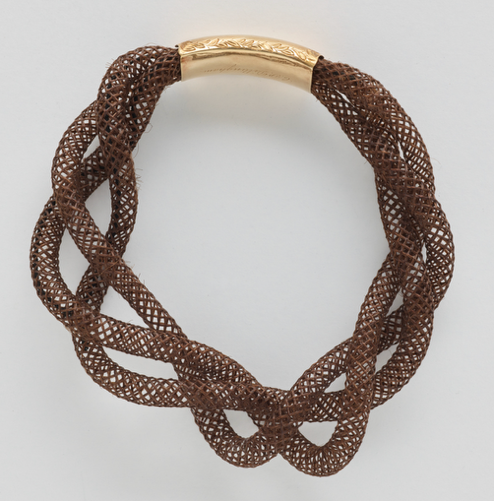
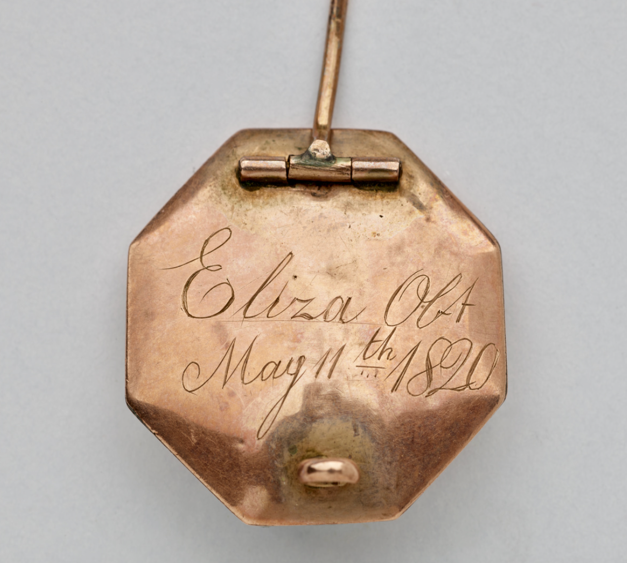
So, how did three pieces of jewelry with seemingly unrelated names and photographs to the Hamlin family come into Margaret’s possession? Where did they come from? Whose hair is in these pieces? At least for one out of the three pieces of jewelry with such unique identifying marks in the RISD Museum’s collection, I might have an answer.
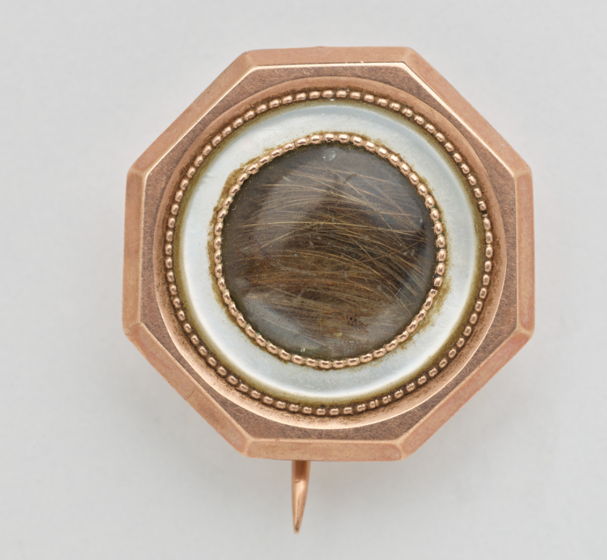
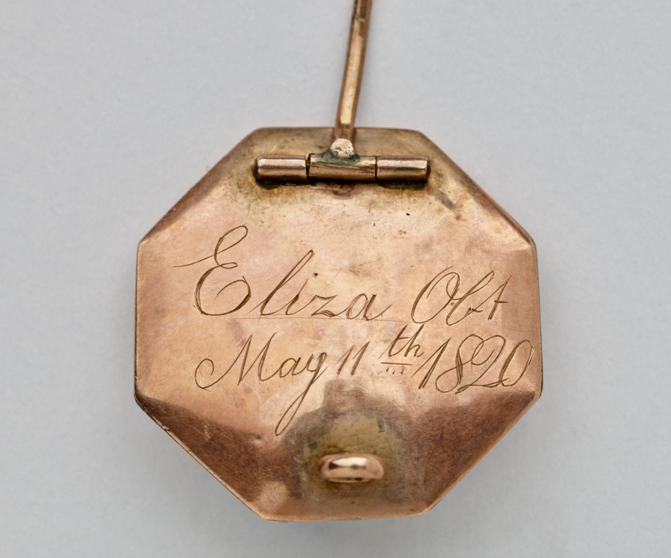
This gold pin with a lock of hair, likely made in the 1820s (62.086.5), has an inscription on the back reading Eliza Obt (coming from the Latin obiit, meaning he/she died) May 11th 1820. Based on my research, this person is likely 2-year-old Eliza Ann Tilton, who was born in Chilmark, Martha’s Vineyard in August 1817 and died in Livermore, Androscoggin County, Maine in 1820. (then Massachusetts)
Many members of VP Hannibal Hamlin’s family, including his three eldest siblings and his mother, Anna (née Livermore, and great-grandmother-in-law of Margaret), were also born in Livermore. Anna was the daughter of Deacon Elijah Livermore, who co-founded the town of Livermore in 1795. Elijah, his wife Hannah (née Clark), and many of their children were buried in the same cemetery as Eliza Ann Tilton, which leads me to believe that these two families might have known each other as neighbors.
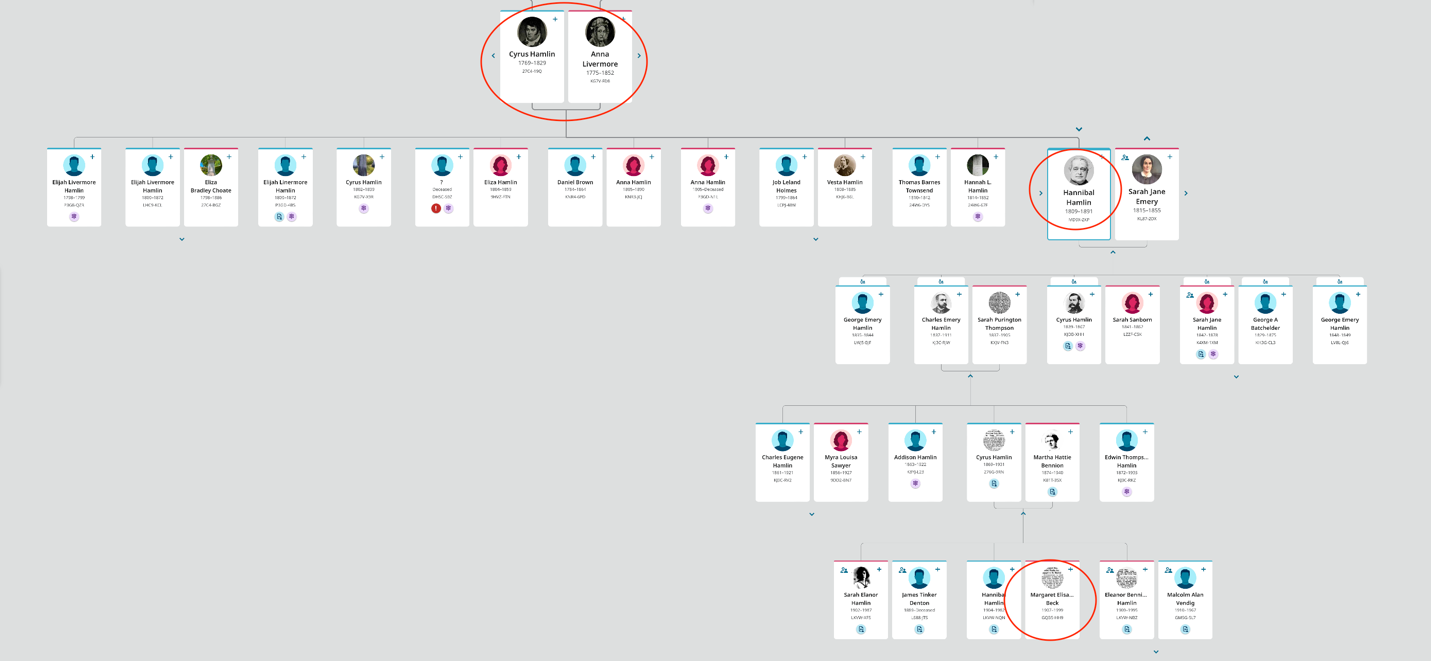
So now the question becomes, how were the two families related so that Margaret Hamlin would, in the 1960s, have a piece of mourning jewelry from Eliza Ann’s death in 1820? In 1795, Cyrus Hamlin (Anna’s husband and a Harvard-educated physician) was invited to Livermore to be the town’s physician, according to an invitation reproduced in The Hamlin Family; a Genealogy of James Hamlin of Barnstable, Massachusetts. Dr. Hamlin’s practice was “celebrated for skill in the treatment of diseases of children” and he gained the “esteem of his fellow citizens.” When he and Anna married in 1797, many talked about “the doctor and his charming wife, the center of the county social society.” Anna was a “charming hostess, an interesting conversationalist, and…a devoted wife and mother” who “won the love and esteem and grateful remembrance of the neighbors, so closely intimate with her life.”
Given that hair jewelry was typically given to family members and very close friends who were in attendance during funerals, there are multiple ways this object could have made its way into Cyrus Hamilton's hands. Perhaps the Tiltons were acquainted with the Livermores as neighbors, since they lived in the same city around the time (the early 1820s). Maybe Cyrus Hamlin treated Eliza Ann Tilton before her death (her cause of death is unspecified), as a poem written about him noted that he “welcome[d] strangers from afar.” Or there might be a possible familial relation between the families (either close or distant) that I have yet to uncover.
While we may never know the depth of grief or the intimate bonds that tied Eliza’s friends and family together, this hairwork pin—decorated with a lock of her hair and mother-of-pearl, which was traditionally linked to children and unmarried women—we are left with the silence that surrounds a mourning family’s sorrow and a community’s shared loss. In these subtle details, the glimmering setting and her tawny hair, we feel the emotional weight shouldered by those who once knew Eliza Ann Tilton, reminding us that beyond what the records may share with us lies the very real and raw human experience of love, loss, and remembrance. Beyond being something eccentric or weird within the Museum’s collection, the pieces in the Hamlin group hold all the details of these untold stories (records of lives, loves, identities, and communities) that exist within each strand of plaited and coiled hair.
So, the next time someone asks, “Is that made from real human hair?”, answer an enthusiastic, “Yes!” and ask them in return, “What does it mean to wear part of another person’s body as personal ornament? And why was hair—something so personal and individual—considered sentimental and socially appropriate?” While at first glance hair jewelry may feel unsettling to our modern conceptions, these brooches, bracelets, and necklaces each tell incredible stories about how people in the 19th century once celebrated their communities, expressed their identities, and honored remembrance through sentimentality.
But beyond hair jewelry, this framework extends to any piece of jewelry you see in a museum’s collection. Who wore it?Who passed it down? and Who did it belong to? are all valid questions when we probe deeper into the history of jewelry in any collection, private or public. It only takes one curious eye to notice something interesting and try to find out more about it. And it is those curious eyes that return those lost stories and reclaim these families’ voices for centuries to come.
The author extends special thanks to Emily Banas, Curator of Decorative Arts & Design at the RISD Museum, for the ability to conduct this research into the Hamlin collection, during Summer 2025, when she was the Decorative Arts & Design Curatorial Intern (specifically in Jewelry) at the RISD Museum.
(Cover Image: Unknown Maker (American), Bracelet, ca. 1840, hair and gold, (RISD Museum, 62.086.3).)
Cara explores how Natalia Goncharova redirects the ambitious, often technologically oriented rhetoric of Russian avant-garde abstraction toward an intimate and playful subject: domestic cats.
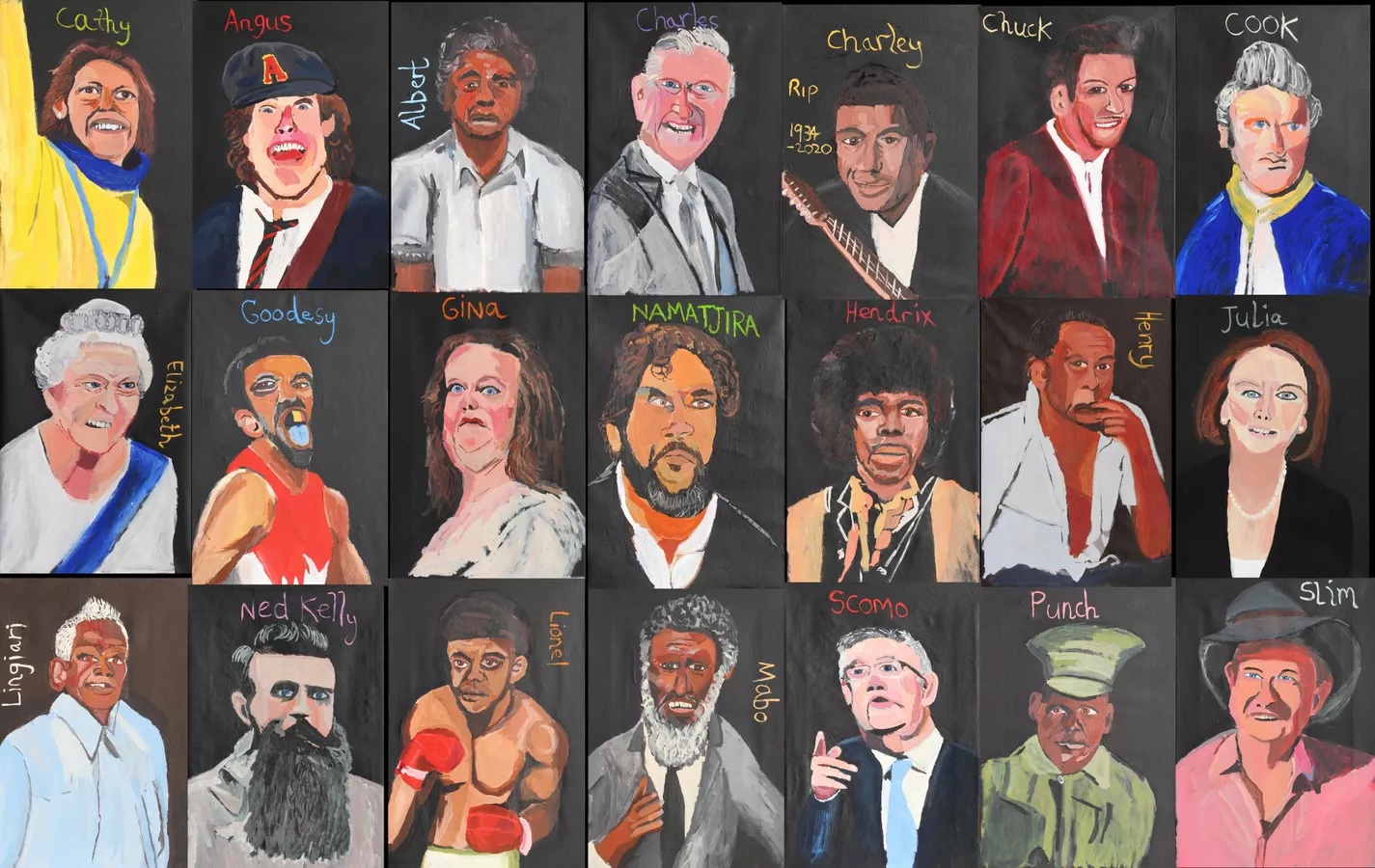
Kate explores how Australian artist Vincent Namatjira redefines portraiture to confront the legacies of colonialism while envisioning a more inclusive future—one expansive enough to embrace all Australians.

Clarke Reynolds (Mr. Dot) talks with the Art Review about interactive art, changing the narrative around blindness, and creating a world where art is more accessible for all.