
May 1, 2026
Opinions
Opinions
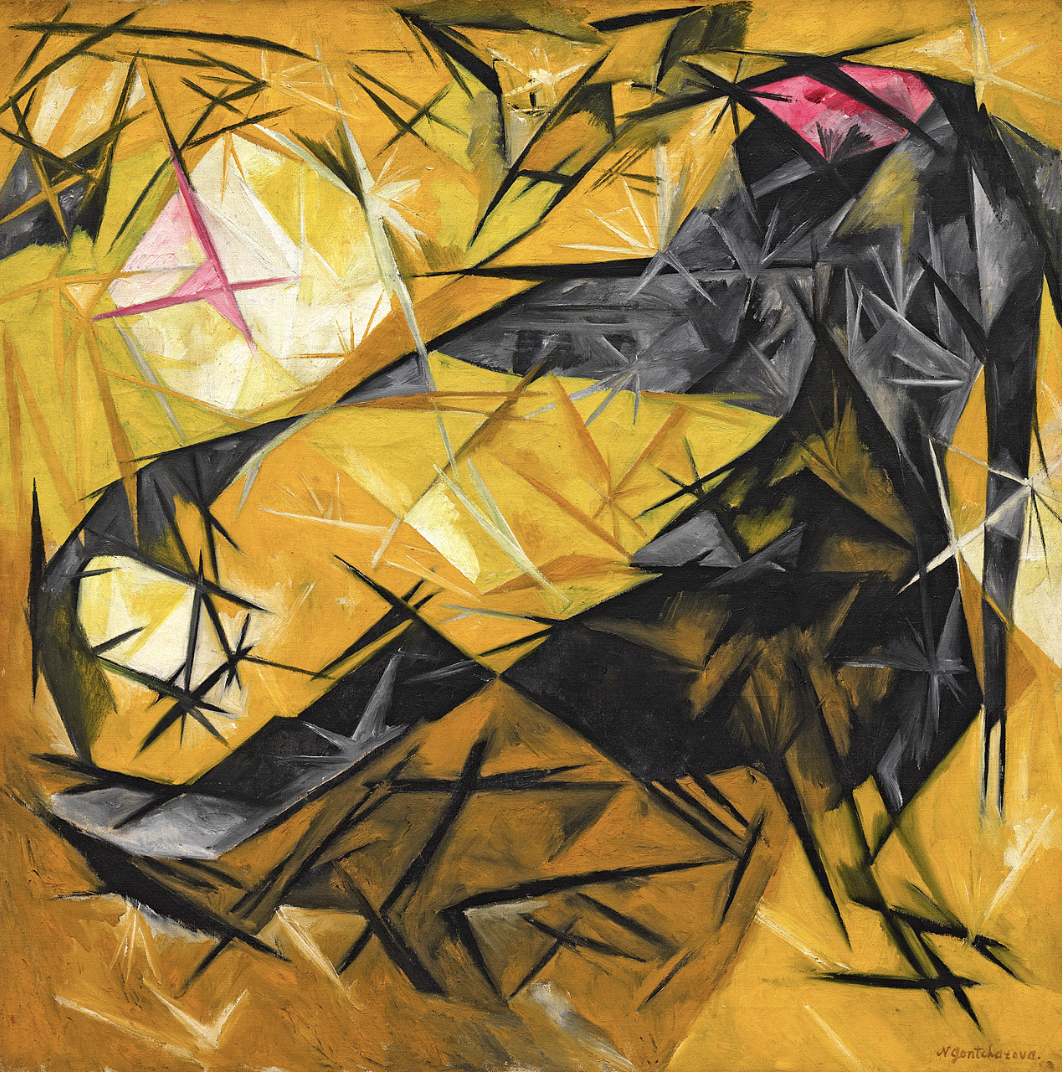
Cara explores how Natalia Goncharova redirects the ambitious, often technologically oriented rhetoric of Russian avant-garde abstraction toward an intimate and playful subject: domestic cats.

As the Metropolitan Museum of Art opens its newest exhibition on Raphael’s works, Alexandra reflects on his piece Portrait of Young Woman with Unicorn alongside Leonardo da Vinci’s Lady with an Ermine. In particular, she considers symbolism of animals and the relationship between technology and visual analysis.


On March 29, 2026, the Metropolitan Museum of Art opened its new exhibition titled Raphael: Sublime Poetry. Exploring the artist’s artistic process, the show brings together more than 200 works. It was with great enthusiasm that I learned that Raphael’s Portrait of Young Woman with Unicorn will be traveling to Manhattan from Rome’s Galleria Borghese, on loan for the show. This excitement stems in part from the work that first comes to mind when I encounter Raphael’s piece: Leonardo da Vinci’s Lady with an Ermine. In these two Renaissance portraits, I find a particular mystique and charm. Completed near the end of the 15th and beginning of the 16th century, these two works exemplify early modern painters’ representations of purity in female portraiture through animal symbolism. Furthermore, they present an opportunity to explore Raphael and Leonardo’s intentional inclusion of animals, shaped by technological analysis.
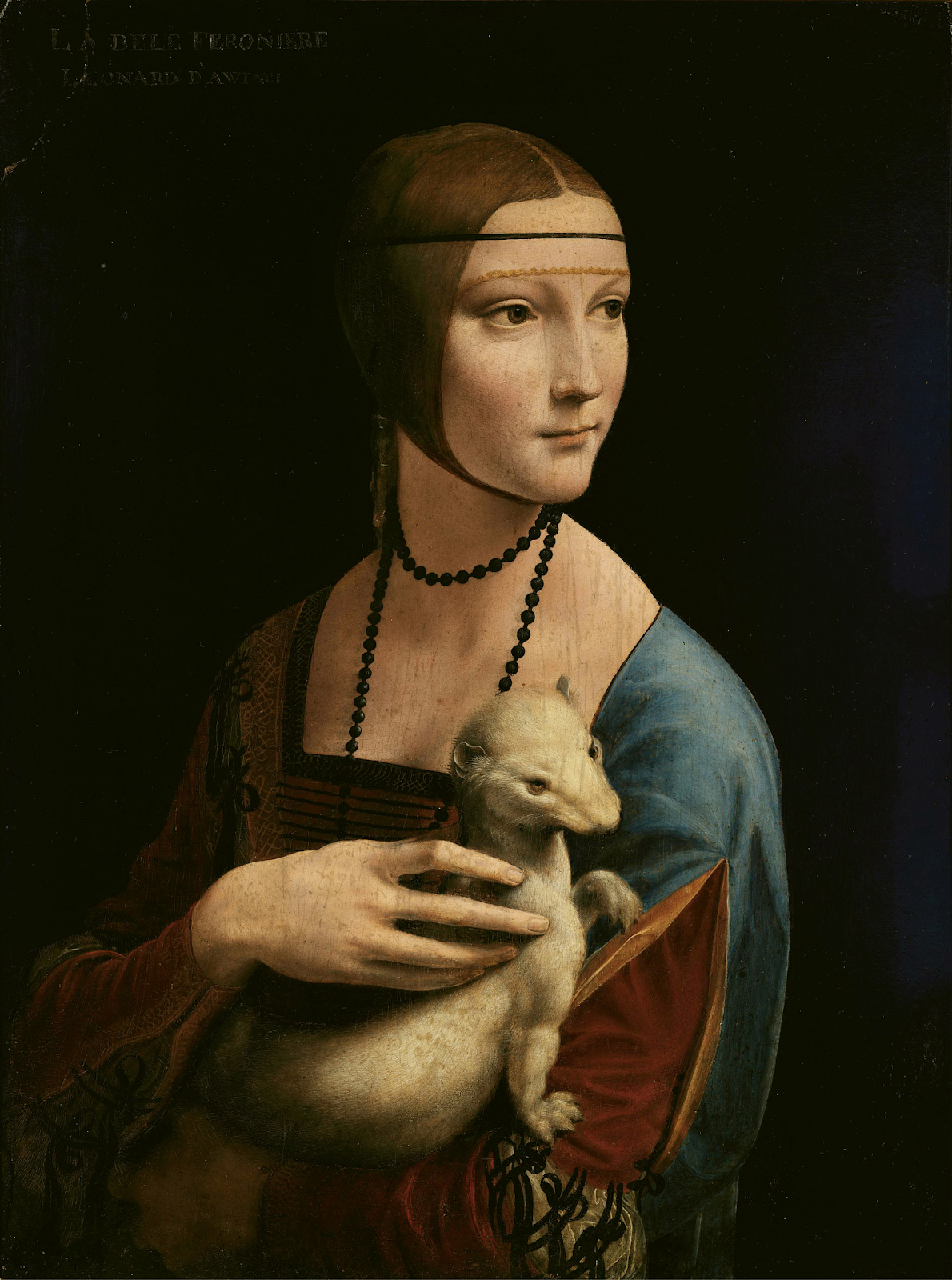
Leonardo, while in residence at the court of Ludovico Sforza where he would later become court painter, completed Lady with an Ermine (fig. 1) between 1489 and 1491 (Kane 114). Leonardo maintained a clear interest in the natural world, exemplified in both his artistic and scientific works. In his written observations, Leonardo considered a diversity of subjects pertaining to nature through “botany, zoology, human anatomy, comparative anatomy, physiology, and geology” (Kane 114). This scientific concern translated into his art, as he represented animals with “exact realism and life” (Niemelä and Örma 304). In the portrait, assumed to be of Cecilia Gallerani, Sforza’s mistress, Leonardo’s understanding of the natural world and respect for its creatures enabled his skillful depiction of the ermine. The ermine has been diversely interpreted: “the ermine in art is generally considered to represent purity and innocence,… the woman and the ermine are thought to represent chastity or motherly love, as well as having complex mythological origins, [and] it has [been] speculated that the Greek name for ermine, galé, refers to the young woman in the painting, as it has the same first three letters as her surname, Gallerani.”3 It reflects cultural norms and the nature of Cecilia and Szforza’s relationship. Thus, the contribution of the ermine proves diversely expressive, communicating meaning intertwined with the depiction of Cecilia’s chastity and commitment to Sforza.
In Portrait of a Young Woman with a Unicorn, dated to 1505-1506, Raphael too takes on a female sitter, placing his own creature on her lap. Raphael consciously engaged with representations of animals as strategic symbols. For example, in his depiction of an ostrich around 1520, he “[faced] the bird forward, hiding the tail feathers that denote justice, [refusing] to make the creature a straightforward symbol” (D’Elia 28). In this, “Raphael forced the viewer to consider how the natural world is imbued with meaning…, [raising] the question that became central to ongoing debate about art in the cinquecento, namely, how physical form contains and communicates inner truths” (D’Elia 28). While the woman’s identity is unknown in Portrait of a Young Woman, the unicorn provides symbolic and contextual information: “scholars believe that the painting was commissioned to celebrate a wedding, and the unicorn, a conventional symbol of chastity, may offer clues to her familial lineage” (FAMSF). The addition of the mythical creature presents valuable information for dissecting the guiding principles of Raphael’s portrait, just as Leonardo’s, rooted in purity.
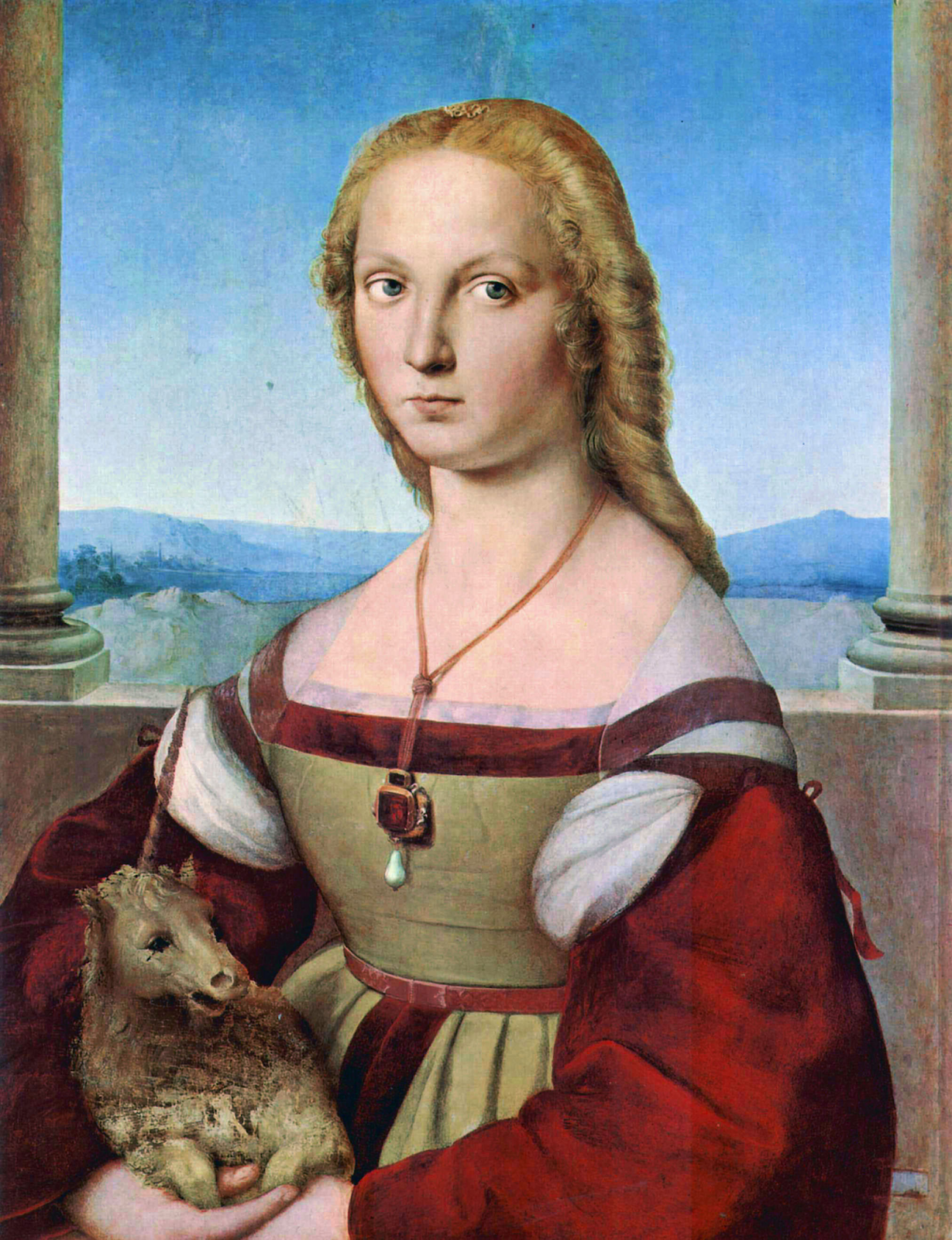
Returning to Lady with an Ermine, as Cecilia gazes to the right, she supports the ermine’s body facing the same direction. “Poised and alert” (Bull 67). The tension depicted in the ermine’s body presents a contrast to “the gentle sensuality of Cecilia's right hand” as it rests on its shoulder. Leonardo’s deep intellectual intrigue enabled this transcendence of fields, and his inclusion of the ermine provides an air of ambiguity to the image through the contrasting of the softness of Ceclia against the physical readiness of the ermine (Bull 67). On Portrait of a Young Woman with a Unicorn work, scholar Christof Thoenes wrote, “However unabashedly Raphael adopts the pose, compositional framework and spatial organization of the Leonardo portrait…the cool watchfulness in the young woman’s look is very different”from the “enigmatic ambiguity” of Mona Lisa” (Thoenes). This similar ambiguity is perhaps visible in Lady with an Ermine, enabling an intriguing comparison between the two pieces. In turn, the comparison of these two works provides an opportunity to examine the contrasting tonal efforts of the artists.
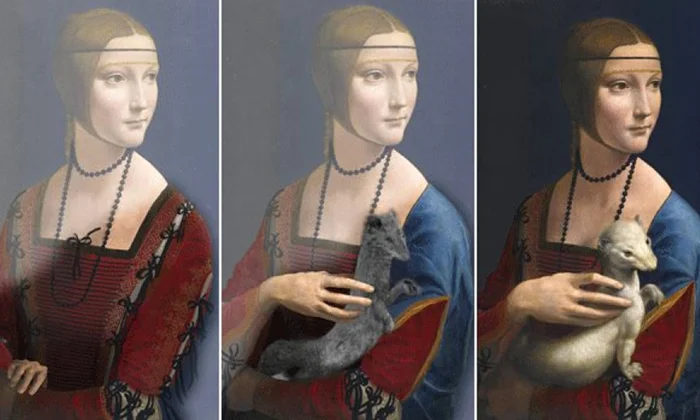
Finally, these two portraits share a striking similarity as the animals included were not always depicted as we see them. Through a new light technique, a French scientist revealed that Leonardo had painted two versions prior, finding that in the first he omitted the animal, in the second he added a smaller gray animal, and in the last he added the prominent white ermine (fig. 3). While the reasons for this change have been speculated, “It has been suggested that Leonardo made these late-stage changes to the coloring and the build of the forelegs of the animal in response to demands by Sforza, who wanted a more “presentable” portrait” (Niemelä andÖrmä 309). The progression of the ermine’s position serves as a foundational reminder of its intentional interaction with the painting's purpose.
Just as Leonardo's ermine, the unicorn was a later addition. A 17th century alteration had “concealed [the unicorn with] the attributes of the saint’s martyrdom – the wheel and the palm, [and] a cloak covered her shoulders” (Galleria Broghese). A 20th century X-ray analysis (fig. 4) revealed this unicorn, and found that the unicorn had been painted on top of a dog in her arms. Again, the symbolic animal emerges as a feature of clear intention. Just as the ermine, the unicorn serves a particular purpose, and Raphael’s engagement with the mythical world is integral and thoughtful.
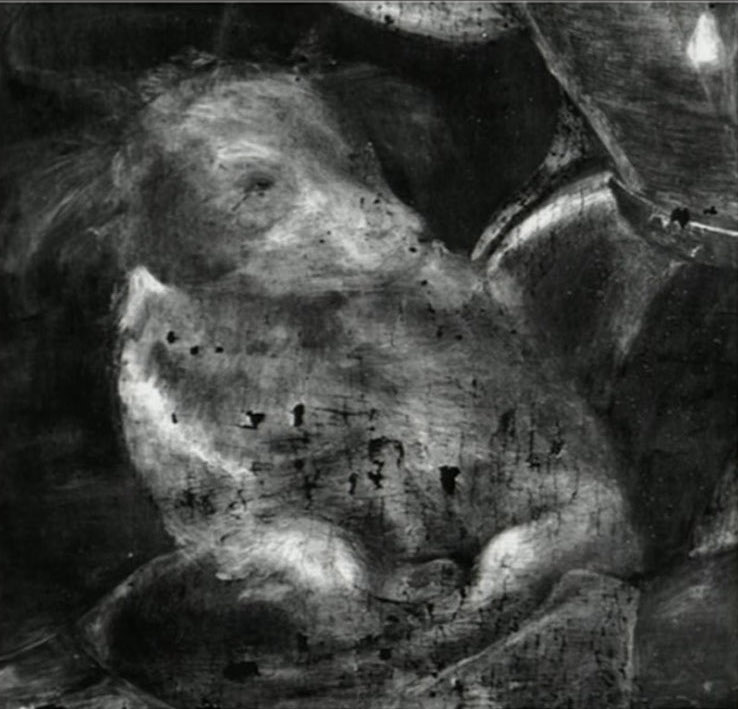
My hope in this article was to briefly expand upon these paintings’ composition and symbolism, and thus highlight the role of technology in refining our understanding of the artists’ motivations for deploying animal symbols in early modern portraits of women. These X-rays have provided scholars with a rich opportunity to consider the reasons for their later addition, examining the natural world’s applicability as a tool for portraiture. In the case of these two portraits of women, purity and chastity frames the symbolism of these animals. Through positioning the ermine in a realistic prominence, “Leonardo has elevated the nobility of an animal and made it almost the equal of humans” as it serves as a symbol and compositional feature of the painting, elevating the captivating depiction of Cecilia (Kane 115).The same can perhaps be said for Raphael. In turn, the ermine and unicorn reflect the painterly desire for a perfect composition, in symbolism and structure.
Bibliography
Bull, David. “Two Portraits by Leonardo: ‘Ginevra de’ Benci’ and the ‘Lady with an Ermine.’” Artibus et Historiae 13, no. 25 (1992): 67–83. https://doi.org/10.2307/1483457.
D’Elia, Una Roman. Raphael’s Ostrich. 1st ed. University Park, Pennsylvania: The Pennsylvania State University Press. doi:10.1515/9780271077499.
Fine Arts Museums of San Francisco (FAMSF). “Sublime Beauty: Raphael’s ‘Portrait of a Lady with a Unicorn.’” www.famsf.org/press-room/sublime-beauty-raphaels-portrait-of-a-lady-with-a-unicorn.
Galerie Borghèse. “Portrait of Young Woman with Unicorn by Raphael: A Famous High Renaissance Masterpiece.” borghese.gallery/collection/paintings/portrait-of-young-woman-with-unicorn.html.
Johnston, Chris. “Secrets of Leonardo Da Vinci Painting Laid Bare by New Scanning Technique.” The Guardian, Guardian News and Media, 29 Sept. 2014, www.theguardian.com/artanddesign/2014/sep/30/leonardo-da-vinci-painting-portrait-lady-ermine.
Kane, Douglas D. “Science in the Art of the Italian Renaissance II: Leonardo Da Vinci's Representation of Animals in His Works.” Ohio: Department of Evolution, Ecology, and Organismal Biology, The Ohio State University, 2002.
Niemelä, Pekka, and Simo Örmä. “Lady with an ‘Ermine.’” Source: Notes in the History of Art 35, no. 4 (2016): 302–10. https://www.jstor.org/stable/90022850.
Cara explores how Natalia Goncharova redirects the ambitious, often technologically oriented rhetoric of Russian avant-garde abstraction toward an intimate and playful subject: domestic cats.
Kate explores how Australian artist Vincent Namatjira redefines portraiture to confront the legacies of colonialism while envisioning a more inclusive future—one expansive enough to embrace all Australians.

Clarke Reynolds (Mr. Dot) talks with the Art Review about interactive art, changing the narrative around blindness, and creating a world where art is more accessible for all.