May 1, 2026
Opinions
Opinions
Cara explores how Natalia Goncharova redirects the ambitious, often technologically oriented rhetoric of Russian avant-garde abstraction toward an intimate and playful subject: domestic cats.

The famous Argentine soccer player is making waves in the art world.

There are few more well-known names in the sports world than Lionel Messi, but recently the Argentine sports legend has been making a splash in the art world. His recent artistic collaboration with Refik Anadol, titled Living Memory: Messi – A Goal in Life, is an immersive AI-driven installation that captures the excitement of his game-ending goal against Manchester United during the 2009 UEFA Champions League Final: a 70th-minute header that the Argentine recounts as the most memorable moment of his impressive career.
Born on June 24, 1987, in Rosario, Argentina, Lionel Messi is widely regarded as one of the best soccer players in modern history. Debuting at just 16 years old, Messi has masterfully conquered even the most difficult of goals, making the impossible seem simple. His humility stands out among other sports stars, and he serves as an inspiration for budding soccer players and for people all around the world. Boasting 889 goals over the length of his 21-year career, he played for FC Barcelona, the Argentine national team (Asociación del Fútbol Argentino), Paris Saint-Germain, and, most recently, Inter Miami. His mesmerizing style and extreme grasp of technical skills make him a captivating presence on the field. However, it is his focus on teamwork and his dedication to helping his teammates that make him stand out among other athletes. Throughout his career, Messi won eight Ballon d’Or awards—more than any other famous player—cementing him as truly one of the greatest of all time. Across the world, fans wear his blue-and-white-striped jersey with a 10 on the back as a statement of pride: an act that carries Messi’s legacy into everyday activities. With this impressive legacy, Messi firmly established himself as an international household name.
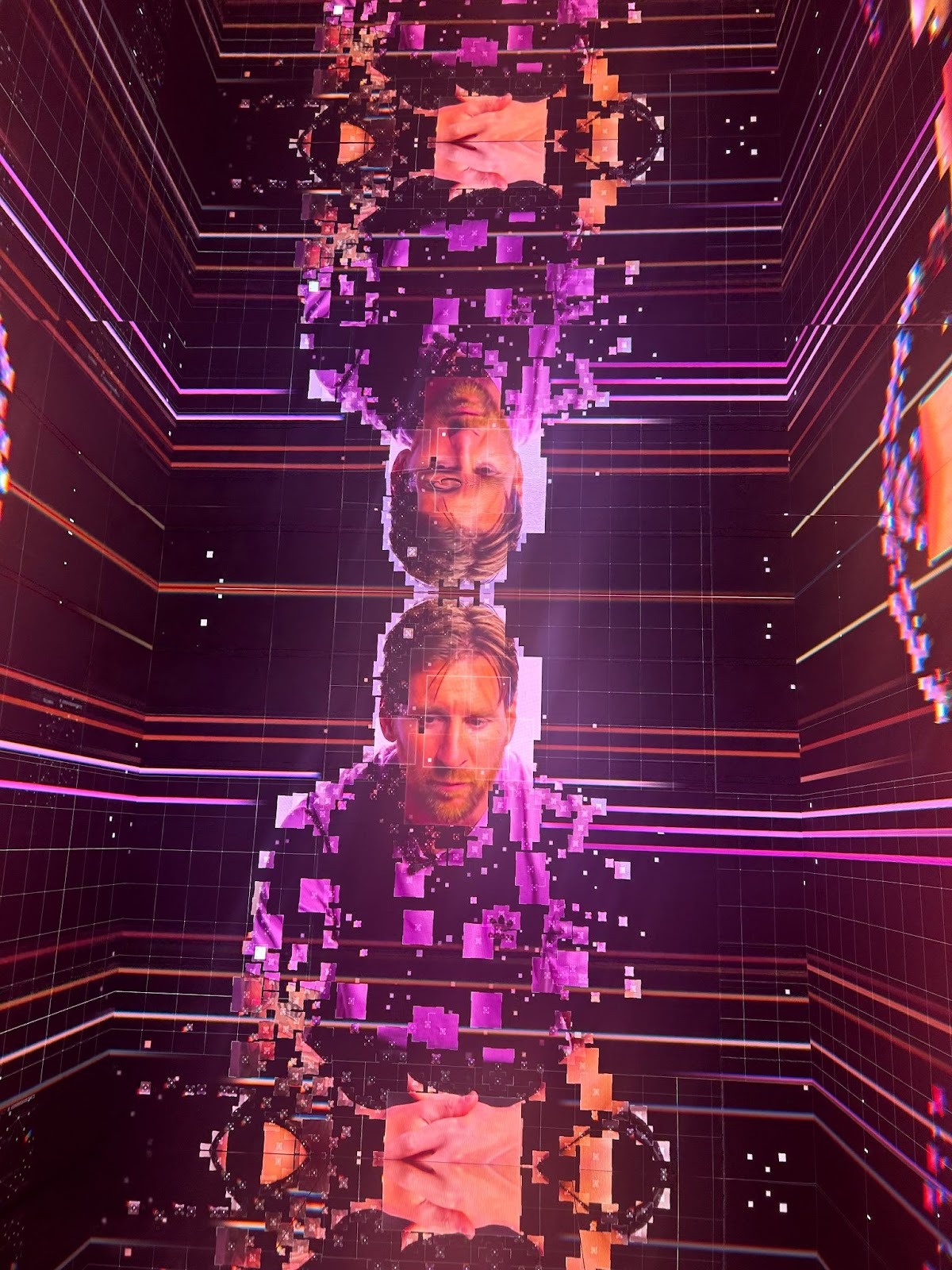
With the power of the Messi legacy at an all-time high, Refik Anadol’s collaboration takes commemorating the soccer player one step further, blending art, technology, and sports in an attempt to enable viewers to step into Messi’s mind. Living Memories uses seventeen different points on Messi's body to reconstruct his movements and layers an interview with Messi, where the soccer player reflects on his 2009 goal, throughout the piece. The goal was mathematically reconstructed, highlighting the fluidity of Messi’s movement and the teamwork required to achieve it. Even if viewers remember the 2009 header, they are presented with the goal in a completely different manner. When I watch soccer with my family, I do not think about the angle of his kick or the speed at which he is running. I watch Messi do the impossible. I watch him weave through opposing players and kick the ball to his teammates, all while having the energy of the stadium coursing through my veins. In these moments, my eyes dart across the screen as I take in the commentary from the Telemundo broadcasters, internalizing how each and every player acts as a pivotal cog in the wheel that is the team. However, Refik Anadol gives us a Messi-centric view of the goal, one that dials in all our focus onto one man.
The Turkish artist is a pioneer in the intersection of art and AI. As the founder of Dataland, the first Museum of AI artworks, Anadol is on a mission to combine the “aesthetics of data and machine intelligence” with the ever-evolving nature of art, creating multisensory works that challenge viewers to reconsider how they engage with the world. His pieces involve multiple AI algorithms developed by his team of designers, architects, data scientists, and researchers, bridging the gap between humans and machines. Anadol’s works can be found worldwide with one of his most notable pieces being Machine Hallucinations—Sphere, an ongoing public art exhibition at The Sphere in Las Vegas. Throughout his artworks, Anadol transforms AI, and allows a technological model to dream, creating undulating and self-colliding simulations. The complex colors, shapes, and fluid dynamics found in Anadol’s artworks, especially those in his artwork Melting Memories, illustrate the complex nature of human experience and the fluidity with which we move through life.
The result of Anadol’s and Messi’s collaboration is this eight-minute “memory temple,” a meshing of the past and present, human and machine, and reality and memory. But what is a memory temple, and why is it so important for this artwork? To me, this painting forms a dedicated space for reflection, one that subverts the known by introducing and spotlighting new perspectives. The artwork is set against a black background, with brightly colored shapes and videos that move across the screen. The overlapping of these squares features different moments, either Messi’s interview or moments from the header itself, but are interrupted by black squares, which creates an illusion of fragmentation. This unique play on completion evokes our own interactions with memory: we remember some things with clarity, while others are interrupted by gaps and blank spots.
Anadol and Messi created an artwork that is dynamic and evocative, prompting viewers to reconsider how they interact with their own memories and the emotions they evoke. And as such, it deserves an exhibition space that does Anadol’s message, and Messi’s legacy, justice. The exhibition room at Christie’s New York, where it was displayed from July 12 to July 22, 2025, only fosters the experience. Through the front doors of Christie’s Rockefeller office, guests were greeted by security and ushered upstairs into a gallery off the main escalators on the second floor. Upon entering the gallery space, visitors were asked to wait in line. Even though there were countless people in front of me when I visited, we were surrounded by Messi memorabilia at every turn, including explanatory wall plaques, Messi’s classic Inter Miami jersey, and video interviews with Anadol and Messi. As we moved closer to the exhibition room—a 5-foot by 5-foot room with screens on three walls and a mirrored ceiling and floor—I began to hear Messi’s voice and see flashing lights. A Christie’s attendant stood at the front of the line, and at the edge of the work, inviting small groups of 4-6 people inside. He would set a timer for 2 minutes, the duration of each guest’s visit, and then call upon the next group of visitors when the time ran out. For those couple of minutes, the artwork becomes the viewers’ only focus—the cinematic soundtrack fills their ears and drowns out the sounds in the gallery room, while their eyes race around the walls, attempting to capture and retain every detail on the screens. Upon exiting, each guest’s excitement was palpable, as they chattered amongst themselves with wide grins.
In a collaborative Instagram post with Christie’s, Messi expressed his excitement for the piece: “Me parece que el resultado es espectacular y también muy especial para mí. Ojalá sirva para ayudar a muchísima gente. [trans. I think the result is spectacular and also very special for me. Hopefully it helps a lot of people.]” The work was sold in Christie’s one-lot online auction, A Goal in Life: Leo Messi x Refik Anadol, on July 22nd. The work’s buyer, who remains anonymous, had the opportunity for “a private signing experience” with Messi and Anadol in Miami, a benefit of the sale announced through Instagram on July 17, 2025. The proceeds, which totalled over $1.8 million, benefited many nonprofit organizations, most notably the Inter Miami CF Foundation's collaboration with UNICEF. One of Messi’s many charitable undertakings, the Inter Miami CF Foundation is dedicated to supporting education across Latin America and the Caribbean. The trappings of the artistic exhibition extend beyond the art sphere: not only is Messi the famous soccer player known and loved by thousands, he is also the empathetic and impassioned philanthropist.
However, reactions to the artwork weren’t all that positive. Valentina di Liscia with Hyperallergic called the work “soulless” while there were reports of Anadol fighting online with an art critic who called his work at large a “banal screensaver.” Anadol is no stranger to criticisms of his work, as he responded that such critiques are part of “a beautiful dialogue" which shows “how we grow, all together.”
Thus, the piece is more than just artwork—it is a living, breathing extension of the soccer player’s mind and body, one he willingly shares with all who experience it. If Messi’s memory can be transformed and reinvented using technology to create such an impactful artwork, one can only imagine what everyday experiences can create.
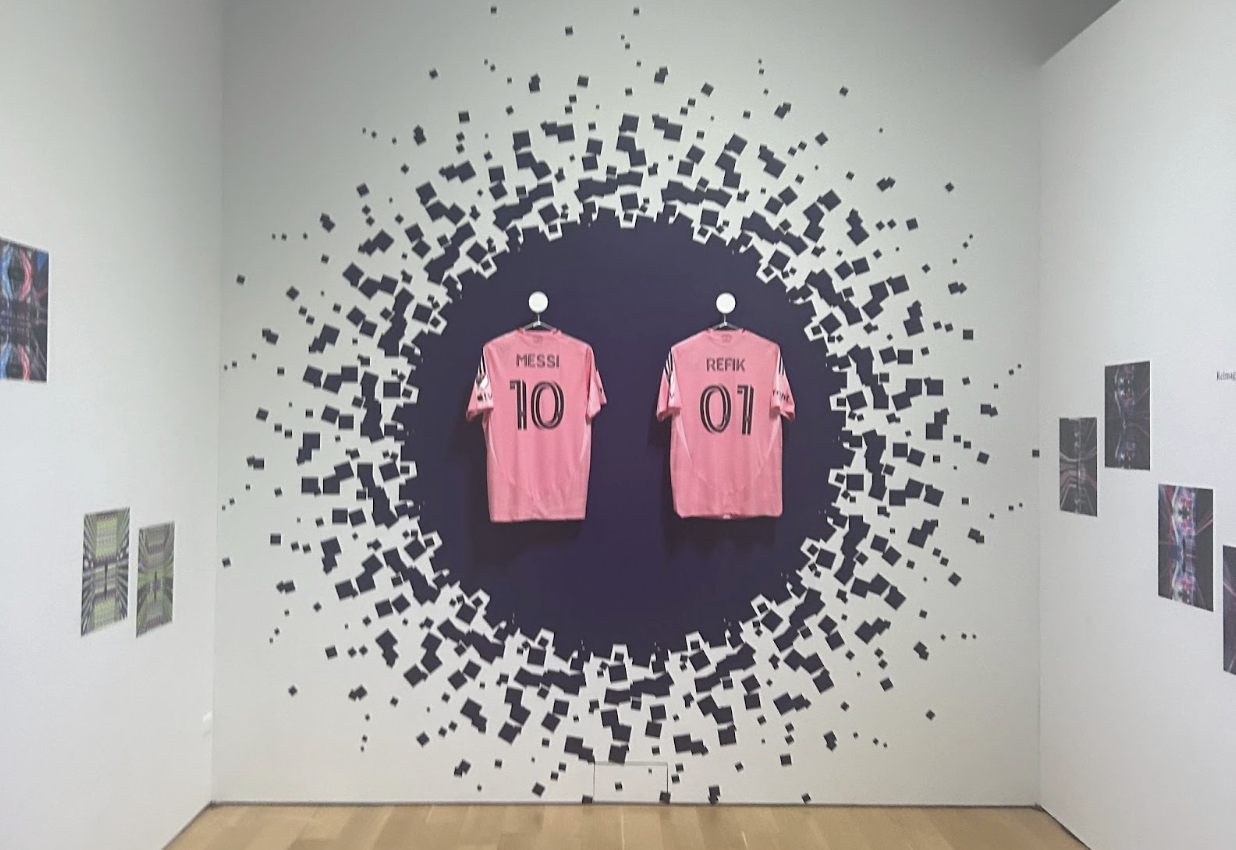
(Cover Image: Two pink InterMiami jerseys hang on the wall of the Christie’s New York exhibition of Living Memory: Messi – A Goal in Life. Image courtesy of the author.)
Cara explores how Natalia Goncharova redirects the ambitious, often technologically oriented rhetoric of Russian avant-garde abstraction toward an intimate and playful subject: domestic cats.
Kate explores how Australian artist Vincent Namatjira redefines portraiture to confront the legacies of colonialism while envisioning a more inclusive future—one expansive enough to embrace all Australians.

Clarke Reynolds (Mr. Dot) talks with the Art Review about interactive art, changing the narrative around blindness, and creating a world where art is more accessible for all.