

May 1, 2026
Opinions
Opinions
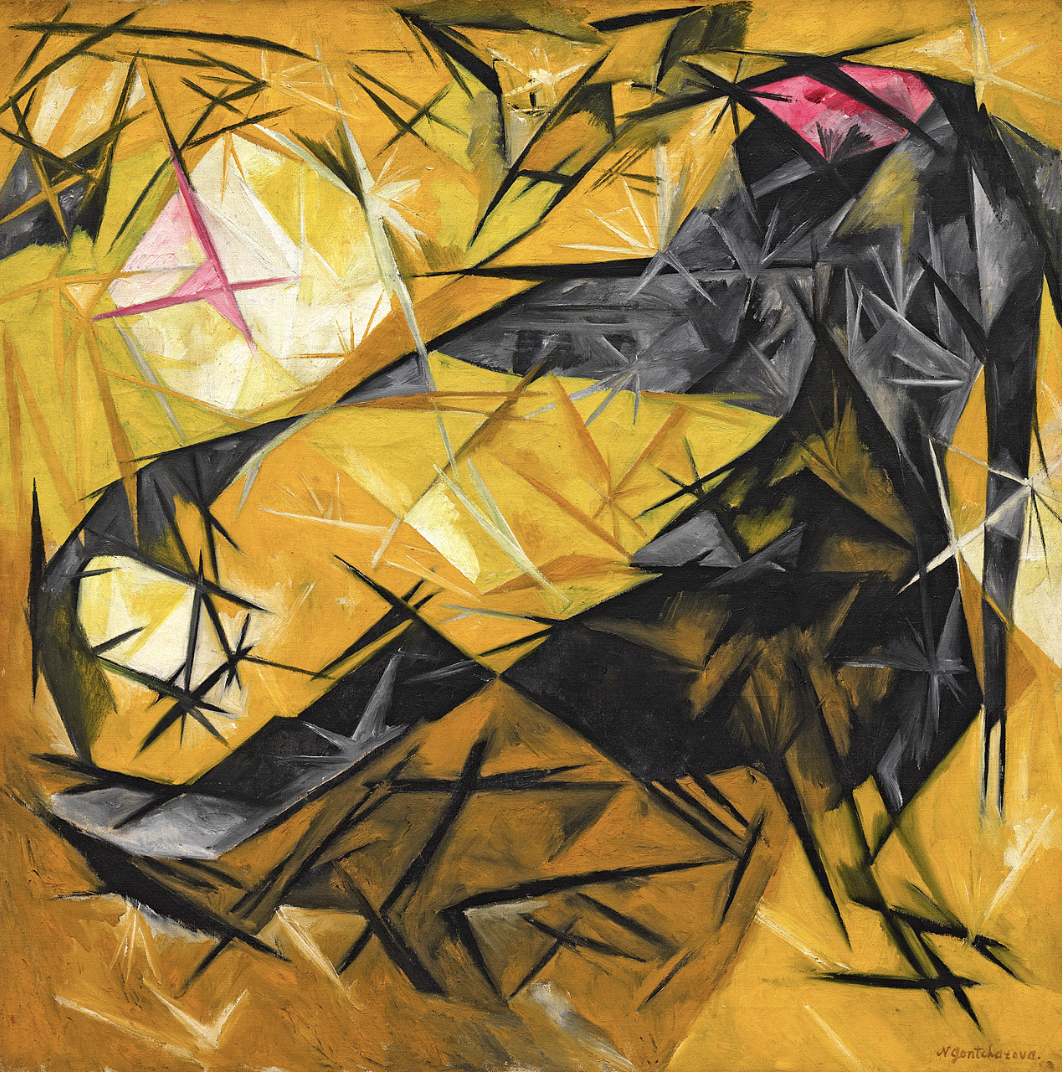
Cara explores how Natalia Goncharova redirects the ambitious, often technologically oriented rhetoric of Russian avant-garde abstraction toward an intimate and playful subject: domestic cats.

Parsa examines Annibale Carracci’s ceiling frescoes in Palazzo Farnese and argues for a reworking of Gian Pietro Bellori’s Neoplatonic interpretation of early Carracci biographers through the lens of Socrates’ so-called Ladder of Love from Plato’s Symposium.


Between 1597 and 1601, Annibale Carracci undertook a project to paint the vaulted ceiling of the Farnese Gallery, leading to one of the most influential ceiling frescoes since Michelangelo’s ceiling frescoes in the Sistine Chapel earlier in the century. The iconography of Carracci’s fresco cycle, which has been referred to as the Loves of the Gods, can be clearly understood through the title of the work itself. The work draws on ancient Graeco-Roman mythological stories of romantic dalliances and amorous friction based on Ovid’s Metamorphoses, as well as a handful of other antique sources, such as Virgil’s Georgics and Ovid’s Heroides. While the iconography of the work is rather readable, the broader iconological interpretation of the frescoes has been fiercely debated in contemporary scholarship. In his Lives of the Artists, Gian Pietro Bellori, a 17th-century Italian art historian, argues for a Neoplatonic reading of the frescoes through an interpretation of Pausanius’ speech from Plato’s Symposium. Bellori asserts that the viewer is intended to read Pausanius’ reflections on Aphrodite Urania (Heavenly Love) and Aphrodite Pandemos (Common Love) into the fresco cycle, yielding a message about the battle between earthly and heavenly love.
While the Neoplatonic reading of Annibale Carracci’s ceiling frescoes on the vault of Palazzo Farnese is reasonable, Bellori’s particular Neoplatonic approach lacks a substantial amount of evidence. Indeed, it is clear that Carracci’s Loves of the Gods follows earlier notable precedents for ceiling frescoes in portraying the soul’s ascent to immortality and divine love, based on the Ladder of Love from Socrates’ speech in Plato’s Symposium as opposed to Pausanius’ speech. As a brief summary, in his speech, Socrates explains how all people aspire towards the immortal, and people fulfill their aspirations for immortality by either begetting children or begetting beautiful ideas. Notably, Socrates explains that to be the “heir of immortality,” one must follow the “greater mysteries,” which have become known as the Ladder of Love. Socrates’ Ladder of Love is one of the main components of his speech, and it entails a certain ascent, where the true lover moves from a love of one beautiful body to loving all beautiful bodies to beautiful souls to beautiful laws and institutions to knowledge, and finally, to the Form of Beauty. Overall, I intend to rework earlier Neoplatonic conceptions of the work through the lens of the iconology of the frescoes in Villa Farnesina.
I’d like to begin by motivating the question of why Villa Farnese occupies such a curious and perplexing position in art history. By 1563, the Council of Trent, a council of Catholic clergy convened to develop a theological defense against the Reformation and reaffirm Catholic doctrine, had come to a close. Notable for our purposes, the session of the Council of Trent called for certain moralizing stipulations on art, arguing that artworks should avoid “all filthy lucre” and that “figures shall not be painted or adorned with a beauty exciting to lust” (On The Invocation, Veneration, And Relics, Of Saints, And on Sacred Images). The Council of Trent brought about a series of changes to art, leading to clothing being added to Michelangelo’s Last Judgement and titles being changed on Veronese’s Last Supper. Carracci’s Loves of the Gods is situated at the height of the Post-Tridentine period, yet the figures seem to represent everything the Council sought to abolish from art. In Carracci’s frescoes, one can see scenes of homoerotic love between Jupiter, in the form of a bird of prey, and a nude Ganymede, where the God sinks his talons in between Ganymede’s legs and carries him upwards towards Olympus, as he stares lovingly into the youth’s eyes with a tender gaze that is reciprocated by the smitten Ganymede. It is not difficult to imagine that scenes like this would evoke a frisson of desire within the viewer, and Ganymede is not the only source of such desire. One can also see a marine scene underneath the central panel of Bacchus and Ariadne with a sordid-looking moustachioed man placing his hand onto the cloth-covered genitalia of a central Nereid. A contemporary 1599 charcoal on paper drawing by the artist’s brother, Agostino Carracci, further complicates the matter by displaying the same scene but removing the cloth from the Nereid. Indeed, at first glance, everything about this painting seems “profane” and “indecorous,” flying right in the case of the Council of Trent’s stipulations.
What is even stranger about the Loves of the Gods is that it was commissioned for a Catholic clergyman, Cardinal Odoardo Farnese. Cardinal Odoardo was also a direct descendant of Pope Paul III, who opened the Council of Trent in 1545. While some art historians have attempted to argue that the practical purpose of the fresco reveals its interpretation, this reading of the frescoes would have some strange conclusions. Some art historians have claimed that Carracci’s frescoes were made to commemorate a marriage between Duke Ranuccio Farnese, Odoardo's brother, and Margherita Aldobrandini, the niece of Pope Clement VIII, but this does not appear to be the case. As explained by Jaynie Anderson, the marriage between Ranuccio and Margherita was celebrated through a different series of fresco paintings, specifically those by Agostino Carracci. Anderson claims that Agostino Carracci was commissioned in 1600 to prepare paintings for Margherita’s entry into Parma for the Palazzo del Giardino in Parma, the city where the Farnese ruled as dukes. Likewise, the dates simply do not add up to argue that Farnese Gallery in Rome commemorates the marriage between Ranuccio and Margherita because the two were only engaged by 1599, two years after Annibale already started working on the frescoes of Farnese Gallery. Thus, there had to be a motivating factor before Ranuccio and Margherita’s marriage to motivate Cardinal Odoardo to commission Annibale to paint the frescoes.
Prior to unpacking the Neoplatonic reading in Carracci’s Loves of the Goes, it would first make sense to examine Raphael’s Villa Farnesina, the clear precedent for Carracci’s ceiling fresco and a work that yields to a much clearer Neoplatonic interpretation based on Socrates’ speech. Villa Farnesina is located within walking distance of Palazzo Farnese, and in fact, it is located just on the other side of the River Tiber. The close parallels between Villa Farnesina and Palazzo are made more clear by the fact that the Farnese purchased the property from the Chigi family, renaming it to its current name, which translates to “Little Farnese.”
The story from the Loggia of Cupid and Psyche comes from Apuleius’ Metamorphoses, which holds the distinction of being one of the few literary works from antiquity to survive in its entirety, and Raphael’s frescoes map out onto the events of the story quite well. The story of Psyche and Cupid is one of the most famous in Greek mythology, and Apuleius’ version of the story begins in Book IV and concludes in Book VI. The story follows Psyche, the princess of an unnamed land, whose beauty was so dazzling that visitors bowed their heads in prayer upon seeing her, believing her to be a divine manifestation, a new Venus. As a result, Venus’ shrines throughout Greece dwindled in attendance, her sacred rites were forsaken, and her temples fell into ruin due to neglect. A furiously envious and vengeful Venus then commanded her son, Cupid, to make Psyche fall in love with a miserable wretch. This scene of Venus manipulating her maternal bond over her son to “exact harsh punishment from defiant beauty” can be seen in the fresco titled Venus and Cupid, where Venus pulls her son in close to her and points out the person that Cupid needs to shoot with his arrow. However, Cupid accidentally shoots himself with his own arrow instead, falling in love with Psyche. Cupid and Psyche soon begin a relationship of erotic passions under the cover of the night, but, eventually, Psyche betrays her lover’s trust, severing the relationship, and leading Cupid to fly off and abandon her. After wailing and drifting aimlessly for a period of time, Psyche eventually comes into contact with her step-mother, Venus, who commands her to perform a series of difficult and nearly impossible tasks to reestablish her love for Cupid. Psyche performs the tasks to the best of her ability and with some external assistance, and the story ends with Psyche receiving the ambrosia of immortality and marrying Cupid at a divine wedding feast.
The story of Psyche and Cupid is quite clearly one of divine union and an ascent towards the divine, as Psyche’s name quite literally means “Soul” in Greek. Indeed, Raphael’s depiction of the various scenes accentuates the story’s Neoplatonic dimension based on Socrates’ Ladder of Love. For example, the fresco of Mercury Brings Psyche up to Olympus, represents the ascent of the soul upwards towards a love of the divine. Psyche has not yet arrived at the divine Eros, but she is preparing to, and her arms are folded in a gesture of humility and acceptance. Psyche’s particular gesture is notable because it draws from scenes of the Annunciation that depict the Virgin Mary with her arms crossed in acceptance of revealing a divine truth. One can see this reflected in Fra Angelico’s 1445 Annunciation from the Convent of San Marco or his 1426 Annunciation in the Prado Museum. Psyche’s acceptance of divine truth and her pursuit of divine Eros allow her to ascend upwards towards that which she most aspires to commune with. Thus, despite the fact that Psyche begins her journey out of a physical love for Eros, Psyche, the soul, ascends up the Ladder of Love towards a greater divine love through a desire for immortality, which is exactly what Psyche receives at the end of her story.
Now, the time has come to show the close relationship between Raphael’s Loggia and Cupid of Psyche and Carracci’s Loves of the Gods. Due to constraints of space, I selected two examples that I believe show the ascent of the soul upwards towards divine love: Ganymede and Hyacinthus. As for Ganymede, the interpretation becomes rather clear now, and the expression on Jove’s avian face becomes much more understandable. The gaze on Jupiter’s face is not lecherous and ravenous like his form would suggest; instead, the soft and sunken eyes of the bird and the sweet smile of Ganymede reveal the two are caught in a moment of divine love, the divine Eros spoken of in Socrates’ speech that is made accessible through the Ladder of Love that progresses from a love of beautiful bodies towards a spiritual love of absolute beauty. And, indeed, Ovid recounts that Ganymede’s profound beauty was what originally drew Jupiter towards Ganymede. Likewise, one can see the same account in Hyacinthus, the lover of Apollo, from the text of Ovid’s Metamorphosis. Notably, Carracci changes Hyacinthus’ story completely to resemble Ganymede’s ascent. In Ovid’s account, Hyacinthus is transformed into a flower, a hyacinth, after dying from a discus that bounces off the ground. However, Carracci depicts Hyacinthus carried by Apollo towards the Sun, which represents absolute beauty and the Form of the Good in Plato’s Republic. A close inspection of the fresco also reveals that Apollo holds Hyacinthus’ arm and points it towards the Sun and the skies, referring to the place where Hyacinthus is destined to ascend to the fact that his soul is about to travel upwards towards absolute beauty. Thus, it becomes clear through an examination of Ganymede and Hyacinthus, that the broader iconological program of the Loves of the Gods aligns with that in Villa Farnesina, which is to tell a tale of the ascension of the soul towards the divine and the immortal through love as a guide that leads one up the ladder like Apollo guiding Hyacinthus’ hand upwards.
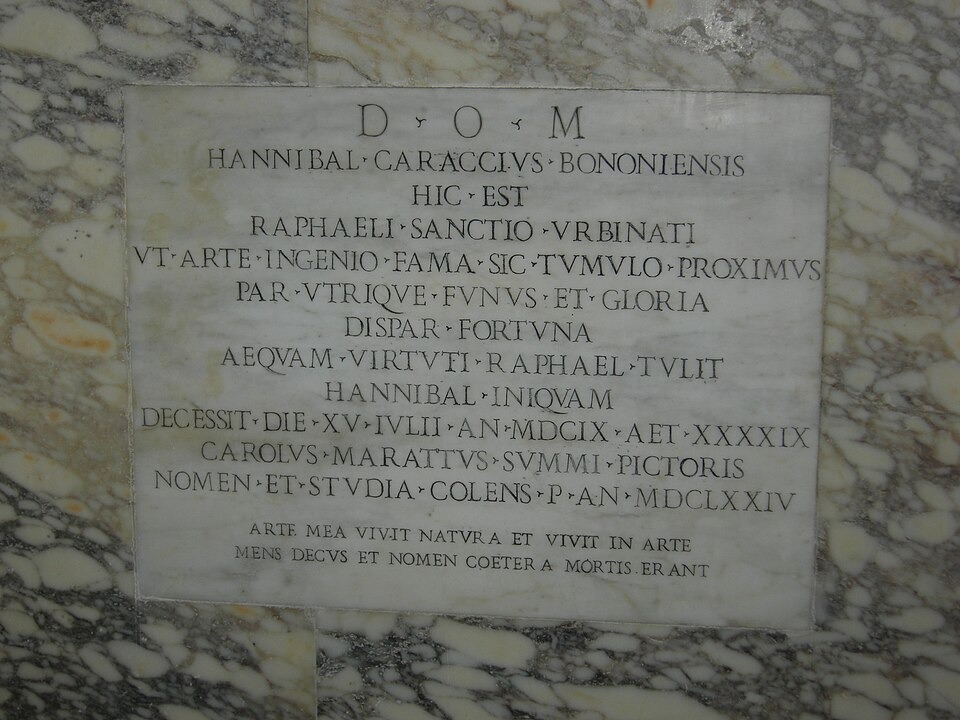
I’d like to conclude with an image of Annibale Carracci’s tomb in the Pantheon in Rome. The Latin epitaph on his tomb reads “Here lies Annibale Carracci of Bologna, who surpassed all the most keen painters of his time, and even those of the past, in such a way that he is considered on a par with Raphael and Michelangelo.” Right next to him, one can see the tomb of that same great Raphael whom Annibale admired so greatly. One must imagine Annibale taking a respite from painting his frescoes in Palazzo Farnese and walking to Villa Farnesina to gaze upon the paintings by Raphael, where he was reminded of the soul’s ascension through beauty. Annibale’s final wishes were to be buried near Raphael, and so it remains true with the Loves of the Gods, which stands in the course of art history next to Raphael’s Villa Farnesina in its inspiration and interpretation.
(Cover Image: Annibale Carracci’s The Triumph of Bacchus and Ariadne (1597-1601), Farnese Gallery via Robert.Allen on Wikimedia Commons)
Cara explores how Natalia Goncharova redirects the ambitious, often technologically oriented rhetoric of Russian avant-garde abstraction toward an intimate and playful subject: domestic cats.

Kate explores how Australian artist Vincent Namatjira redefines portraiture to confront the legacies of colonialism while envisioning a more inclusive future—one expansive enough to embrace all Australians.

Clarke Reynolds (Mr. Dot) talks with the Art Review about interactive art, changing the narrative around blindness, and creating a world where art is more accessible for all.