BisonsPoursuivisParDesLions.jpg)


May 1, 2026
Opinions
Opinions
Cara explores how Natalia Goncharova redirects the ambitious, often technologically oriented rhetoric of Russian avant-garde abstraction toward an intimate and playful subject: domestic cats.

Analyzing how the techniques used in the earliest cave paintings reveal insights into human creative development and form the foundation for later artistic expression.


What makes humans, human? It is our ability to think beyond mere survival and to branch into the theoretical and the imaginary. Nearly four million years ago, as we separated ourselves from our quadrupedal ancestors and began to explore the world in an upright position, we took one of our first great leaps toward what would define us as a species. Bipedalism did more than change how we moved. It freed our hands and expanded how we could interact with the world around us.
Not long after, we began shaping our environment to suit our needs, making use of natural resources to assist in daily life. The creation of primitive tools like rocks and sticks nearly 2.6 million years ago marked one of the most dramatic shifts in early human development. This was one of the first clear moments of humans intentionally creating within their environment rather than simply existing within it. That shift, the ability to transform raw materials into something purposeful, helped form the foundation of innovation that still defines us today.
It is here, in the early formation of these tools, that we begin to see the groundwork for artistic expression. The same hands that shaped stone for survival would later grind pigments and fashion crayon-like pieces of red ochre or charcoal for marking surfaces. These early artistic instruments became vital means of expression and were integral components in the ancient creation of sprawling cave paintings and laid the foundation for more recent artworks.
The oldest known markings made by ancient humans come from the Blombos Cave in South Africa, dating back almost 73,000 years. These markings were simple, crosshatched red ochre lines etched onto a small flake of stone. At first glance, they may seem insignificant. Yet they are deliberate, intentional, and symbolic. It remains unclear whether they were part of a larger composition or what exact meaning they carried, but they represent one of the earliest known instances of symbolic thought.
During this same broad span of development, the brains of early humans were increasing in size and complexity. As our cognitive abilities expanded, so did our capacity for innovation and symbolic reasoning. From this growth emerged creativity that extended beyond function. Art became more than markings. It was a means of storytelling, imagination, and shared meaning. Cave walls began to depict animals, movement, and scenes that suggest memory, planning, and even belief.
But what conditions allowed this leap from survival to symbolism? What environments made creativity not just possible, but necessary? And how did these early expressions lay the foundation for the artistic achievements that would come thousands of years later? To better understand this progression we can examine specific moments in history where human creativity reshaped culture, perception, and identity.
The oldest known example of an ancient human painting that depicts a recognizable subject was discovered in the Leang Tedongnge Cave in Indonesia. Dated to at least 45,500 years ago, the image portrays a warty pig, which is an animal that still inhabits the region today. The choice to intentionally paint this particular creature highlights a lot of compelling questions. Why this animal? Why render it in such a deliberate and enduring way? The pig may have held symbolic meaning, perhaps representing sustenance, strength, or even spiritual power. Alternatively, it may have reflected a scene from everyday life, capturing an animal central to survival.
What is especially stunning about the warty pig is that it is not just crude mark-making or random lines. It is the oldest known artwork of something identifiable. The artist used natural pigments to outline the pig’s form with confident, continuous lines. The proportions are coherent, even the distinctive facial warts and bristled back, which are key characteristics of the species, are clearly emphasized. This cave painting is not an accident. It reveals an early-human ability to observe, select defining features, and translate a three dimensional living being into a two dimensional image. Such translation requires advanced visual cognition, fine motor control, and creativity.
A second impressive string of paintings come from the Chauvet Cave in southern France, known for its scenes of wild animals. The first case study is the Woolley Rhinoceroses Butting Horns, created approximately 36,000 years ago.
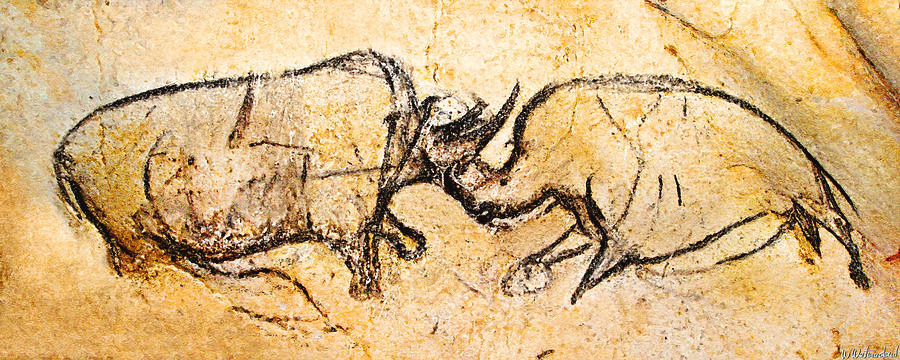
What makes this image interesting is a simple application of a sophisticated artistic technique. One rhinoceros appears positioned slightly in front of the other, creating a convincing sense of three-dimensional space. The artist used subtle mark-making techniques like thicker, darker lines around the head and lighter, thinner lines toward the rear to suggest mass and perspective. The overlapping forms and forward thrust of the bodies convey movement and tension, and give the painting the likeness of a modern sketch.
This image reveals much about early humans’ capacity for creativity and interpretation. For the first time in human history, we see clear evidence of depth, motion, and even some kind of narrative, which suggests that ancient humans had some form of advanced mental processes, such as understanding spatial relationships and anticipating movement.
Another slightly younger work in the Chauvet Cave, the Panel of Lions (dated to roughly 32,000 years ago), presents an even more complex composition.
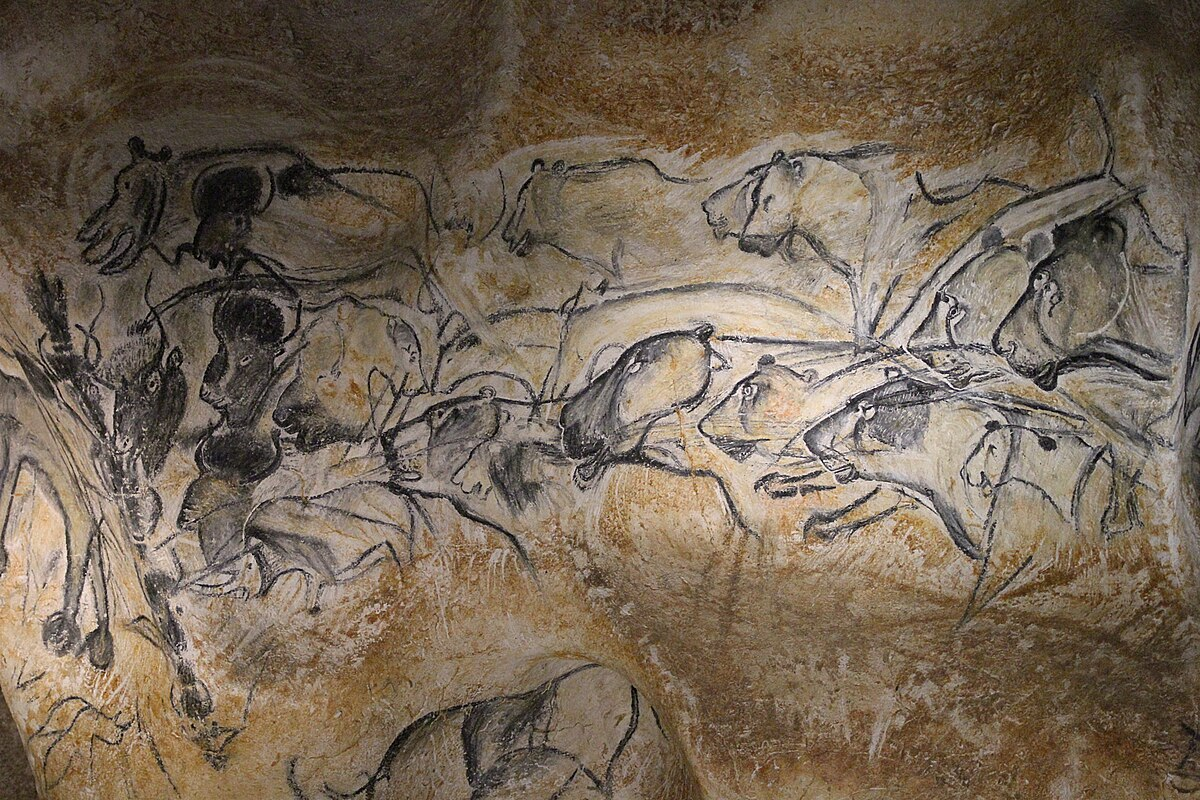
Unlike the two rhinoceroses, this panel depicts an entire pride of lions stalking bison and rhinoceroses in a coordinated hunting scene. The artist drew multiple figures with striking realism and structure, and arranged their bodies in rhythmic sequence to show the lion’s quick advancement. The main, significant difference in creative advancement from the first case study mentioned are the subtle variations in line weight to create depth and, more importantly, the scraping of the rock surface to produce lighter planes that bring certain forms visually forward, like an underpainting. This was an advanced technique for this time period, and a version is still used today when creating oil paintings.
From a cognitive perspective, the Panel of Lions suggests an even greater leap in creative and abstract thinking. Depicting a coordinated hunt requires not only close observation of animal behavior but also the mental capacity to synthesize multiple moments into a single visual account. This implies foresight, planning, and some level of composition. The painting may have served to transmit knowledge about predator-prey dynamics, reinforce social memory, or encode symbolic meanings tied to survival and power.
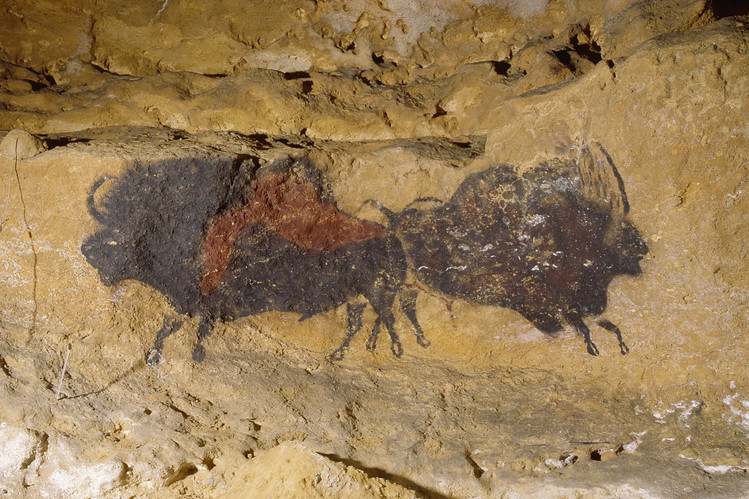
Another French cave, the Lascaux Cave, also houses some important cases of emerging human creativity. The painting known as the Crossed Bison, which is estimated to be around 17,000 years old, shows two bison overlapping in a way that strongly shows intentional spatial depth. The animal on the left clearly appears to stand in front of the one on the right, and this effect is not accidental. When closely observing the hind legs, a faint outline of the rear (right) bison can be seen through the body of the left one, demonstrating an early use of transparency and obstruction to convey space. The larger, darker forebodies of each bison contrast with their lighter, less emphasized hindquarters, further enhancing the illusion of mass and forward projection.
The Crossed Bison represents further human advancement in representational thinking. The painter was not merely outlining animals but consciously creating a three-dimensional image on a two-dimensional surface. The work reflects abstract reasoning and the ability to conceptualize depth, anticipate how forms interact, and intentionally construct an illusion for the viewer. This breakthrough in early spatial representation laid important groundwork for later artistic developments in the future in both the Renaissance and Medieval periods.
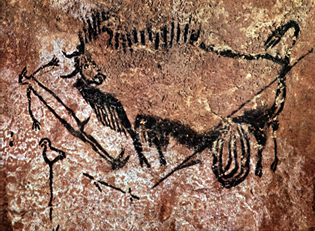
Unlike many ancient animal depictions, another painting from the Lascaux Cave, Man Attacked by a Bison, presents a dramatic story. A massive bison, pierced by a spear in its rear, stands with lowered head and raised tail, while a human figure lies before it, seemingly injured or dead. The artist isolates the moment of confrontation, using posture and gesture to convey tension and consequence. The bison’s dark, enlarged body contrasts with the simplified, stick-like human form, emphasizing the power imbalance between hunter and prey.
The scene may have functioned as a warning, a lesson about the dangers of the hunt, or even a ritualized account of a significant event. Regardless, it shows that ancient humans during this time period had the ability to reflect on experience, extract meaning from it, and encode that meaning visually for others. The emergence of creativity is evident in the shift from depicting what is seen to conveying what is understood. This capacity to symbolize risk, memory, and shared knowledge marks a crucial development in human imaginative and intellectual evolution.
The shift toward creative cave art from just rudimentary mark-making, seen in the shift from the Blombos Cave flakes to the dynamic rhinoceroses of the Chauvet Cave raise questions on how and why creativity emerged. In these caves, we do not simply see isolated animal outlines but instead see constructed scenes filled with interactions between human and animal, and implied stories. Such imagery proves that early humans were thinking symbolically and using visual forms to represent ideas, memories, and social knowledge. This capacity for imagination and storytelling may have offered evolutionary advantages, strengthened group dynamics, or communicated information in ways that spoken language alone could not yet accomplish.
Some research proposes that symbolism conferred adaptive benefits and was therefore shaped by natural selection. In unpredictable environments, individuals capable of flexible thinking, problem-solving, and rapid communication would have been more likely to survive and support their communities. Creativity may have emerged as part of this broader cognitive toolkit. Enhanced memory, foresight, and social awareness would allow early humans to represent knowledge visually, whether warning of a dangerous hunt (as in Man Attacked by a Bison) or capturing predator-prey dynamics (as in Panel of Lions). Art, in this sense, may have functioned as an extension of communication.
Some theories also point to biological changes such as increases in brain size and neural complexity expanding humans’ capacity for abstract reasoning, planning, and symbolic association. The cognitive skills required for advanced toolmaking also likely served as precursors to the art on the walls of these caves.
Over time, the combination of environmental pressures, expanding cognitive capabilities, and the need for complex communication may have manifested into artistic expression. In this view, cave paintings are not isolated moments of creativity but instead a visible spectrum of a deeper evolutionary shift where creativity emerged as both a survival strategy and a defining human trait.
(Cover image: Cueva de las Manos, Argentina, 11,000 BCE, Image: Santa Cruz Cueva Manos)
Cara explores how Natalia Goncharova redirects the ambitious, often technologically oriented rhetoric of Russian avant-garde abstraction toward an intimate and playful subject: domestic cats.
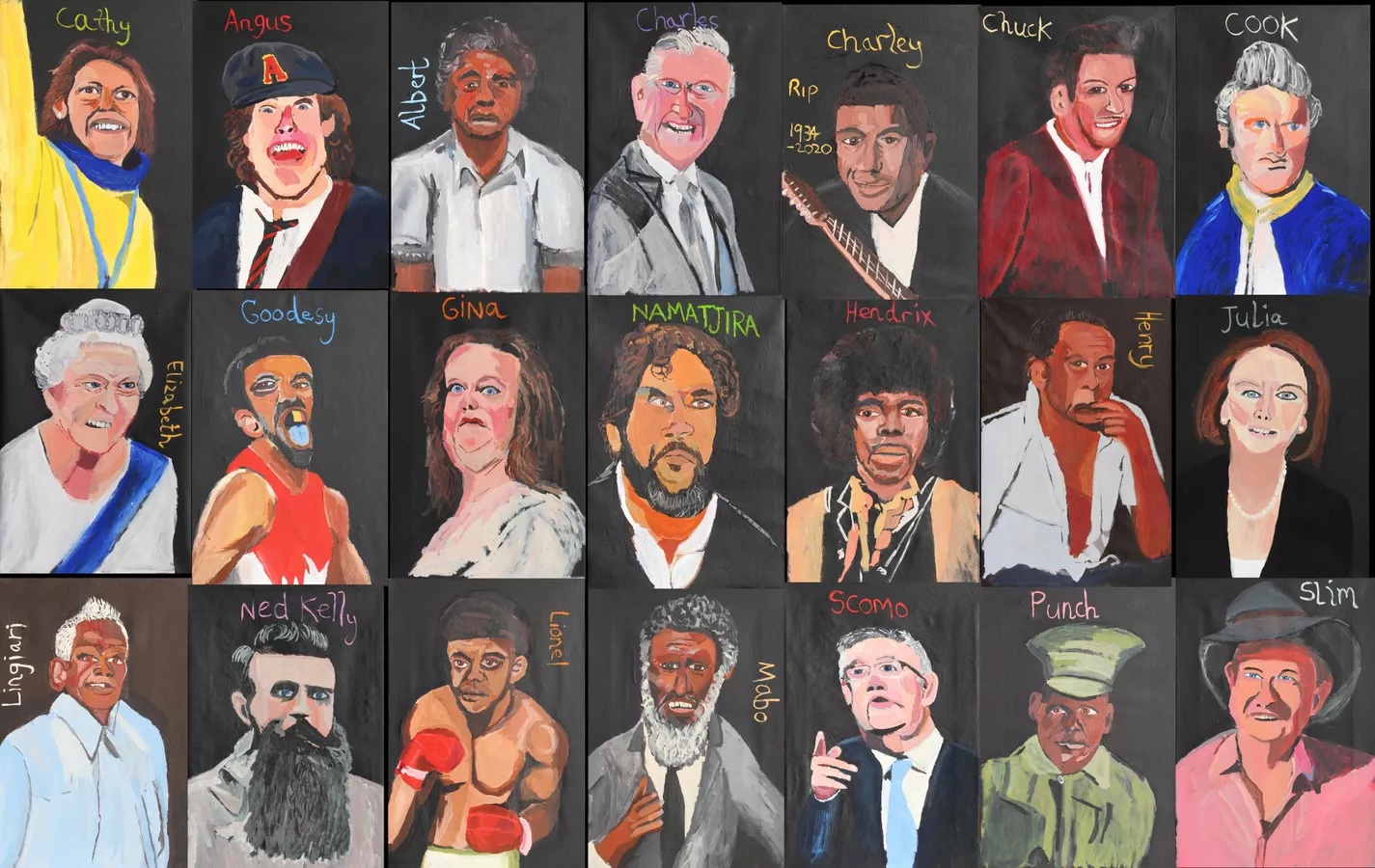
Kate explores how Australian artist Vincent Namatjira redefines portraiture to confront the legacies of colonialism while envisioning a more inclusive future—one expansive enough to embrace all Australians.

Clarke Reynolds (Mr. Dot) talks with the Art Review about interactive art, changing the narrative around blindness, and creating a world where art is more accessible for all.