May 1, 2026
Opinions
Opinions
Cara explores how Natalia Goncharova redirects the ambitious, often technologically oriented rhetoric of Russian avant-garde abstraction toward an intimate and playful subject: domestic cats.

Beginning her career surrounded by Abstract Expressionists, artist Audrey Flack grappled with her impulse toward Baroque-inspired, illusionistic, and iconographic work for decades. After pioneering an often disregarded sentimental dimension of Photorealism within a male-dominated 1970s art world, the contemporary art world at last fully embraced her final body of work before her death in 2024.


“If this artist sees splendor rather than degradation in the things of this world, if she perceives its artifacts enveloped in a transcendental light, a light which has always been synonymous with divinity, why should the artist’s vision be denied or distorted?” – Cindy Nemser, Feminist Art Journal, 1975
In the 1930s and 1940s—a time when the art world increasingly favored abstraction—a precocious young girl named Audrey Flack was growing up in Brooklyn, spending her days admiring magazine clippings scattered across the walls by her mother featuring the works of Rembrandt, Jan Van Eyck, Ghirlandaio, and Cassatt. Since childhood, Flack felt it was her calling to become an artist. By the time she began studying art at The Cooper Union in 1948, Abstract Expressionism was at its peak in popularity, and, living in New York’s Bowery neighborhood, she found herself at the epicenter of its culture. While she was exhilarated by the “rough and fast” nature of movement and being in the presence of its forerunners, Flack kept her innate inclination towards dramatic, illusionistic, representational work buried within (Flack 2024, 13). Old masterworks were completely disregarded as mimetic and academic in Abstract Expressionist circles, where only a handful of downtown galleries dominated the New York art market. To step out of abstraction would be a career risk, especially for younger women who already had their fair share of struggles making their way in a male-dominated movement whose very ethos centered on masculinity, spontaneity, and an idealized expression of American freedom. Treating a canvas with careful detail could have been labeled a polite, domestic “craft,” akin to women’s historical association with textile arts.
In 1951, Josef Albers, then chair of the Yale School of Art, visited Cooper Union in search of a shocking abstract painter to import to his department, which was filled with students still working in an academic style. After reviewing her work, he selected Flack for the task, and she began at Yale that year. While she continued to fling abstract masses of color at her canvases, she found great joy in taking art history courses at the college. Despite her Jewish upbringing, she remarked in a podcast with Hyperallergic that the course, Iconography of the Bible, “inspired in me a love of iconography that I use to this day,” and that after the fact, she knew “more about the saints than, you know, any good Catholic.” Inspired by her studies, she began spending hours each night sketching colored-pencil recreations of Baroque masterworks.


By the late 1960s, Flack began painting highly rendered images from photographs. Despite a long history of artists employing the photograph, camera obscura, and daguerreotype in painting processes (Rembrandt, Manet, Cezanne, to name a few), critics and several of her artist friends adamantly objected to her use of them when she first started to reference from photography. At the cost of friendships, she wrote in her 2024 Memoir, With Darkness Came Stars, she maintained her faith in using photographs in her process (Flack 2024, 142) Just a few years after she began experimenting with Photorealism, it was popularized as a contemporary movement, which, like Abstract Expressionism, was completely male-dominated, including prominent figures like Chuck Close, Charles Bell, and Robert Bechtle. These men employed “unemotional, unfeeling, cool colors,” as Flack described to Hyperallergic, and were all interested in the forms and reflections of motorcycles, cars, and deadpan portraits.
Flack’s work, by contrast, evolved into illusionistic, narrative, and emotionally evocative pieces. Additionally, her process frequently involved a masterful command of the airbrush (in place of the paintbrush), which was far from being considered a serious medium at the time outside of commercial illustration (Flack 2024, 182). Throughout these early photorealistic works, a clear line of iconography emerged, depicting sentimental images informed by modern history and her personal relationship to symbols, objects, and figures of the past. Despite their sharp, realistic imagery, her new work was more than strict academic representation. Her paintings were large-scale and engaged with all-over patterning, giving viewers an immersive experience through techniques she retained from her days as an Abstract Expressionist. Flack’s best-known body of work from this period was her Vanitas series, which echoed the 17th-century Flemish tradition of carefully composed still lifes symbolic of the ephemerality of life. Her Vanitas renditions were updated with vivid colors, symbols of modern pop culture, and images of personal memorabilia—painted from still-life photos she composed herself.
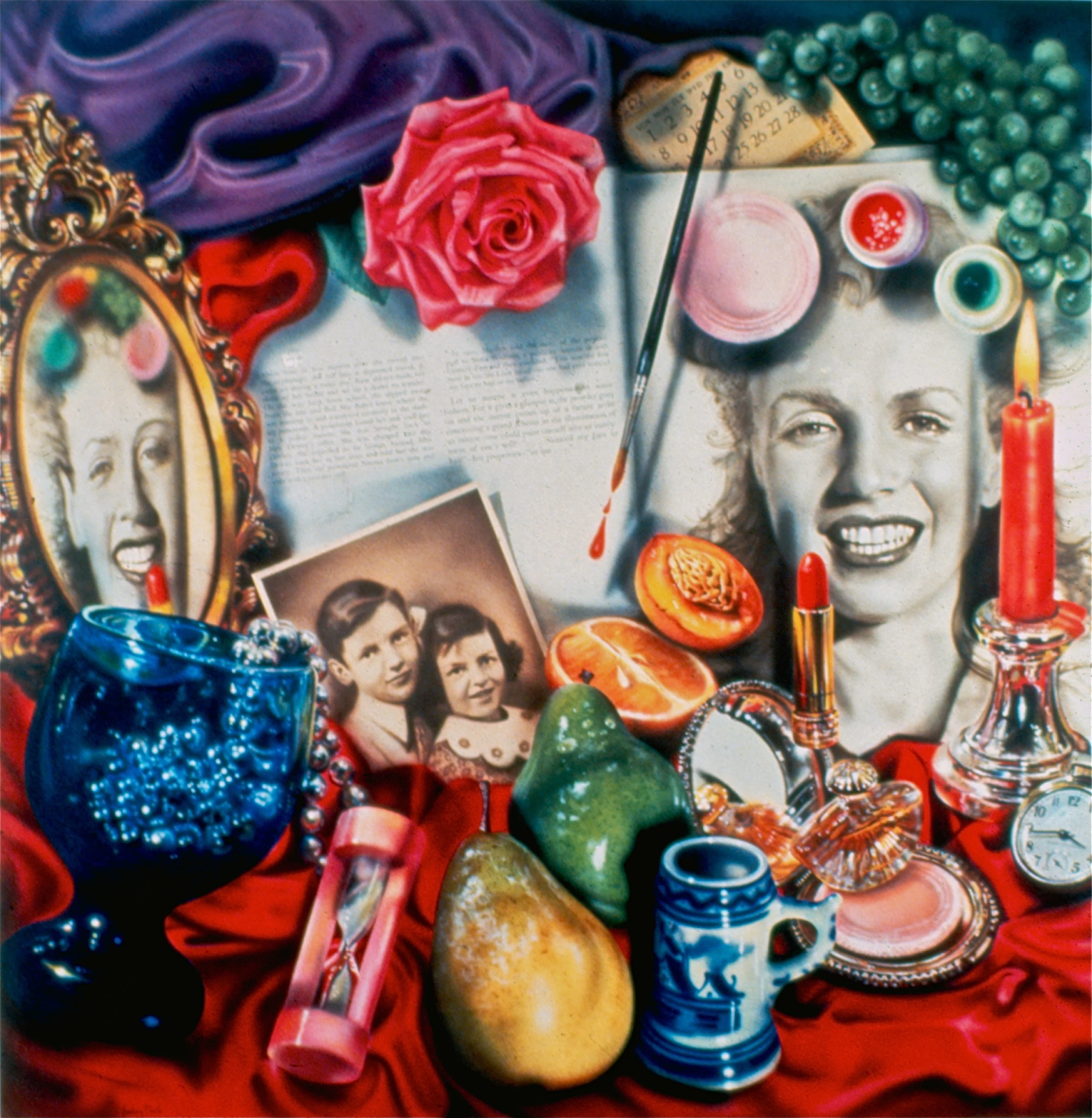
One notable work of this Vanitas series was World War II (1977). Audrey Flack’s brother, Milt Flack, was drafted into the war in his teens, surviving the Battle of the Bulge and becoming one of the first foot soldiers to enter Hitler’s summer home, Eagle’s Nest. Milt returned home to Brooklyn with a stolen portfolio of Hitler’s original watercolor paintings and a ruby necklace that likely belonged to Eva Braun—both of which he gifted to Flack. In her 2024 memoir, she expressed fascination with these “beautiful” objects and their shared context of tragedy. Keeping them in her room for years, they often haunted her. Raised Jewish herself, and thinking of the evil hands that touched these objects, Flack knew she would have to paint about World War II at some point in her career (Flack 2024, #). By the 1970s, she was baffled by the lack of well-known narrative works centered on World War II and the Holocaust. There were, of course, Abstract Expressionist works that many considered embodiments of or reactions to the war, but none, she thought, used representational imagery in the way of Picasso’s Guernica (Flack 2024, 208) She wanted to create a painting, World War II, on the subject that would haunt audiences with a violent contrast of good and evil, much like her Hitler memorabilia. She achieved this by juxtaposing sickeningly sweet pastries and jewelry with a painted photograph of concentration camp survivors by Margaret Bourke-White. World War II was a meditation on brutality, survival, faith, and the passage of time, which shocked and touched audiences with its bold narrative (Baskind 2009, 108). It was her symbolic and precisely detailed technique that questioned whether there were more truthful, tangible, or emotionally resonant approaches to portraying war than any doctrine of abstraction saw fit.

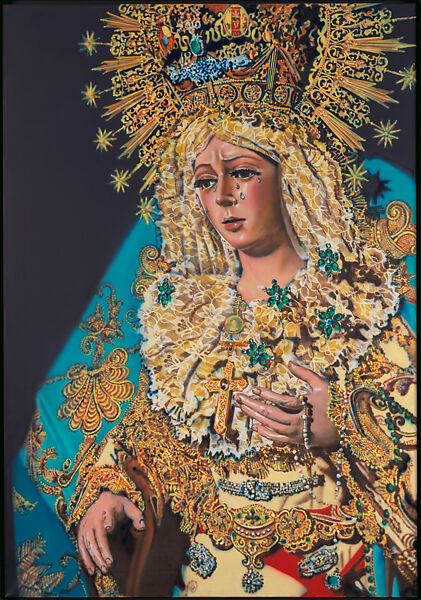
Like how she used images of the survivors of the Buchenwald concentration camp from Bourke-White’s photograph as modern iconography in World War II, she was also inspired by figures of the distant past in creating photorealistic works with deeper autobiographical ties. In 1959, Flack gave birth to her first daughter, Melissa. In the years that followed, she faced constant demands caring for her daughter, who was diagnosed with autism spectrum disorder, amid constant worry and little available support or sympathy. In the mid-1960s, she saw an image of Luisa Rudan’s wooden sculpture Macarena Esperanza, located in Seville’s Basilica de Santa María de la Esperanza. She immediately resonated with this picture of a mother with tears rolling down her face, a connection she came to understand years later (Flack 2024, #). She traveled to Seville as soon as she could to see the Macarena in person, taking photographs to use for her paintings Macarena of Miracles (1971) and Macarena Esperanza (1971). Continuing to find the deeply personal in the historical, Flack recognized in the Macarena a kind of universality of motherhood—a quiet despair she felt especially in a time where women’s art, even more so mothers’ art, was seldom accepted into the art canon. She was also moved by the painting’s author, Roldán, a 17th-century woman artist, and Flack was thrilled to learn of and honor her ornate work.

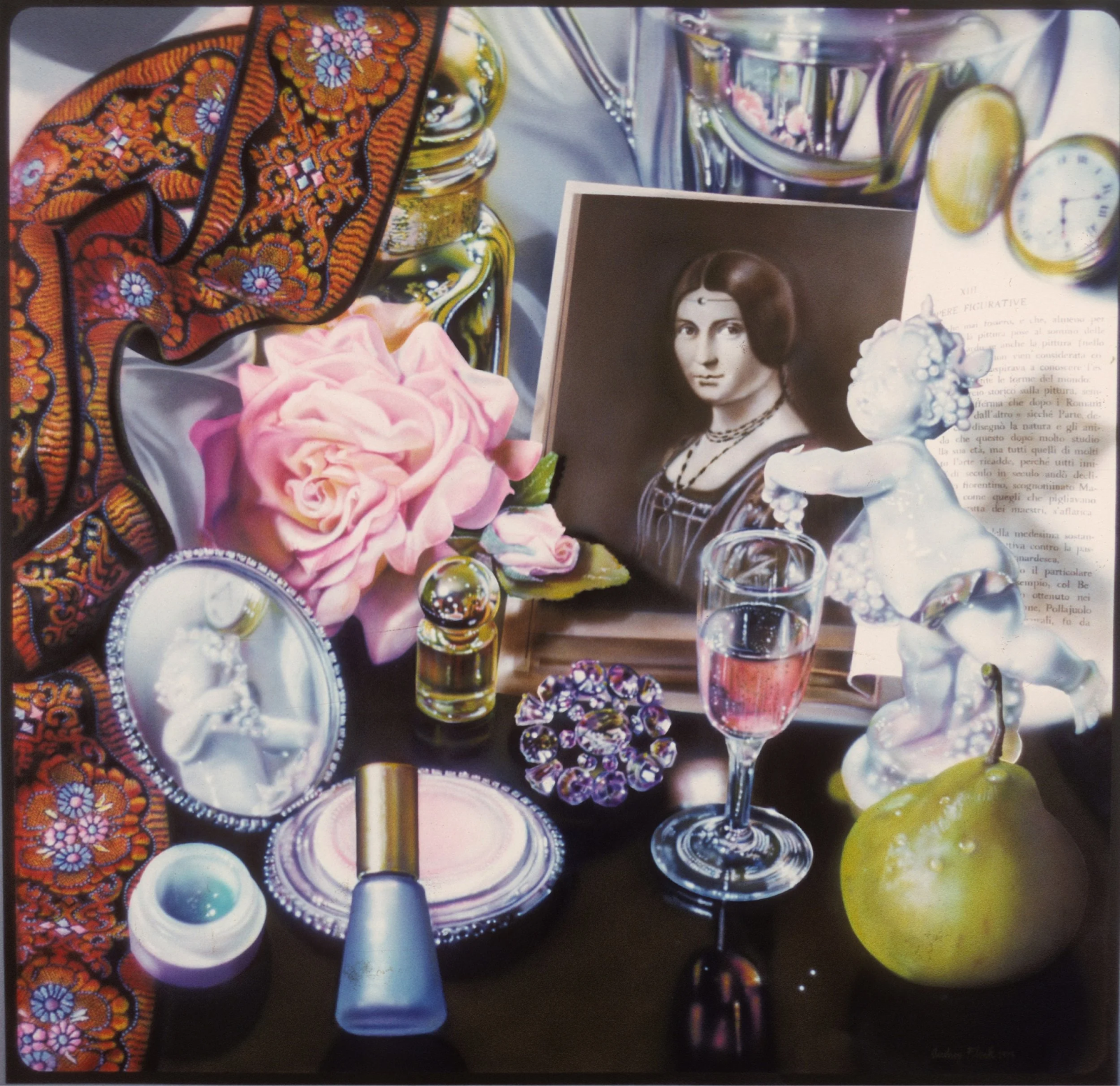
Although Photorealism finally allowed her to work in a context where detailed representation was institutionally accepted, the sentimentality in her photorealistic pieces drew backlash. In a 1976 New York Times article, critic Hilton Kramer denounced her work as “kitschy [...] based on blow-ups of gaudy color photographs and executed with an airbrush. It is distinguishable from advertising art only to the extent that the product being advertised is the artist herself. [...][She is] one of the brassiest of the new breed—Audrey Flack, the Barbra Streisand of Photorealism.” Many thought her work’s content was considered too accessible, unsubtle, and consequently excluded her work from the category of “high art.” Her use of warm colors, Baroque-reminiscent drama, and depictions of perfume bottles, lipstick tubes, and photographs of women led critics to believe her work was explicitly aligned with feminism. While Flack was supportive of the Women’s Liberation movement of the 1970s, almost none of her work was overtly inspired by its goals. She resented the ways that women’s artwork was categorized as having “feminine” subject matter, boxed into absolute sociopolitical ideologies, while men’s work was approached in criticism as universal and its ambiguities were commonly recognized—a frustration shared with countless women artists throughout history.
Her painting, Macarena of Miracles, was exhibited in the 1972 Whitney Biennial, where, at first, critics praised the statue’s tears for what they took to be a sarcastic commentary on old sculptures, while others saw it as a feminist ploy. She recalled in her memoir that whenever she explained that the tears were part of the original sculpture and that she was inspired purely by its ornateness and emotion, positive critiques were quickly withdrawn, and it was dismissed again as kitsch (Flack 2024, #). In response to the gendered boxes she felt were prescribed to her work, she created her only consciously feminist painting, Chanel (1975). Cluttered with enormous, gleaming cosmetic products, jewelry, and fruit from top to bottom, she recalled thinking about the piece, “Now I’ll show them.”


From the 1980s to the 2010s, Flack stepped back from painting, finding a new interest in sculpture. She took time to master the medium of clay, sculpting figures with no less stunning accuracy than her Photorealism work. Her interest in iconography, history, and portrayals of women remained throughout this period, with her subject matter including self-portraiture and various figures from Greek and Egyptian mythology. Her most monumental work was born from a commission to build a 35-foot statue of Portuguese Catherine of Braganza (1638-1705), wife of Charles II and the believed eponym of New York’s Queens, to be erected in the borough. After more than six years of work, the project shut down due to public protest over erecting a statue of a woman of the 17th-century Portuguese monarchy, complicit in the transatlantic slave trade.


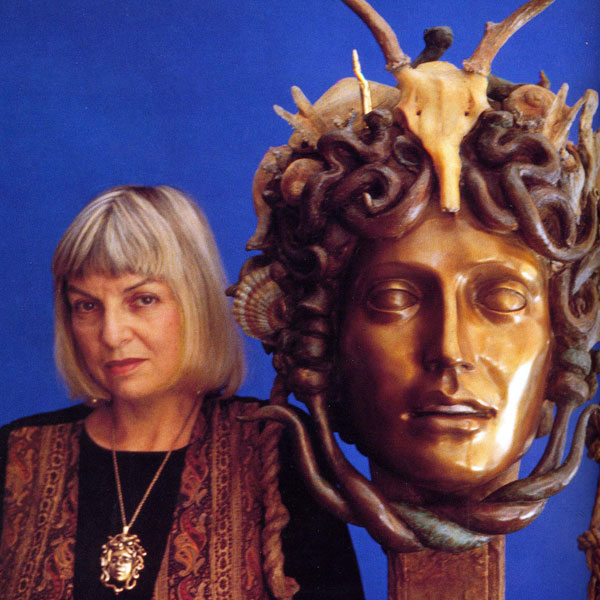
After spending decades solely focused on sculpting, Flack returned to painting with a fervor that yielded her most authentic body of work, which she termed “Pop-Post Baroque,” an unapologetic summation of themes she explored throughout her career. In tandem with the publication of her long-awaited memoir in March 2024, famed art gallery Hollis Taggart displayed 16 of Flack’s new paintings in a monumental exhibition, With Darkness Came Stars.
I spoke with Chloe Pitkoff, a Brooklyn-based artist and illustrator who worked as Flack’s studio manager from July 2023 until her passing, about her final painting series as a culmination of her creative explorations. “In moments of pride–and usually shock– over the age she had reached, [Flack] often noted the artistic knowledge and skill stored in her mind and fingertips, available for her reference as needed.” In her final years, Pitkoff noted Flack spoke “endlessly” with her about icons, particularly iconic artists of history, but also of pop culture, Judaism, Christianity, and her own life. In each of Flack’s icons, present throughout her Pop-Post Baroque work, Pitkoff observed: “she found strength, wisdom, power, and emotional connection.”

Self Portrait with Flaming Heart (2022) can be seen as a thematic starting point for viewers of Flack’s final series. The gilded, ornate framing of her likeness asks us to consider her age, wisdom, and the devotional act of putting her memories and developed passions to canvas. A Brush With Destiny (2023), another self-portrait, is contextualized by a depiction of Jackson Pollock, an icon of American art with whom she had a “familiar but complicated past,” in Pitkoff's words. Many of her late paintings were similarly informed by her experience of watching the American 20th- and 21st-century art scene unfold from Abstract Expressionism, whose culture of male dominance and non-representation contextualized much of her professional life. Her personal relationships with figures like Pollock and other New York School painters were unique, but their simultaneous status as icons of American freedom and expression creates interactive work that uniquely plays with collective cultural perceptions and her lived experience.

Alongside her iconization of art-world figures, Flack also sought to recognize art forms she viewed as “unsung” or “low-brow.” Pitkoff noted that in her later work, she was “fixated on iconic superheroes [...] drawn to figures of power, their complicated back-stories, and their widespread acclaim.”
Flack expressed her awareness of similar imagery in Pop Art, but clearly distinguished the sarcastic, comic-like nature of its imagery from her own, which rather venerated these characters’ shared context with mass audiences through “quirky humor.” Pitkoff recalled Flack’s impassioned talk about incorporating Magneto, an X-Man and Jewish survivor of the Holocaust, who gained his power as a result of his trauma. According to Pitkoff, her depictions of concentration camp prisoners in her Magneto painting drew on imagery from Art Spiegelman’s graphic novel Maus, contrasting with her photographic references in World War II (Vanitas), yet still acknowledging uncelebrated art forms through painting.
Flack likewise recognized the styles of Renaissance woodcut artists in her series, with references to Albrecht Dürer’s Apocalypse in her own Days of Reckoning, a painting depicting societal collapse and growing threats for future generations. It took her four years to complete, upon which Flack asserted in an interview with The Brooklyn Rail, “Artists in the past worked on paintings for 10 or 11 years—something unheard of these days [...] There’s something beautiful about that kind of extension.”


“She was always aware of who was in the spotlight and who was shaping her life and culture,” Pitkoff remembered, who confessed to me she could talk about Flack forever. “She loved a story and the control she had over how the main character could be determined and portrayed, altering the perspective of the narrative while recognizing historical contexts.” Before she died at 93 on July 28th, 2024, Flack was the last so-called “member” of the New York School of Painting still alive, a valued and beloved source of stories about the early days of an American art scene on the cusp of global prominence. From abstraction to Photorealism to monumental figurative sculpture, to Pop-Post Baroque painting, her creative trajectory can safely be considered to have produced one of the most diverse and ultimately authentic oeuvres of any artist who received recognition by the New York School, facilitated by a long life, confidence in her subject matter, and ultimate context in a broadened contemporary art world. Flack can be remembered as a perseverant enthusiast of personal artistic expression, a steadfast lover of what she was told she should disparage, a pioneer of the sentimental potential of Photorealism, and an unapologetic believer in the power of iconization and storytelling.
(Cover Image: Audrey Flack in her studio in January 2024, Image via Hollis Taggart through The Washington Post.)
Bibliography:
Baskind, Samantha. “‘Everybody Thought I Was Catholic’: Audrey Flack’s Jewish Identity.” American Art 23, no. 1 (Spring 2009): 104–115
Flack, Audrey. With Darkness Came Stars: A Memoir. University Park, PA: Penn State University Press, 2024.
Nemser, Cindy. “Audrey Flack: Photorealist Rebel,” Feminist Art Journal 4, no. 3 (Fall 1975): 8.
Cara explores how Natalia Goncharova redirects the ambitious, often technologically oriented rhetoric of Russian avant-garde abstraction toward an intimate and playful subject: domestic cats.
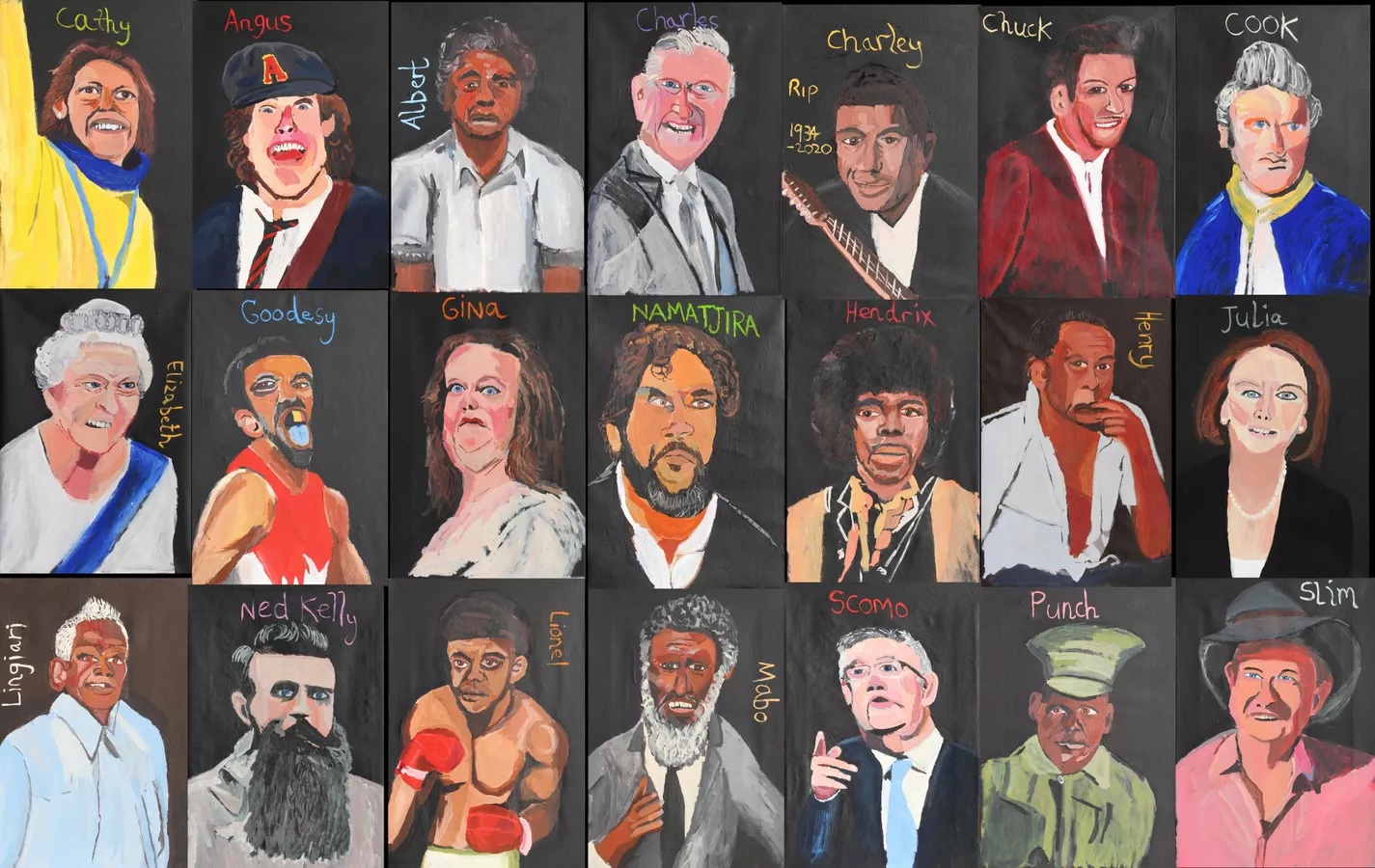
Kate explores how Australian artist Vincent Namatjira redefines portraiture to confront the legacies of colonialism while envisioning a more inclusive future—one expansive enough to embrace all Australians.

Clarke Reynolds (Mr. Dot) talks with the Art Review about interactive art, changing the narrative around blindness, and creating a world where art is more accessible for all.