

May 1, 2026
Opinions
Opinions
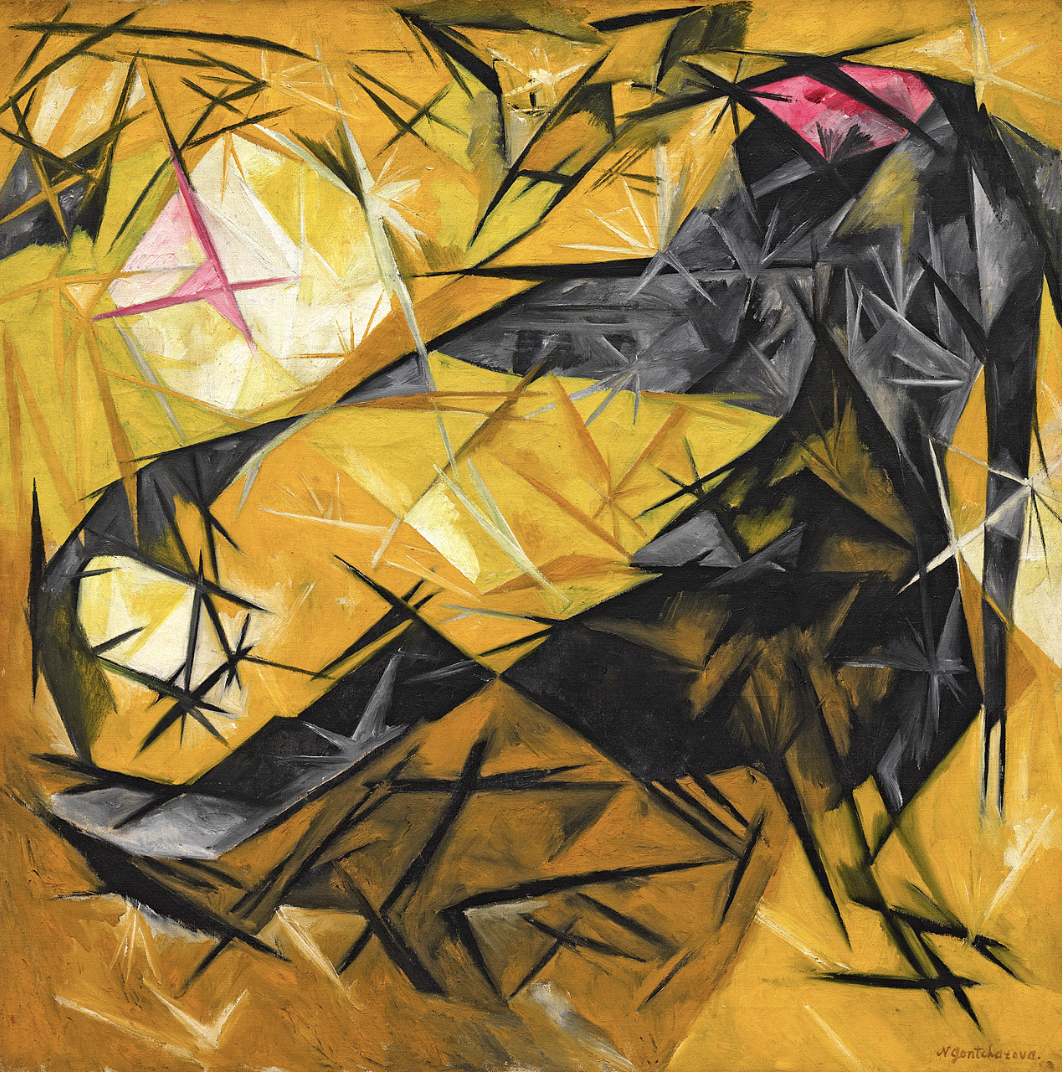
Cara explores how Natalia Goncharova redirects the ambitious, often technologically oriented rhetoric of Russian avant-garde abstraction toward an intimate and playful subject: domestic cats.

In the RISD Museum’s “Trading Earth” exhibit (April 9, 2022 - August 3, 2025), a silver vessel stands quietly in the Tea Cabinet. What is this object and whose story does it carry? Tracing the history of the 'mate con bombilla', a traditional yerba mate vessel in Argentina, reveals a far more entangled past, one shaped by trade, colonial exchange, and the global circulation of both materials and meaning.


Elongated and glinting, a small silver vessel rests tucked into the right corner of the Tea Case’s second shelf in the RISD Museum’s Trading Earth Exhibition. Dwarfed by the other tea objects in the case, this object does not seem to be anything special compared to the swirling, colorful glazes of the Double-Spouted Teapot and the Mochaware Teapot beside it. But it is for these reasons—its unassuming color palette and the sharp, decorative lines that give way to swirling floral motifs and drooping banners—that it caught my eye.

This burnished silver 19th-century mate (mah-teh) Cup with Bombilla (bohm-bee-yah or bohm-bee-shah inRioplatense Spanish) is an exquisite example of South American silversmithing that emulates the bulbous shape of the calabash gourd, or porongo (Lagenaria siceraria), which was used to drink an herbal infusion of Ilex paraguariensis (yerba mate). Other than its short neck and slightly domed lid, the other features that set it apart from its naturally-occurring counterpart are the silver chain that connects the lid to the mate’s body, the polished tripod—three skinny legs that are footed by little boots, emulating those of the gaucho (the Argentine and Uruguayan cowboy)—and the long silver bombilla (filtered drinking straw). Though its exact design is hidden by the mate, this bombilla is a spoon bombilla, which resembles the others in RISD’s collection, and remains undecorated, as most of the decoration on such bombillas appears on the bombilla tube, just before the tip. What the bombilla lacks in decoration, however, is made up for by the mate’s visually pleasing design.

By dividing the mate into five registers of decoration (see above), it is evident that the imagery capitalizes on the vessel’s connection with both the natural and man-made worlds. The foliate chasing in Registers 3 and 5 mirrors images of the natural world: the band of decor near the mate’s shoulder mirrors the leaves of the mate plant that jut out from its branches, while the band at the bottom of the mate resembles the vines of the calabash plant that sinuously crawl around the jungle floor. Register 1’s geometric, diamond-chevron pattern and Register 2’s emptiness, except for areas where the mate is dented or where the maker accidentally hit it, captures some parts of the man-made world’s preference for symmetrical, almost-perfect designs to adorn the vessels they use for everyday life. To me, Register 4 conflates the natural and the man-made. The heavily chased banners with stylized floral borders are carefully chiseled on the inside, giving the illusion of a tightly twisted natural fiber cloth or festoon. The pendant’s alternate heavy and light chasing designs pulls the fabric down, creating a sense of weight. This contrast in the mate’s decoration, therefore, situates it on the border between the natural and manufactured worlds, a notion that also applies to the history of yerba mate.
As a vessel completely made from silver, I imagine the mate carries with it a slight metallic scent that is neither too pungent nor acrid. If I focus enough, however, I believe I could catch the slightest note of the yerba mate itself: an earthy, smoky aroma that builds the complex flavor profile of this infusion and lingers on the metal. Running the pads of my fingers over the face of the mate, I would feel the roughness of the chasing designs contrasted by the smoothness of the unblemished silver. If I were to hold it, just as it is displayed, this light vessel would be cold for just a second and then warm up slightly, as the metal absorbs the heat from my hands. Nevertheless, if the mate were in use, I would most certainly feel the warmth radiating from the hot water and the heaviness of the mate, as it holds the perfect ratio of water to yerba. If I close my eyes, I can hear the light scraping sounds that the bombilla would made as it grazes the sides of the mate on its way into the cup, the ping that the mate’s lid would make as it comes into contact with the vessel’s body, and the dull clank that the gaucho boot-footed tripod would make as the cebador (one who prepares mate) sets it down to begin the mate ritual.
In essence, the mate is more than just a specialized teacup. Rather than boiling a mixture of tea leaves and water in a separate teapot and pouring it through a filter into a teacup, the mate provides one vessel wherein both the brewing and drinking processes occur. Nevertheless, this required innovation in the way one drinks the infusion—if you drink mate like regular tea, you will get a mouthful of herbs, which is not an enjoyable experience. Therefore, the bombilla was developed to act as both a filter and straw, so that the cebador(a) and his (or her) friends were able to enjoy the pure flavor of the mate, focusing instead on the social aspect of the ritual.
The tradition of drinking mate is a legacy of Guaraní culture that began long before the Spaniards imposed their era of colonization. The Guaranís called this plant ka’a, meaning plant or herb and believed that, in one of many versions of the story, it was a gift of the goddesses Yací, the moon, and Araí, the cloud, to an old man who protected them from a dangerous encounter with a jaguar. In his dreams, the goddesses told him to dry and smoke ka’a to create a “bebida [que] reconfortaría al cansado y tonificaría al débil (a drink that would energize the tired and tonify the weak),” which would ultimately become a “símbolo de amistosa hermandad entre los hombres (a symbol of close-knit brotherhood)”. For the Guaranís, ka’a was primarily a medicinal herb that “‘lightens work…purges their stomach of phlegm…makes the senses alert…dispels drowsiness’” (Sarreal 25). In her book Guaraníes y jesuitas, Lucía Gálvez writes that the Guaranís “las masticaban…para tener más vigor (they would chew [yerba mate leaves]…to have more energy),” a practice that has, unfortunately, since disappeared (Gálvez 30, 160). In terms of the social meaning of ka’a, Julia Sarreal mentions that it was even used “to facilitate relationships and to mark special events,” such as weddings (Sarreal 25-26).
Once the Jesuits arrived in Argentina in the 16th century, however, everything changed. Rather than letting the plant grow free “en forma silvestre (in its wild form)” (Gálvez 30) and honoring the natural world, the Jesuits “were the first to attempt its cultivation” in plantations called yerbales that were driven by indigenous labor. This formerly unknown herb was a lucrative economic enterprise that, while initially cultivated to “meet crown tributary requirements,” grew into a massive operation and spread all around the Spanish Viceroyalties in the 18th century, suiting the needs of the man-made world (Folch 15). Sooner or later, everyone (young and old, rich and poor, Mestizo, Indigenous, or Colonist) began to drink the mate infusion and partake in the Guaraní mate ritual (Figs. 9 & 10), “the universal sign of hospitality to offer maté in this manner” (Butler 13-14).
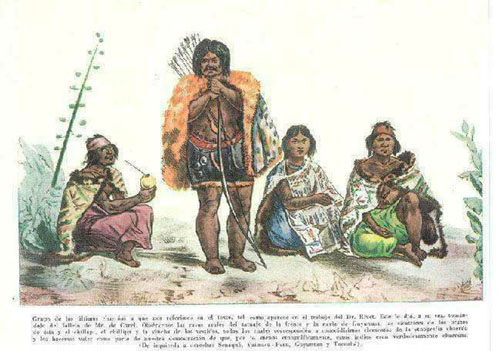
When they first began drinking mate as an infusion, the Guaranís would harvest the finest porongos from deep within the Amazon and dry them to create what we now recognize as the mate cup. Different shapes were created according to regional preferences, creating a mate vessel that had diverse and personal characteristics.


Of course, as more and more people—colonists and Indigenous people alike—drank mate, the need for a differentiation in status and social identity among mate drinkers arose. As such, various new mate cups began to emerge all around the Spanish New World. Pau Navajas, the author of the book “Caá Porã: The spirit of yerba mate” notes that the aristocrats “mandaban a labrar sus mates a Potosí, con la plata de ahí. Cuanto más ostentoso, elaborado y barroco fuera, más refinado se lo consideraba (would comission their mates to be made in Potosí, with the silver from there. The more ostentatious, elaborate, and baroque it was, the more refined it would be considered (Fig. 5).
If we return to the RISD Museum’s Mate Cup with Bombilla, we note its unusual all-silver body compared to the silver-lipped and natural porongos.
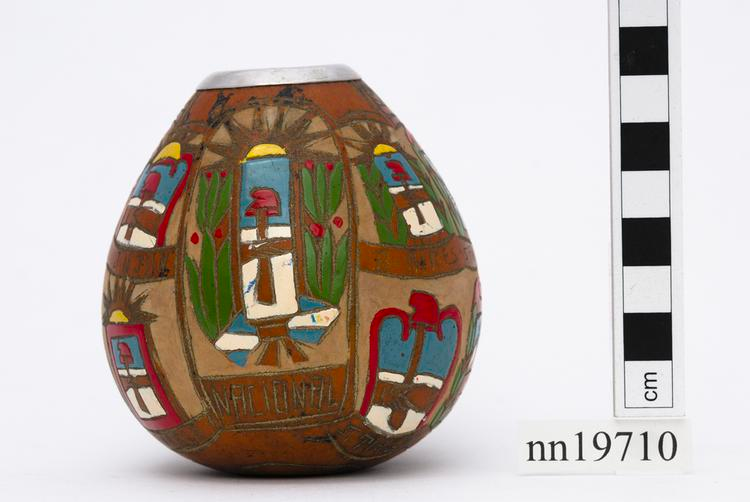
Even in paintings by 19th-century European artists, none of the subjects drink mate out of an entirely silver vessel, which attests to the fact that this was a demand of the nobility. If they were commissioning their mates from Potosí, they required a certain air of excellence in craft that could only be met by the skilled silversmiths of Alto Peru. In terms of the creation of all-silver mates, it seems that the silversmith would work silver by annealing it and rotating it over an anvil and hammering outward to mimic the rounded porongo shape. For the decor, the silversmith could either use repoussé and chasing techniques or attach silver appliqués. As this was a spoon bombilla, it could have either been poured in a mold to get the perfect circular and straight shapes or similarly hammered by the silversmith.
With innovation in form comes innovation in style, and various styles can be traced back to different makers. This Mate Cup with Bombilla does not fit the mold of any particular style: but if I had to guess, I would say that it mostly resembles the Alto Peru style—characterized by an ovoid shape, a tripod, a lid attached by a fine chain, geometric designs, and a mate completely covered in silver—but integrates certain design choices of the Mate Chileno style—especially the preference to mirror and focus on an “armonía de las proporciones (a harmony of proportions).” It seems, therefore, that for a wealthy Spanish audience in the Viceroyalty of Río de la Plata, the Rioplatense vision of art included a move away from the frilly designs of the revered Baroque and Rococo styles, which is directly reflected in this mate cup (compare the RISD mate to the one below, made for an American).

Nevertheless, through this interconnectivity and exchange, we see that the meaning of mate has changed: rather than persisting as a vessel for healing, it became commodified—an “object of consumption”—and was entrenched in a narrative of colonial hierarchy and material wealth. Ironically, by commissioning their mates to be made from silver, the wealthy Spaniards were slowly poisoning themselves—as the repetitive use of the silver mate and bombilla to drink the hot mate slowly leeched silver into their bodies—and negating the health benefits for which ka’a was initially prized. In implementing their personal tastes, the Spaniards transformed the recipes and mates of this centuries-old tradition that still persists today: for example, if some found it too bitter, they would add sugar (Sarreal 25), milk, cinnamon, and cloves.

This does not mean, however, that mate ceased to exist as a social ritual. Rather, the magic of the mate ritual is a five hundred-year-old plus tradition that grows stronger every day. Since colonial times, Argentines have reclaimed mate as a symbol of healing, both through nature and through social/communal activity, which is reflected in the preparation and enjoyment of mate. This preparation process cannot be hurried and the steps must be followed with precision in order to honor the gift from Yarí and Araí, to honor the living energy of the Earth. Mate is prepared with love to welcome others into their homes, extend friendships, and initiate newbies to achieve a special bond. For each mate circle, there is a dedicated cebador/cebadora, who “oversees the mate round” and is in charge of refilling the mate after each person drinks, passing it around, and changing the yerba so that the mate does not become lavado (washed-out) (Sarreal 9-10). The mate circle continues for hours at a time—it is a time and place where friends and family members bond, where stories are told and secrets revealed, where bonds are strengthened and a magical atmosphere of trust and belonging settles. As Gómez describes, “the drinker’s understanding of the other will ultimately shape how the relationship between the drinker and the act of drinking will manifest.”
To drink mate is not to simply sip a cup of ‘green gold’ in a gourd, but to be intimately aware of the complex flavor profiles and the processes of preparation that make up its history. To drink mate is to be an active part of one’s community, reaching for the tender social and communal bonds that hold us together as family, friends, and strangers. Every mate has a story, and though the lost information of RISD’s mate seems to be an obstacle, it forces me to draw together the mate’s artistic forms, iconographic representations, and socio-economic history and weave them together in my own tale of unity, friendship, bonding, and healing, that I now share with you. From its existence in the duality of the natural and the man-made to its loss and rediscovery as a vessel of healing, this mate embodies these ideals that permeated its visual representation and persisted through its historical context, making it such an important, unifying symbol of Argentine culture today. For as Valeria Trapaga, the first Argentine mate sommelier, once said, “Frente a él [mate] [somos] todos igualados (In front of mate, we [are] all equal).”
Bibliography
Gálvez, Lucía. Guaraníes y jesuitas: De la Tierra sin Mal al Paraíso. Buenos Aires: Editorial Sudamericana S.A., 1995.
Joyce, T. A. “Use and Origin of Yerba Mate.” Nature 134 (1934), 760-762. BruKnow PDF.
Sarreal, Julia J. S. Yerba Mate: The Drink that Shaped A Nation. Oakland: University of California Press, 2022. BruKnow PDF.
(Cover Image: Juan Manuel Blanes (1830-1907). Unknown title from Los Gauchitos Series. Unknown. oil on canvas via Museo Juan Manuel Blanes, Montevideo)
Cara explores how Natalia Goncharova redirects the ambitious, often technologically oriented rhetoric of Russian avant-garde abstraction toward an intimate and playful subject: domestic cats.
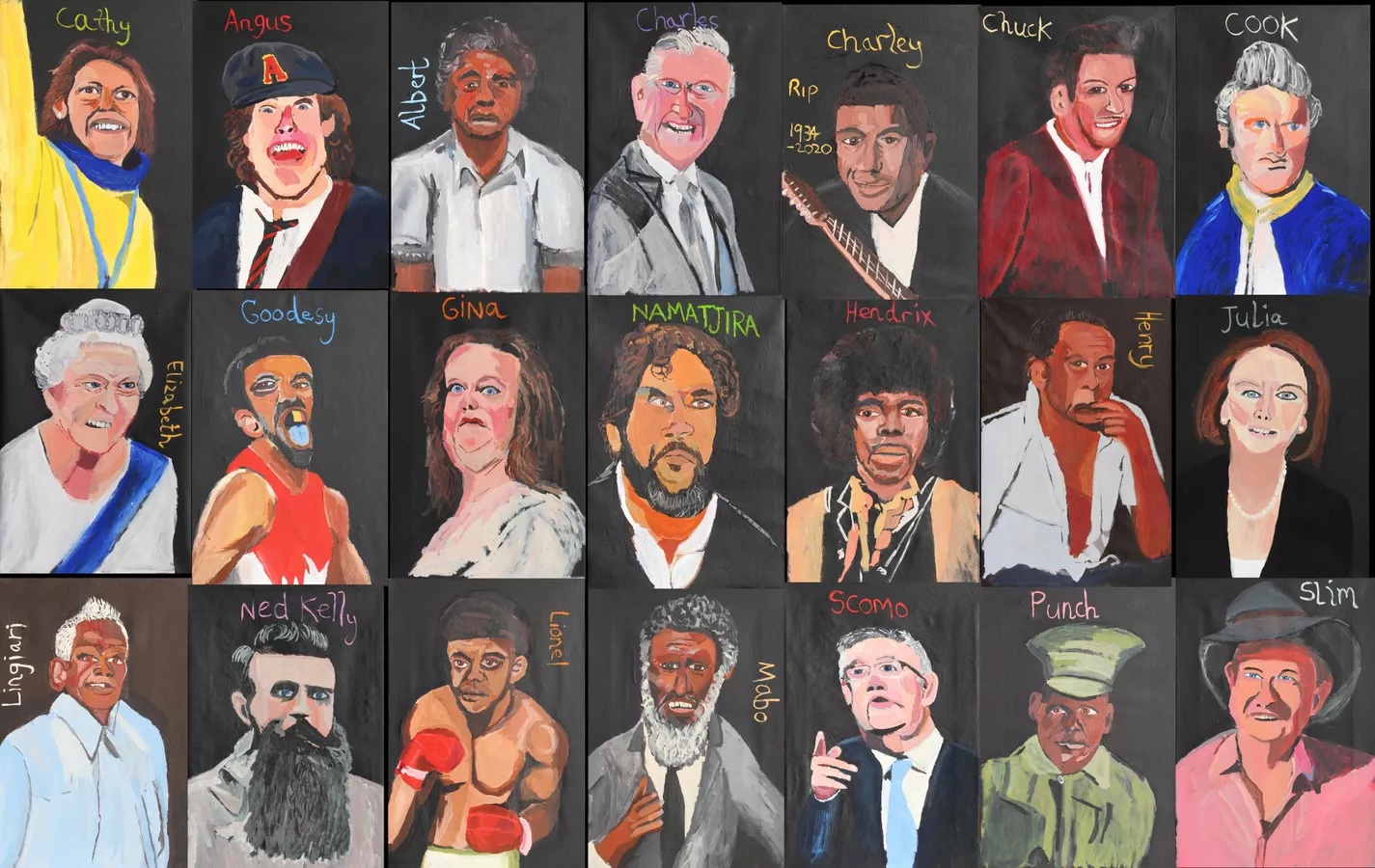
Kate explores how Australian artist Vincent Namatjira redefines portraiture to confront the legacies of colonialism while envisioning a more inclusive future—one expansive enough to embrace all Australians.

Clarke Reynolds (Mr. Dot) talks with the Art Review about interactive art, changing the narrative around blindness, and creating a world where art is more accessible for all.