May 1, 2026
Opinions
Opinions
Cara explores how Natalia Goncharova redirects the ambitious, often technologically oriented rhetoric of Russian avant-garde abstraction toward an intimate and playful subject: domestic cats.

How important is medium for meaning? Can we even distinguish the two? Blek le Rats’ "Venus in Mexico" forces us to consider how meaning intertwines with medium.


Art has long established itself as an irreplaceable pillar of society, one that forces its viewers to reflect, admire, push back against the norm, and reconsider their perspective. Through the various artistic movements that have shaped the past centuries, art has grown to mean different things to different people, adapting and taking on new roles in social, historical, and political spheres. One such movement comprises something many stumble upon in their daily life: graffiti. Street art, since its birth in the ‘60s and ‘70s, has revolutionized the art world, playing with medium and meaning, and shaping city walls. Featuring animals, people, characters, and various scenes, street art serves as the bridge between the world and the individual—where the work of one becomes the reality of others.
This article explores the role of Classics in street art, specifically in Blek le Rat’s Venus Mexico. Beginning with an introduction to and interpretation of Venus Mexico, this paper then explores graffiti theory and the street art movement as a whole, the local traditions of street art in Mexico, and Blek’s work and motivations. Finally, this paper will end with an examination of a Classical Venus in Mexico—highlighting the role of Venus in Mexican and Mayan culture and questioning the meanings and motivations behind including a classical figure in a non-European social justice context.
Of the numerous artworks accredited to Blek le Rat (b. 1951), Venus Mexico (Fig. 1) is one of the few that boasts a clear classical influence regarding the subject. Using his renowned stencil technique, Blek le Rat’s Venus Mexico borrows its form from Venus de Milo, a marble statue from the Hellenistic period that is now housed in the Louvre Museum. The composition contrasts starkly with its background, as Venus de Milo’s black-and-white spray-painted stencil juxtaposes the colorful greens, yellows, and reds of the concert posters behind it. The photograph of this artwork was taken by the artist himself on October 26, 2009, granting us the liberty to assume that Venus Mexico was painted before or around that date. The exact location of this artwork is unknown, maintaining the same sense of ambiguity as the date. The only clues to its location are in its title, Venus Mexico, and in the composition’s surroundings—the writing on the newspaper stand to the right of the object is clearly in Spanish and the posters behind Venus advertise a music festival with primarily Mexican artists. Beyond that, the exact location of this artwork is unknown.
The statue faces the unknown, most likely overlooking a sidewalk or walkway given the electrical box and security gates to the left of the artwork. Venus’ forlorn gaze is focused on her surroundings while she stands in contrapposto, with her gown draping over her hips. Her upper torso remains bare, highlighting the statue’s missing arms. The complex interplay of black and white transforms the statue into a vivid painting that maintains the depth and complexity of the original work. While the artwork is recognizable, its location is inconspicuous—wedged between a newspaper stand and the building’s concrete support—contrasting to the statue’s overt place in the Louvre, where it is flocked with visitors daily. The positioning of this artwork makes its role clear: it is a part of the city, something that the residents see on a daily basis, but not an attraction worthy of a crowd.
To begin this section, I will define street art. In his paper, “Street Art: The Transfiguration of the Commonplaces,” Nicholas Riggle engages his readers in an imaginative exercise to attempt to define street art. Of all the images he proposes, I will highlight the two that I find most interesting. First, he tells his readers to imagine artworks that are “largely disconnected from the artworld because their significance hinges on their being outside of that world” (Riggle 2010, 243). I find this particularly interesting as Riggle implies, through this statement, that street art is not art, or at least its very understanding relies on the fact that one must categorize it as separate from the known art world. However, this does not seem like a proper definition of street art, as arguing that the movement is not part of the art world allows some to argue it is lesser.
Riggle then proposes that street art: "instead of delighting merely the refined sensibilities of an elite few, has the power to engage, effortlessly and aesthetically, the masses through its manifest creativity, skill, originality, depth of meaning, and beauty" (Riggle 2010, 243).
But how is this different from the art that one finds in museums? Based on this statement, we can then understand street art, very broadly, as “art placed on the street, where ‘the street’ is taken in a very broad sense to denote, roughly, any urban public space” (Riggle 2010, 244). That is an equally unsatisfactory definition, however.
After a few more paragraphs of exploration, Riggle eventually offers a definition of street art that he finds satisfactory: “An artwork is street art if, and only if, its material use of the street is internal to its meaning” (Riggle 2010, 246). This appears to be a solid definition, one that emphasizes the importance of the street in street art, but that likewise places street art among other art forms that require artistic resources and techniques, such as painting and sculpting. Furthermore, Riggle’s attention to the complex relationship between art, its meaning, and its location crafts a unifying definition that encourages creativity and activism but separates it from other art forms.
Now that I have established a definition of street art, I turn to graffiti theory—or ways scholars have studied graffiti and its proposed meanings—to elaborate on how one must understand the presence of graffiti and street art. Graeme Evans introduces the idea of “place-making” as a lens through which to analyze the use, presence, and argument against graffiti and street art in his chapter “Graffiti art and the city: from piece-making to place-making” (Evans 2016, 162). Throughout his chapter, Evans emphasizes how graffiti and street art are not just from the individual, but instead can be used to create community and affect the interactions and dynamics of a city (Evans 2016, 162). In Evans’ view, graffiti and street art become essential tools for transforming spaces from spaces we “‘use’” to spaces “we experience…individually, productively (i.e. work) and collectively” (Evans 2016, 175).
This trend seems to be spreading across the world, not just in large metropolitan areas, as the “instrumental use of street art” is “increasingly used in city branding and place-making efforts and strategies” (Evan 2016, 174). Street art and graffiti, therefore, are more than just an individual’s social commentary, but instead, a strategy to change an area and brand it as something other than what it once was. This view suggests that a once personal act of art (the creation of street art) has been commercialized and twisted into a tool for local governments to use. However, the existence of place-making street art does not deny the presence of individuals who make street art for their own purposes but instead acts as an antithesis to the individual’s art. Determining which artworks fall under this “place-making” strategy and which ones stay true to the social activism roots of the movement is quite a challenge, as the intention behind the piece changes its meaning altogether. However, the existence of this challenge suggests that street art is inherently succeeding at its goals: it is causing conversations and bringing people together, whether it is fabricated by a larger corporation or group or by the individual.
Mexican muralism, a movement that started in 1920 after the Mexican Revolution, is a movement that aligns closely with street art. Featuring “monumental public murals” that “depicted the history and everyday life of the nation’s people,” this movement created a new, avant-garde technique of establishing a “new relationship between art and the public” through art. Unlike the street art movement, however, Mexican muralism was a movement commissioned by the new, illegitimate government of Ulises Ruiz. However, it is rather easy to understand this movement as propaganda: “The government needed to construct a shared understanding of Mexican identity and national history,” and pictographically connecting citizens through murals of shared experience was a definitive way to do so. Nevertheless, the work produced during the Mexican muralism movement was a vibrant and colorful exploration of self, community, and heritage, one that connects people together in the same way that street art does.
A more recent example of street art in Mexico comes from Oaxaca in 2006. In late October 2006, seven individuals were murdered by officials in the government occupying Oaxaca (Nevaer 2009, 6). Instead of holding the illegitimate government accountable for its actions, President Vicente Fox used this incident as a precedent to continue violent attacks against the citizens (Nevaer 2009, 6). Out of these horrific attacks emerged dedicated and powerful street artists, like ArteJaguar, with the common goal of “rebuilding a people’s identity, [and] of reclaiming historical symbols” (Downs 2029, 13).
Through these artworks, the people of Oaxaca, although hurting and shaken from the tragedies, used street art to create a new language, shaping the visual narrative and pushing the community together. Each image adds to the “discourse,” creating a complex web of commentaries, and, as Lila Downs writes, as the “repression continues, the symbols become stronger, and they come to life” (Downs 2009, 13). The figures used in the street art in Oaxaca become more than just painted individuals, they became victims, warriors, villains, and civilians—characters that come to life in the painted stories. In contexts like Oaxaca, street art becomes the medium for social justice, rallying communities together to face matters that affect them intimately.
Xavier Prou, more commonly known as Blek le Rat, was born in Paris in 1951 and is widely “credited with starting the stencil graffiti movement.” With a vibrant career spanning over four decades beginning in the 1980s, Blek le Rat, often shortened to just Blek, began his career as a graffitist in a duo named BLEK, working on his pieces in the dead of night and observing passersby’ reactions during the day. His early work featured stenciled “little rats, these bananas, [and] the little running men,” but by 1983, after years of perfecting the stencil technique, Blek transitioned into life-sized artworks. As a result, numerous figures appeared in the streets of Paris, attracting attention from local residents and the press alike. Although equally thrilled by the reception of his work, Blek’s pieces, especially his rats, were his way of commenting “on the urban environment whilst symbolising certain members of society.” As expected of all good commentary, more artists soon joined the conversation, and the streets of Paris became the vibrant pages across which complex “dialogue” was exchanged
However, this seeming booming age of graffiti and street art in Paris began to face a foe, as the “(...criminal justice system) began to stretch out its feelers.” In 1984, Blek was arrested for the first time—an event that, instead of stunting his art, inspired him to push the limits of his creativity further. In 1991, he was arrested again. At this time, Blek, along with other graffitists and street artists in Paris felt the effects of the “war on graffiti” as authorities began to adopt a stricter response to this art form. Despite this, Blek’s work has permeated beyond Paris, with his works featured in many of the world’s major metropolitan cities. Beyond the geographical spread of his work, Blek is widely considered to be the father of stencil art, inspiring a new generation of street artists. Most famously was Bansky, an internationally recognized, yet anonymous, street artist and activist. Bansky draws upon Blek’s work, though unintentionally at times: “Every time I think I’ve painted something slightly original, I find out that Blek le Rat has done it as well, only 20 years earlier,” he wrote in his book, Wall and Piece Bansky and Blek are respected in this movement in their own right, as their artworks function in tandem to further the movement as a whole.
Like most works in the graffiti and street art movement, Blek’s pieces convey a meaning that extends beyond the aesthetics of his artwork. In a 2023 interview with Art Plugged, Blek emphasized that his work is “never political,” but always inherently “a social statement,” bringing attention to social issues such as homelessness, poverty, religion, the economy, and war. The figures Blek chooses for his works highlight the messages he intends to share, as one series which commented on homelessness across Europe, the US, and Australia features the stencil art of beggars. He understands the importance and power of images in a social justice context, as “sometimes, images have a bigger impact than reality.”
Blek’s art, therefore, becomes a powerful conversation starter as people are drawn in by the stunning art, but linger to discuss its meaning. As such, the location in which he places his art is equally as important as the figures he chooses to display, and Blek pays special attention to “ensure it works for the environment and surroundings and will give the most impactful and correct message of the work.” The careful planning of Blek’s pieces, from the stencils he chooses to the location where he paints, transforms his art from what some may consider a defacing of public property to a thoughtful provocation of the status quo, a loud yet voiceless protest against injustice.
As the father of the movement, Blek seems to speak for all those who follow in his footsteps, emphasizing the true purpose of street art. Street art is a community-building activity, from its creation to its viewing, as “these images are intended words to the community.” Therefore, street art is in constant flux—not only is it a social movement, one that pushes for the betterment of the world, but it also weaves through the community, connecting individuals through shared experiences and interpretations.
Having explored the meaning of Blek’s work and the contexts in which they exist, I would like to turn my attention back to Venus Mexico. The aims of this section are broad, but necessary for our understanding of the role of classics in street art and to ascribe meaning and motivation to Blek’s inclusion of a classical figure in a non-European social justice context. I will begin by exploring the role of Venus in Mexico and emphasizing its cultural importance. From there, I attempt to reconcile the classical, Greco-Roman view of Venus with Mexican and Mayan culture. Finally, returning to Blek and the meanings of his works, I will then work to mesh the use of classics with both Mexican culture and social justice.
In Mesoamerican and Mayan culture, Venus was not known as the Roman goddess of love, but rather was revered as a planet and a stellar being. Taking on an important role in the “art, ritual, oral traditions, and symbolism of warfare,” Venus, or the “Morning Star,” became Tlahuizcalpantecuhtli, “a fearsome being but also an aspect of the feathered serpent Quetzalcoad” who is likewise a revered figure in Mesoamerican culture (Mathiowetz et al. 2015, 1). Rooted deeply in “socially shared beliefs of fate” throughout central Mexico, Tlahuizcalpantecuhtli is a complete contrast to the Roman Venus—he is feared where she is admired. Not only is Venus, as the Morning Star, a male, but he is often depicted as a skeleton without flesh and armed with a spear (Mathiowetz et al. 2015, 5). In addition to his association with war and warfare, he is “intimately related to rain and maize agriculture” (Mathiowetz et al. 2015, 5). There are many mentions of Venus in various codices, such as the Madrid Codex, and the Nahuatl text Anales de Quauhtitlan, a Colonial period text from which the story of Tlahuizcalpantecuhtli seems to originate (Vail 2017, 480). The overwhelming presence of Venus in these codices is an area of study with numerous sources, highlighting the importance of Venus in Mayan and Aztec culture.
Furthermore, Uxmal, a Mayan site dating to around 750-1000 AD, bears prominent evidence that the site itself was built with the Venus synodic in mind (Lamb 1980, 79). In his paper, “The Sun, Moon and Venus at Uxmal,” Weldon Lamb suggests that the “five doorways of the East Building facade evince knowledge of this cycle” and that the specific size of each of the nine steps leading to the courtyard “might record the knowledge of the eight-year, five-synodic cycle” (Lamb 1980, 83). Throughout his paper, Lamb suggests that the very architecture of the East Building at Uxmal, which was used for ceremonial rituals, was intentionally designed to acknowledge Venus and its planetary motion. Therefore, Venus was not only a literary figure who existed in codices and books but also one inherently tied to religion, culture, and society, even in the most nuanced ways. While Mayan and Aztec culture may have held Venus in a prominent position of power, however, it does not seem that modern-day Mexicans view him in the same regard. Nevertheless, Venus’ historic importance is impossible to ignore, even in light of modern perspectives.
We must, therefore, question: what does it mean to use the classical, Greco-Roman figure of Venus in Mexico when Venus was once revered in Mesoamerica? Is this one example of the ever-common abuse of classics, where Classics is used to overwrite another culture?
Blek’s artwork is spray painted directly on top of posters for a musical event, and despite the photograph being taken in October, the partially covered text reads “VIEMBRE,” which could mean Noviembre, or November, implying that the concert has yet to happen. This is a blatant overshadowing of the existing culture—by painting over these posters, one may argue that Blek consciously chooses to hide aspects of modern Mexican culture with this classical figure and, therefore, uses his art to exalt a Eurocentric and white art form over a non-white, Mexican one. While this is a seemingly valid argument to raise in response to Blek’s choice for his artwork, given Blek’s social justice background, I would like to take a step back to explore the other potential meanings behind Venus Mexico.
To aid in this exploration of meaning, I would like to introduce Venus del Mitreo (Fig. 2), a street art mural by Spanish duo PichiAvo (Pichi, b. 1977; Avo, b. 1985) depicting the reimaged bust of the headless Venus del Mitreo in Mérida, Spain inspired by Aphrodite of Syracuse. In this mural, Venus’ face is turned away from the audience, leaving only her profile visible as she looks off to her surroundings. While clearly representing a statue, the purples, oranges, blues, and greens of the work, as well as the graffiti tags along the border, transform this sculpture from a simple piece of history into a new, exciting artwork that seamlessly connects the classical with the modern. Spanning multiple stories of a building, this vibrant mural offers a curious commentary on the “absence of matter, fragmentation of archeological pieces and the reconstruction of Classical artworks.” The duo PichiAvo is unique in that their works solely focus on figures of antiquity, and they seamlessly weave “classically idealized portrayals of deities like Mercury and Venus” with “contemporary street art.” The meaning of these pieces is closely tied to the location where they are painted, and Venus del Mitreo is no different: the inspiration for this artwork, Venus de Mitreo, is at the Museo Nacional de Arte Romano, which is also in Mérida, Spain.
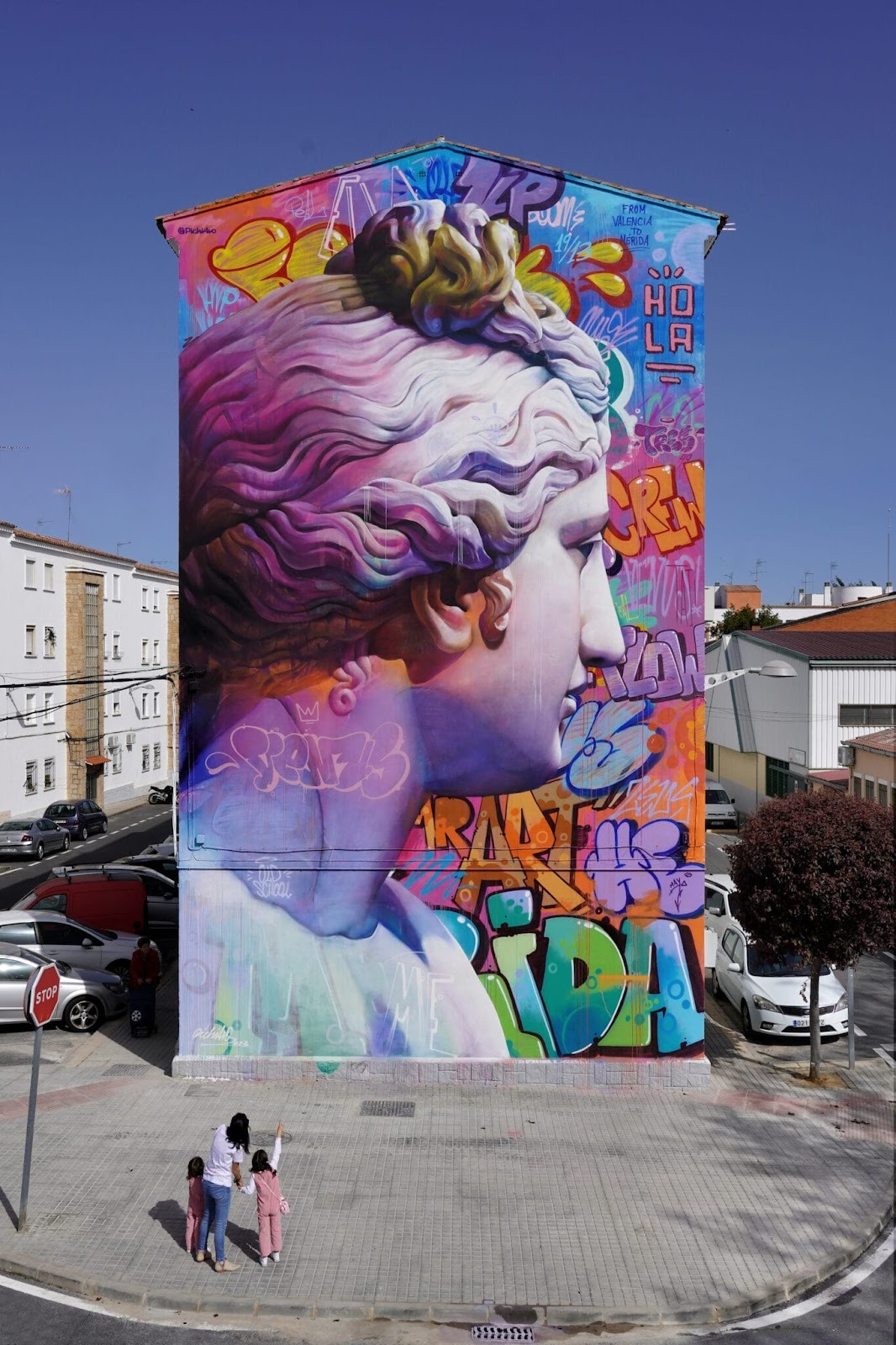
While this work seems to mirror Blek’s Venus Mexico in many ways, there is one important difference. This piece by PichiAvo is of a project with Museo de Muralismo Contemporáneo de Mérida. This inherently changes the meaning, context, and implications of this painting, as sponsorship from a museum implies an agenda the museum wants to further, whether that be issues of race, class, socioeconomic status, or simply advertising their museum. Any individual social or political statements this artwork may be making are shrouded by the museum’s presence, leaving the audience guessing as to whether the true intention of this artwork is shrouded by a hidden agenda.
This work is not street art in the traditional sense, but rather transformed into an exhibition. Nevertheless, this specific work of art does not seem to be pushing a specific message that relates to issues of social justice, as its focus is more on the status of classical artworks. Regardless, this artwork places a classical figure at the forefront—this work is massive, and one can argue that scale is a tool the artists use to emphasize the importance, prominence, and perhaps even superiority of Venus, other figures of antiquity, and other Eurocentric views. Blek’s work, by contrast, is not tied to any larger association with museums or individuals who could influence the piece’s intended message. However, the issue of whether Blek’s work pushes Eurocentric and classical ideals over indigenous Mexican ones still stands.
As discussed in the previous section, Blek’s works are inherently intertwined with social justice and, in some way, make a comment on society. However, I find it hard to reconcile the use of classics with both Mexican culture and social justice. Therefore, I focus once more on the figure Blek chooses to feature in Venus Mexico. There are two noticeable features about this figure: first, this artwork features one of the few Classical figures in Blek’s work, and second, upon my study of his catalog, Venus Mexico seems to be the only artwork that involves its stencil. If Classical figures are not frequent in Blek’s works, one can rightly assume that the few he does choose to feature must have a unique meaning, one that is external to the Eurocentric and white supremacist legacies these statues carry. It is reasonable to assume that, given his prominent presence in the Street Art community, if Blek wished to promote such ideas, his work would feature more Classical figures and would have less of a focus on social justice. Operating under this assumption therefore allows us to move away from a racial-focused or white-supremacy interpretation of this artwork.
This iteration of Venus Mexico seems to be the only one of Blek’s artworks with its stencil, Venus herself seems to be an important figure to Blek. Before the Romans superimposed the role of the Greek Aphrodite on her, Venus was an “ancient Italian goddess associated with cultivated fields and gardens,” and thus was perpetually tied to the idea of fertility. However, after this shift, the Romans worshiped Venus as the goddess of love and a figure of beauty and eroticism.
Since then, she has long been a well-known face in the art world, with hundreds of paintings and sculptures sharing her visage. With her fame, Venus has attracted numerous activists who use paintings of her as their medium to bring attention to their cause. One such event occurred on March 10, 1914, when a suffragette Mary Richardson attacked Diego Velázquez’s Toilet of Venus (ca. 1647-51) to protest the treatment of Emmeline Pankhurst, the leader of women’s suffrage. This attack permanently transformed Venus from a mere figure of beauty and love to one of activism and feminism, as this painting will forever “‘be a sign and a memorial of women's determination to be free.’” More recently, in February 2024, two environmental activists defaced Sandro Botticelli’s The Birth of Venus in the Uffizi Gallery to garner support for victims of the deadly flooding in Tuscany the year before. Therefore, through the use of paintings featuring Venus, activists worldwide have transformed the goddess from an outdated and shallow figure of antiquity to a complex advocate who has earned her place in the modern world.
In every work of art that depicts her, from sculpture to graffiti, Venus plays a complex role that extends far beyond her realm as a deity. She becomes a thought exercise, where “artists explore complex emotions and ideals” through her image and the scenes they depict her in. As a being of beauty and sensuality, Venus has long been the idealized woman, but each depiction pushes at the bounds of what is considered perfect and beautiful, subverting the established ideals. Therefore, “the theme of rebirth and new beginnings” abound in artworks featuring Venus artworks, adding yet another facet of complexity to an already multifaceted being. Each painting with Venus “reflect[s] the evolving standards of beauty, the complexities of love, and the profound impact of mythology on human culture,” transforming these works into a commentary where Venus is the conversation starter.
Through modern reinterpretations of the goddess and her story, artists stretch the bounds of Venus, reimagining her and further rooting her in recognizable and novel ideas. As such, Venus has grown to represent more than she ever has, standing tall as a figure of “feminism, the democratization of Western art, and the progression of capitalist economy.” Though the artists who depict her still pay homage to her Greek and Roman roots, Venus has stepped into the present through the work of hundreds of artists, Blek included.
Combining the activist role that others have imparted upon her and the common interpretations of her presence in artworks, I propose that Venus is the perfect figure for Blek’s message of social justice and the street art movement. The goddess exists as a fluid figure that adapts to the needs of artists, activists, and people around the world, constantly adopting new interpretations and meanings that reinvent Venus through the lens of the artist. While his motives for placing Venus in Mexico still remain unclear, we can assume that Blek chooses the figure of Venus for a reason.
The premise of Blek’s works has always been to bring awareness to social issues, and Venus has historically been used as a figure of social activism, progression, and new beginnings. Blek infuses the streets with beauty and power through his works and enacts change visually in the same way that Venus stands as a figurehead of those two ideals and empowers individuals worldwide. Despite the fact that Blek has not commented on this artwork or his decision to use Venus in this piece or even in this location, it is possible that Venus Mexico is a symbol of empowerment. Regardless of Blek’s original intent, her mere presence allows passersby to draw their own interpretations, taking away whatever meaning resonates most with them. After all, these pieces are intended to provoke, as Blek writes in his manifesto, and these are “paroles of love, of hate, paroles of life, and of death.”
Works Cited
"About." PichiAvo. Accessed May 14, 2025. https://www.pichiavo.com/about/.
Bacharach, Sondra. "Finding Your Voice in the Streets: Street Art and Epistemic Injustice." The Monist 101, no. 1 (January 2018), 31-43. https://www.jstor.org/stable/26370821.
"Blek le Rat Art." Woodbury House. Accessed May 12, 2025. https://woodburyhouseart.com/artists/blek-le-rat/.
Blek Le Rat. "2000s." Blek Le Rat. Accessed May 13, 2025. https://blekleratoriginal.com/en/2000s.
Blek le Rat. "The Manifesto of Stencilism." Blek le Rat. Accessed May 12, 2025. https://blekleratoriginal.com/en/manifesto.
Blek le Rat. "Venus Mexico." Flickr. 2010. https://www.flickr.com/photos/25mag/4317581617/.
BLocal, Giulia, and Alex Pope. "History of graffiti and street art: the 1960s and the 1970s." STRAAT. n.d. https://straatmuseum.com/en/blog/history-of-graffiti-and-street-art-1960s-1970s?srsltid=AfmBOop1hX1XuJPRK7HeuFU_DedMHsX9g-OYjvVMQLo6fuysxgX7uy17.
Downs, Lila. "See the Walls Scream." In Protest Graffiti - Mexico: Oaxaca, edited by Louis
E. Nevaer, 12-15. New York: Mark Batty Publisher, 2009.
Evans, Graeme. "Graffiti art and the city: from piece-making to place-making." In Routledge Handbook of Graffiti and Street Art, edited by Jeffery Ian Ross, 168-182. Routledge, 2016.
Gorden, Len. "Rats, Rebellion, and Revelation Unmasking The Enigmatic World Of Blek le Rat." Art Plugged. Last modified March 23, 2023. https://artplugged.co.uk/rats-rebellion-and-revelation-unmasking-the-enigmatic-world-of-blek-le-rat/.
Halconruy, Claire. "The representation of Venus in art history." Artsper Magazine. Last modified February 7, 2023. https://blog.artsper.com/en/a-closer-look/the-representation-of-venus-in-art-history/.
Haskell, Barbara. "América: Mexican Muralism and Art in The United States, 1925–1945." Whitney Museum of American Art. Last modified 2020. https://whitney.org/essays/america-mexican-muralism.
Jebb, Louis. "How Velázquez's 'Rokeby Venus' became a symbol of public pride—and political protest." The Art Newspaper. Last modified November 8, 2023. https://www.theartnewspaper.com/2023/11/08/how-velazquezs-rokeby-venus-became-a-symbol-of-public-pride-and-then-political-protest.
Lamb, Weldon. "The Sun, Moon and Venus at Uxmal." American Antiquity 45, no. 1 (January 1980), 79-86. https://doi.org/10.2307/279661.
Mathiowetz, Michael, Polly Schaafsma, Jeremy Coltman, and Karl Taube. "The Darts of Dawn: The Tlahuizcalpantecuhtli Venus Complex in the Iconography of Mesoamerica and the American Southwest." Journal of the Southwest 57, no. 1 (Spring 2015), 1-102. https://www.jstor.org/stable/24394934.
"Mexican Muralism." The Museum of Modern Art. Accessed May 14, 2025. https://www.moma.org/collection/terms/mexican-muralism.
Moench, Mallory. "Why Protesters Targeted Botticelli’s Birth of Venus by Covering It With Alternative Images." Time. Last modified February 14, 2024. https://time.com/6694718/climate-activists-target-botticelli-birth-of-venus-florence/.
Mothes, Kate. "Monumental Classical Figures and Graffiti Converge in New Murals by PichiAvo." Colossal. Last modified June 13, 2023. https://www.thisiscolossal.com/2023/06/pichiavo-murals.
Nevaer, Louis E. Protest Graffiti - Mexico: Oaxaca. New York: Mark Batty Publisher, 2009.
PichiAvo. "Venus del Mitreo mural in Mérida, Spain." PichiAvo. Accessed May 13, 2025. https://www.pichiavo.com/venus-del-mitreo-mural-in-merida-spain/.
PichiAvo. "Venus del Mitreo." PichiAvo. 2023. https://www.pichiavo.com/venus-del-mitreo-mural-in-merida-spain/.
Riggle, Nicholas A. "Street Art: The Transfiguration of the Commonplaces." The Journal of Aesthetics and Art Criticism 68, no. 3 (Summer 2010), 243-257. http://www.jstor.org/stable/40793266.
Vail, Gabrielle. "Venus Lore in the Postclassical Maya Codices: Deity Manifestations of the Morning and Evening Star." Ancient Mesoamerica 28, no. 2 (Fall 2017), 475-488. https://www.jstor.org/stable/26302049.
"Venus." Britannica. Last modified April 16, 2025. https://www.britannica.com/topic/Venus-goddess.
Vishakha. "Different Venus Paintings You Should Know About." Teravarna. Last modified July 24, 2024. https://www.teravarna.com/post/different-venus-paintings-you-should-know-about.
(Cover Image: Blek le Rat, Venus Mexico via Flickr)
Cara explores how Natalia Goncharova redirects the ambitious, often technologically oriented rhetoric of Russian avant-garde abstraction toward an intimate and playful subject: domestic cats.
Kate explores how Australian artist Vincent Namatjira redefines portraiture to confront the legacies of colonialism while envisioning a more inclusive future—one expansive enough to embrace all Australians.

Clarke Reynolds (Mr. Dot) talks with the Art Review about interactive art, changing the narrative around blindness, and creating a world where art is more accessible for all.