May 1, 2026
Opinions
Opinions
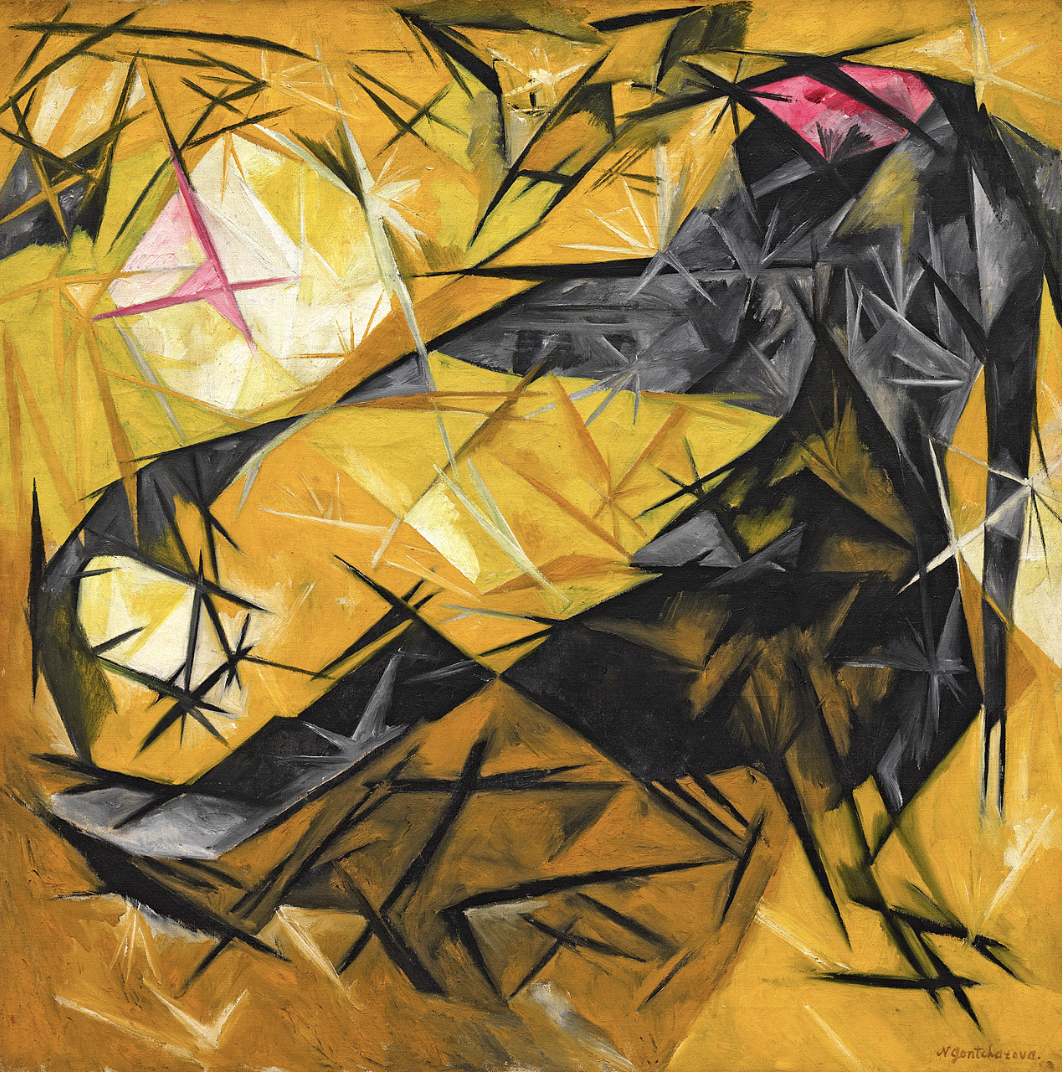
Cara explores how Natalia Goncharova redirects the ambitious, often technologically oriented rhetoric of Russian avant-garde abstraction toward an intimate and playful subject: domestic cats.

Examining the Boschian and elemental influences of Leonora Carrington’s practice.


Long considered a master of enchanted worlds, the celebrated Leonora Carrington completed The Pleasures of Dagobert at the height of her career in 1945, which immerses the viewer in a magical realm infused with divine imagination.
Just a few years prior to the completion of the painting, Carrington and other surrealist painters fled to Mexico since, under Nazi occupation, leadership had determined the work of her colleagues, such as Max Ernst, to be Degenerate Art. Following the move, her work increased in its complexity, as it had previously been primarily influenced by British and Parisian culture. While in Mexico, she befriended cultural anthropologist Ignacio Bernal and became acquainted with pre-colonization myths and images. It is interesting to consider these influences and how they interact with her Catholic upbringing, which becomes apparent in the dream-like scenes she paints. In addition to Catholicism, she was also raised by her Irish mother, whose Celtic mythology is deeply imbued in Carrington’s work. Perhaps this is what drew her so much to the Mexican hybrid Catholicism, which combined folkloric traditions with the Catholic calendar. Another close friend of hers, Remedios Varo, became extremely influential in her work. The two women, somewhat outcasts in the male-dominated surrealist circles at the time, met in Colonia Roma, Mexico City. Alongside Varo, Carrington explored the domestic sphere as a site of magical power. Within her own kitchen, for example, she would concoct spells, prepare herbs, and conduct alchemical experiments. Both Carrington and Varo were recently featured in the Philadelphia Museum of Art’s Dreamworld: Surrealism at 100 exhibition, dominating the “Magic Art” section.
Carrington’s piece, Les Distractions de Dagobert, or The Pleasures of Dagobert, particularly stood out in this exhibition. The work made the news in May of last year when it sold for $28.5 million to Eduardo F. Costantini, thus solidifying Carrington’s position as the most valuable British-born woman artist at auction. This sale placed her among other successful artists such as Louise Bourgeois, Frida Kahlo, Georgia O’Keeffe, and Joan Mitchell. Since then, the work has been exhibited at the Rose Art Museum, Brandeis University, and, most recently, in Philadelphia’s Dreamworld exhibition.
The Renaissance influences in the artwork are particularly evident, both compositionally and thematically. The painting was completed using the egg tempera method, which involves adding powdered pigment to an egg-yolk base, creating a luminous, satin-like finish once dry. Because the paint dries rather quickly, most work with egg tempera is done in a cross-hatching style, which can be seen in Carrington’s composition up close. This technique, which dates back to ancient Egypt, was used in many famed Renaissance works completed by both Botticelli and Michelangelo, but later fell out of fashion and was rediscovered by Carrington and her contemporaries.

The Renaissance references continue as Carrington evokes the style of the famed Dutch painter Hieronymus Bosch. Les Distractions de Dagobert combines many fantastical scenes into one work, which is reminiscent of the well-known Bosch triptych displayed above, The Garden of Earthly Delights. The work was created at the height of the Renaissance, between 1490 and 1500, and, like much of Carrington’s work, combines the mythical, religious, and surreal. By way of their weird and fantastical nature, both paintings elude meaning; at the same time, they carry themes of lust intertwined with potential alchemical, folkloric, and subconscious threads. Pleasure in its many forms is portrayed in both Carrington's and Bosch’s dreamlike scenes.
Another notable aspect uniting the two pieces is their segmented nature. Although less obvious than in The Garden of Earthly Delights, Leonora Carrington’s work, Les Distractions de Dagobert, has a fragmented construction. Critics and historians of her work such as Yves Vadé have related these fragments to the four elements: water, fire, earth, and air. To begin with, the upper left corner appears to be representative of the air element. Above a field of petrified ruins are floating islands in the sky, one of which is occupied by a sleeping figure. Given the influences of Christianity and Celtic traditions on Carrington’s work, it is possible that this quadrant evokes the story of Bernard the Navigator, a Catholic saint who upon departing from Ireland, discovers fantastical rocky islands on his search for paradise. Moving clockwise, the next section appears to represent the earth, where two scenes become evident. This first is a tiny Dagobert, a Mergovian ruler in the Middle Ages, on his chariot going through perhaps the most “earthly” of scenes. He is separated from the other section of earth by a river that bridges the painting’s water and earthly sections, which could be significant as a means of journey to the afterlife. Above Dagobert’s scene, the forest and staircase appear to also carry otherworldly significance, while three standing women seemingly evoking the Fates. Continuing to the bottom right and center, the element of water appears to be a site of metamorphosis for the woman on the boat, doubled by her expanding shadow, as well as the figure in the center. Most notable is the figure’s head, which takes on a white, fleur de lys, horse shape (perhaps referencing the Celtic Mari Lwyd tradition). Advancing to the final section, the element of fire, one sees an inverted person in the flames surrounded by rocky terrain, underneath a spirit dressed in pink playing a triangle-shaped instrument, which potentially symbolizes a harmony between worlds. The crowded, though organized, dreams and realities in Carrington’s worlds are particularly evocative of Bosch’s work.
In addition to being viewed in a circular way, the painting can also be read vertically. Though amidst a dark night sky, the upper half of The Pleasures of Dagobert evokes the heavens, particularly through the inclusion of a graceful angel/ghost above the three women and the heavenly floating islands in the left corner. Below, there appears to be many images of transition, from the woman on the boat to the burning figure in a Hell-like atmosphere. In Bosch’s triptych, the three sections, read horizontally, represent the Garden of Eden, the Garden of Earthly Delights, and Hell. The leftmost section depicts the story of creation and appears by far the most peaceful. Though the center section of the Garden of Earthly Delights has a clear foreground, middle ground, and background, unlike Carrington’s work, there is still a similar sense of chaos. Moving onto the last panel, Bosch’s Hell is similar to Carrington’s in its bizarre, though undoubtedly tumultuous portrayal.
There are endless ways one can interpret both of these fascinating works, rich with Medieval and Renaissance references underscoring an exploration of the uncanny. Leonora Carrington successfully integrates many Boschian elements into The Distractions of Dagobert specifically, while also infusing the work with elements of her own experiences of religious spirituality, from folkloric, Catholic, mythological, and Celtic sources. Even when naming potential influences, there are many elements in Carrington’s work that remain obscured to our consciousness. Thus, analyzing her work is like the confounding recollection of a dream.
(Cover Image: Leonora Carrington, “Les Distractions de Dagobert” (1945), egg tempera on masonite, 29 1/2 x 34 inches via Gallery Wendi Norris)
Cara explores how Natalia Goncharova redirects the ambitious, often technologically oriented rhetoric of Russian avant-garde abstraction toward an intimate and playful subject: domestic cats.

Kate explores how Australian artist Vincent Namatjira redefines portraiture to confront the legacies of colonialism while envisioning a more inclusive future—one expansive enough to embrace all Australians.

Clarke Reynolds (Mr. Dot) talks with the Art Review about interactive art, changing the narrative around blindness, and creating a world where art is more accessible for all.